
Cash Book I
BUSINESS STUDIES FOR JSS2 THIRD TERM
SUB -THEME: BOOK-KEEPING AND BUSINESS SUCCESS
WEEK 2
Cash Book I
Performance objectives:
Students should be able to:
-
- Explain the meaning of cash book
- Identify items and columns of cashbook
- Prepare a cash book
Content
Meaning of Cash Book
Cashbook means the cash account. It is part of the ledger which is kept by a cashier
A cash account is an account in which all receipts and cash payments transaction is recorded. The cash book has two sides namely, the debit side which is on the left-hand side where all cash receipts are recorded, and the credit side is on the right-hand side where all cash payments are recorded. At the end of a given period, the cash book is to be balanced. To do this, the total of each side that is debit and credit side of the cash book is calculated. The smaller one which is the credit side is subtracted from the debit side to give the amount of money left in the cash book. The balance is then entered in the credit side as balance carried down to make the total of the debit and credit side equal. This amount must be the same as the amount left in the cash book. The balance is then brought down and carried forward in another period on the debit side.
The rule of preparing cash account
- Debit what comes in
- Credit what goes out
Types of cash book
- The single-column cash book
- The double-column cash book
- The three-column cash book:
Simple Cash Books
This is also known as a Single Column Cash Book. This cash book will only record cash transactions. The cash coming in (receipts) will be on the left and the cash payments will be on the right. And since we will record all cash transactions here there is no need for a cash ledger account.
Two Column Cash Books
Here instead of one column, we have an additional column for discounts. So along with the cash transactions, we will also record the discounts in the same cash book. So both discounts received and the discount that is given is recorded here. If any organization is in a general practice of giving or receiving discounts this is the preferable option.
Discount is a nominal account – so the discount is given (loss) is on the debit side and discount received (profit) is on the credit side. At the end of the period, we balance both columns and transfer the closing balances.
Three Column Cash Books
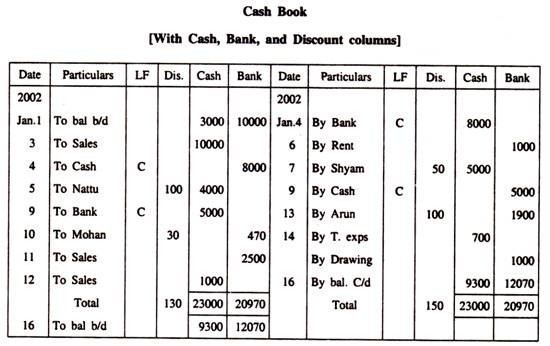
This cash book has the cash, the discount and additionally the bank columns in it. Since the development of banking most firms, these days prefer to deal in cheques or other such bills of exchange. Having a bank column in your cash book makes things concise and simpler to understand.
So, when you receive a cheque and you deposit it in the bank the same day you make the entry in the bank column (the debit side in this case). But say you send the cheque later (not the same day) then this will be a contra entry. A contra entry is transactions that happen between a cash account and a bank account. Ultimately your Cash & Bank balance remains the same, the money just moves around.
Meaning of Contra Entries
Contra Entries is a situation whereby money may be withdrawn from the bank for office use or part of the cash in hand may be paid into the bank. These are called contra entries of the two-column cash book. For example, cash was withdrawn from the bank for office use, two transactions will be recorded.
- Cash column is debited as cash accounts receive the money
- Bank column is credited as bank accounts gives the money