
FAMILY NEEDS, GOALS AND STANDARD I
HOME ECONOMICS J. S. S ONE SECOND TERM
WEEK FIVE
THEME; FAMILY LIVING AND RESOURCE MANAGEMENT/CLOTHING AND TEXTILE FOOD AND FOODS AND NUTRITION
FAMILY NEEDS, GOALS AND STANDARD I
PERFORMANCE OBJECTIVE
Students should be able to;
- Explain Family needs
- List family needs
- Explain family resources
CONTENT
Family needs are the things that are essential for the family's physical, emotional, mental and social health. Wants, on the other hand, are those things which the family desire even though they are not essential for the health and well being of the family. A family is basically a group of people consisting of a father and mother with their children living as a unit. A family is an essential part of the society, and for a society to function properly the families in it must be in a good state. The family is the first school of our life and we learn manners and customs from the family.
There are some specific needs that must be met for a modern family to survive properly in today’s society.
LISTS OF FAMILY NEEDS
- Housing /Shelter
- Food
- Security
- Clothing
- Effective communication
- Education
- Access to Information technology
- Health
- Love
10. Order
1. Housing:
One of the most important needs of a family is shelter because every family needs a base. For a family to survive and for its members to live in ease, there should be a house.
A modern family needs a decent house with dedicated space for each member, right down to the pets. For a person to live daily life and add value to his/her society, he must have access to basic amenities that a house provides; a kitchen, toilet, bathroom, etc.
Each member of the family should also be given the autonomy to design their space as they see fit. This freedom of expression is great for self-discovery and self-awareness, great qualities that enable an individual to be of value to the society.
2. Food
Food is the fuel we need to survive, we need the energy to move around and actually live life, and this energy comes from food. Like housing or shelter, food is also an integral part of the day to day needs of a family.
In this modern-day and age, food is starting to serve medicinal purposes, so every member of a family should have access to a balanced diet. Children especially need a balanced diet to grow properly in mind and body. Moreover, parents can be role models for their children during family meals by showing healthy eating ideas and teaching polite table manners.
3. Security
The world has grown in many ways, and this has increased the dangers out there, so every modern family needs protection. Protection on all fronts, in the physical world and on the virtual world.
This responsibility most times lies on the shoulders of the older members of the family, they have a duty to protect the young ones, especially children and infants who are innocent and oblivious of the dangers out in the world.
The house a family lives in should have security measures put in place for protection; alarms, security cameras, etc. There are numerous security solutions that families can take advantage of to ensure protection.
There should also be secured in the sense that there should be trust between all the members of a family, they should be able to effectively communicate and confide in each other.
4. Clothing
Geographical location and other factors determine the type of clothing that will be appropriate, so a family must dress accordingly to protect itself from the elements. It is very important that every member of a family dresses appropriately for the weather and their age.
5. Effective Communication
Effective communication is the foundation of any great relationship, it creates a conducive environment for expression. This expression is very important in every family, there must be a free flow between the members of a family.
The modern family should take advantage of technology to enhance communication, however, members must try not to replace face-to-face communication with these modes. Modern communication tools can enhance and hinder proper communication so they should be used with care and discipline.
6. Education
Families and education have a very close relationship, the family is the basis of a good education. The family is the root of everything, it is where everything starts, even before formal education. So, education is essential to the growth of any family.
Families must be educated and conscious to raise successful, intelligent, and creative children. The family must create a favourable and flexible environment for growth and development. This aspect is usually handled by the parents or the guardians, it is important that they themselves are educated so they can be positive influences on younger members of the family.
A child’s education starts at home; parents are their first teachers and they have a key role in shaping up their character. A child’s learning scale is highly related to how they are treated at home. So, education must be high on the priority list of any family.
7. Access to information technology
The Internet has grown in leaps and bounds over the years, technology now has a regular and functional presence in our everyday lives. So, knowledge of and access to information technology is very important in this modern day and age.
Every family needs access to the internet. Access to information is very important for both early development and growth, members of a family must stay up to date on what’s happening and new inventions to be able to compete effectively in society.
Information technology also makes learning easy, which makes educating every member of the family easy. Free access to resources encourages members of the family to be themselves and explore their interests.
8. Health
As mentioned above, a family should provide its individual members with key resources for healthful living, including food, shelter, clothing, a sense of self-worth, security, but one of the most important things for the family is access to medical care.
Attention should be paid to family health and history as family members share their genes, as well their environment, lifestyle, and habits, so there is a possibility for there to be risks for certain diseases. Information and insight gotten from family history can be used to prevent diseases or manage existing conditions.
9. Love
Being a part of a family means you are part of something very wonderful, it means you will be loved unconditionally for all of the time. Love is the bond that keeps a family together, so there must be an abundance of love in every family, unconditional love.
10. Order
As much as it is important for there to be love and freedom of expression in a family, the order is also needed to keep things running smoothly. There should be an order to things, the younger members of a family must respect the older members, and each member should recognize and accept their responsibilities and be responsible for fulfilling them.
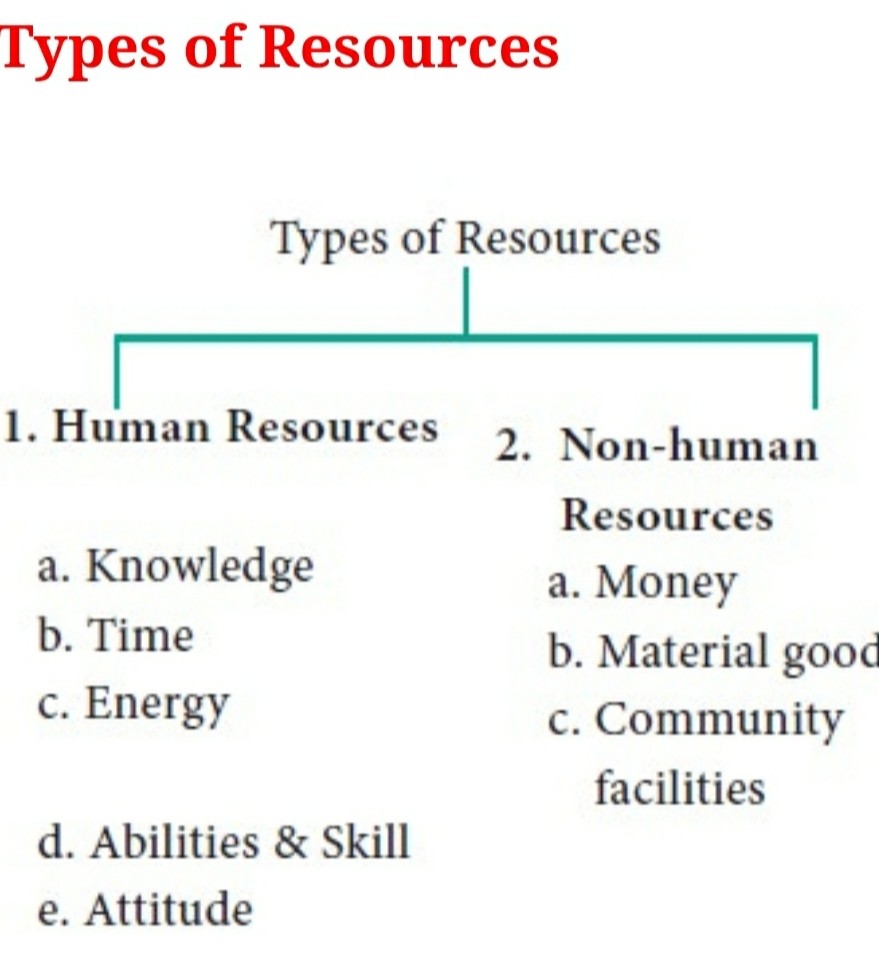
FAMILY RESOURCES
Family Resources can be defined as anything the family uses to achieve what they want (our goals). In other words, they are the materials and human attributes which satisfy our wants.
There are two types of Family resources;
-
- Human resources
- Non-human resources
1. Human Resources: These are the capacities and characteristics of an individual. These can be used only by the person who possesses them. They have the high potential to achieve what we want and many a time may not be cultivated or made available. Most of the time, families underestimate these re-sources and are unaware of them.
-
- Knowledge: It is important to be aware of things to be able to achieve what we want. If we want to buy a T.V. we need to know what features to look for, brands available. This will help in buying a better quality product.
-
- Time: It is constant for everyone, 24 hours a day. The way a person manages and uses her time is her personal choice. A student may finish all the work before going to play; another may waste his time watching television or talking on the cell phone.
- Energy: This is both mental and physical power of a person. To achieve goals, one needs to plan, organize and finally implement the plans. This would require both mental and physical energy.
- Abilities and skill: These are inherited and acquired. These may include skills like cooking, decorating, gardening. Each individual has particular abilities with which he/ she can achieve his/her goals. These skills can also be developed by systematic learning and practice.
- Attitude: These are opinions or feelings a person has towards a thing which may hinder or help in achieving his goals. A positive attitude may help a person achieve what he wants whereas a negative attitude may hinder her in achieving what she wants.
2. Non-human Resources: These are the tools and assets that families have at their disposal to achieve what they want. These are available for everyone to use. A person works hard and earns money to be used by him and his family. He/she may buy material goods or land from this money and may build a house on this land. Community facilities like banks, post offices, parks, and library. These are tangible and are more identifiable.
-
- Money: It is the pivotal resource which can be exchanged to buy material things, commodities and services. It can also be used for future use and thus gives a sense of security to the family.
-
- Material goods: These include durable goods or perishable goods used and owned by a family in their everyday use. Land, house, furniture and vehicle are examples. These help to make life easier and more comfortable for all family members. Durable goods like land can also help families to earn or save money. If vegetables are grown on land, the family can save money on buying vegetables or sell these vegetables to earn money.
-
- Community facilities: These are those facilities which are common for all members of a community. Parks, libraries, post office, police and fire protection, banks, hospitals, transport facilities, roads, railways, electricity, water supply, markets, community centres and ration shops are examples of community facilities. All families can avail these facilities without directly paying for them but indirectly paying for them through taxes.
- Community facilities: These are those facilities which are common for all members of a community. Parks, libraries, post office, police and fire protection, banks, hospitals, transport facilities, roads, railways, electricity, water supply, markets, community centres and ration shops are examples of community facilities. All families can avail these facilities without directly paying for them but indirectly paying for them through taxes.
CHARACTERISTICS OF RESOURCES
- All resources are useful and all help to achieve goals.
One cannot call energy or time as a resource if it is wasted or not used. If a piece of land is lying vacant, it is not a resource, only when a family grows vegetables on it, does the land become a resource.
- All resources are limited.
There is a limit to a person’s knowledge, skill, energy, material goods and money available to the family.
- All resources are inter-related.
A resource cannot be used in isolation. If a homemaker has to go to the market, she will use her knowledge, skill of bar-gaining, time, energy, money, market and transport to achieve this goal.
- Resources can be substituted.
One can exchange one resource for another. A family uses time, skill and energy of a servant and gives her money in exchange. Similarly, material goods can be bought in exchange for money. One can exchange knowledge by paying tuition fees.
- All resources need to be managed.
Since all resources are limited, they need to be utilized properly, otherwise, they may be wasted. Time and energy have to be managed by work simplification techniques, proper postures and labour-saving devices.