
BINOMIAL EXPANSION: PASCAL TRIANGLE, BINOMIAL THEOREM OF NEGATIVE, POSITIVE AND FRACTIONAL POWER
FURTHER MATHEMATICS SSS2 THIRD TERM
WEEK 3
BINOMIAL EXPANSION: PASCAL TRIANGLE, BINOMIAL THEOREM OF NEGATIVE, POSITIVE AND FRACTIONAL POWER
Content
PASCAL’S TRIANGLE
Consider the expressions of each of the following:
(x + y)0; (x + y )1; (x + y)2; (x + y)3; (x + y)4
(x + y)0 = 1
(x + y)1 = 1x + 1y
(x + y)2 = 1x2 + 2xy + 1y2
(x + y)3= 1x3 + 3x2y + 3xy2 + 1y3
(x + y)4 = 1x4 + 4x3y + 6x2y2 + 4xy3 + 1x4
The coefficient of x and y can be displayed in an array as:
1
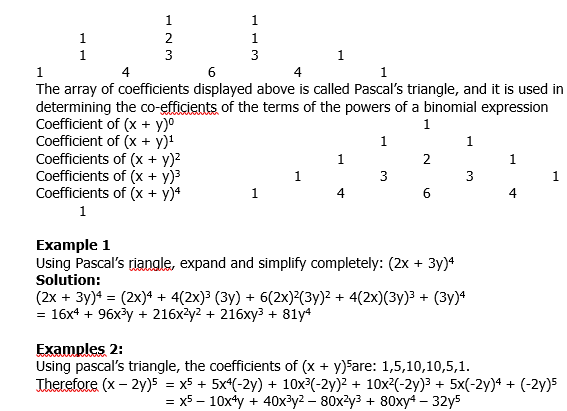
Example 3
Using Pascal’s triangle, simplify, correct to 5 decimal places (1.01)4
Solution
We can write (1.01)4 = (1 + 0.01)4
(1 + 0.01)4 = 1 + 4(0.01) + 6(0.01)2 + 4(0.01)3+(0.01)4
= 1 + 0.04 + 0.0006 + 0.000004 + 0.00000001
= 1.04060401
= 1.04060 (5 d.p)
The Binomial Expansion Formula
Consider the expansion of (x + y)5 again
(x + y)5 = (x + y)(x + y)(x + y)(x + y)(x + y)
The first term is obtained by multiplying the xs in the five brackets. there is only one way to do this
(x + y)n = xn + nxn – 1y + n(n-1)2! xn – 2y2 + nn-1( n-2)3!
 xn-3y3 + …. nn-1n-2….(n-r+1)r!
xn-ryr + …. yn
It can be shown that the binomial expansion formula holds for positive, negative, integral or any rational value of n, provided there is a restriction on the values of x and y in the expansion of (x + y)n
We shall however consider only the binomial expansion formula for a positive integral n
Example 4:
- Write down the binomial expansion of 1+ 14x
 6 simplifying all the terms
 - Use the expansion in (a) to evaluate (1.0025)6 correct to five significant figures.
Solution
1+ 14x 6 = 1 + 6C1 14x
 1 + 6C214x
 2
2
+ 6C3 14x 3 + 6C4 14x
+ 6C5 14x 5 + 6C6 14x
 6
6
1+ 14x 6= 1 + 6114
 x + 6 x 51 x 214x
 3 + 6 x 5 x 4 x 31 x 2 x 3
 x
x
14x 4 + 6 x 5 x 4 x 3 x 21 x 2 x 3 x 4
 x 14x
x 14x 5 + 14x
 6
6
= 1 + 32 x + 1516
 x2+ 516
 x3 +15256
 x4 + 3512
 x5 + 14096
 x6
x6
- (1.0025)6 = (1 + 0.0025)6
= 1+ 2510000 )6
)6
= 1+ 1400 )6
)6
Put 14 x =1400
x = 1400 x 4 = 1100
 = 0.01
therefore (1.0025)6 = 1 + 32 (0.01) + 1516
 (0.01)2 + 516
 (0.01) +15256
  (0.01)4 + …
= 1 + 0.015 + 0.00009375 + 0.0000003125
= 1.0150940625
= 1.0151 (5 s.f.)
EVALUATION
Expand ( 2 + 4x )4 simplifying the terms
Example 5
(a) Using the binomial theorem, obtain the expansion of (1 + 3x)6 + (1 – 3x)6 simplifying all the terms
(b)Use the above result to calculate the value of (1.03)6 + (0.97)6, correct to five decimal places
Solution:
(1 + 3x)6 = 1 + 6C1 (3x) + 6C2 (3x)2 + 6C3 (3x)3 _ 6C4 (3x)4 _ 6C5 (3x)5 + 6C6 (3x)6 ….. (1)
(1 - 3x)6 = 1 - 6C1 (3x) + 6C2 (3x)2 - 6C3 (3x)3 + 6C4 (3x)4 _ 6C5 (3x)5 + 6C6 (3x)6 ….. (2)
Adding (1) and (2)
(1 + 3x)6 +(1 - 3x)6 = 2 + 2 x 6C2 (3x)2 + 2 x 6C4 (3x)4 + 2 x 6C6 (3x)6
= 2 + 2 x 6 x 51 x 2 9x2 + 2 x 6 x 5 x 4 x 31 x 2 x 3 x 4
 x 81x4 + 2 x 729x6
= 2 + 270x2 + 2430x4 + 1458x6
(1.03)6 = (1 + 0.03)6
(0.97)6 = (1 – 0.03)6
Put 1 + 0.03 = 1 + 3x
Therefore 3x = 0.03
Therefore x = 0.01
Hence
(1.03)6 + (0.97)6 = 2 + 270(0.01)2 + 2430(0.01)4 + 1458(0.01)
= 2 + 0.027 + 0.0000243 + 2.0270243
= 2.02702 (5 d.p)
Example 6
- Using the binomial theorem, expand (1 + 2x)5, simplifying all the terms
- Use your expansion to calculate the value of 1.025, correct to six significant figures
If the first three terms of the expansion of (1 + px)n in ascending powers of x are 1 + 20x + 160x,
Find the values of n and p
Solution:
- (1 + 2x)5 = 1 . 5C1(2x) + 5C2(2x)2 + 5C3(2x)2 + 5C4(2x)4 + 5C5(2x)5
= 1 + 5.(2x) + 5.41.2  . 4x2 + 5.4.31.2 .3
 . 8x3 +5.4.3.21.2 .3.4
 . 16x + 32x5
= 1 + 10x + 40x2 + 80x3 + 80x4 + 32x5
- (1.02) = (1 + 0.02)
Put 1 + 0.02 = 1 + 2x
Therefore 2x = 0.02
x = 0.01
Hence:
(1.02)5 = 1 + 10(0.01) + 40(0.01)2 + 80(0.01)3 + 80(0.01)4 + 32(0.01)5
= 1 + 0.1 + 0.004 + 0.0008 + 0.00000008
= 1.10408 (6.s.f.)
6.3 The Binomial Theorem for any index
The Binomial expansion formula is also applicable to any index n, where n can be a positive or negative integer or even a fraction
If /x/ < 1, then:
(1 + x)n = 1 + nx + nn-1x22! + 3! nn-1(n-2)x3
 + nn-1n-2n-34!
 x4 + … where n may be a negative integer or a fraction.
Example 7
Use the Binomial expansion formula to obtain the first five terms of the expansion of (1 + 12 x)-2
x)-2
Solution:
(1 + 12 x)-2 = 1 + (-2) (12
 x) + (-2(-3)2!
 (12
(12 x)2 + -2-3(-4)3!
 (12
(12 x)3 + -2-3-4(-5)4!
 (12
(12 x)4 + ….
= 1 – x + 3. x4  2 - 4.x8
  3 + 5.x16
  4
4
- (1 + px)n = 1 + 20x + 160x2 + …
(1 + px)n = 1 + nc1 (px) + nc1 (px)2 + …
= 1 + npx + nn-12 p2x2 …
= 1 + 20x + 160x2 + …
By equating coefficients
np = 20 … (1)
nn-12 p2 = 160 … (2)
From (1) p = 20n … (3)
… (3)
Therefore p2 = 400n2 … (4)
… (4)
Substituting (4) into (2)
nn-12 x 400n2
 = 160
= 160
nn-12 x 200 = 160
There 200(n – 1) = 160n
200n – 200 = 160n
200n – 160n = 200
40n = 200
n = 5
From (3)p = 205 = 4
= 4
Hence, n = 5, p = 4
Example 8
Obtain the first four terms of the explanation of (2 + 12 x)8in ascending powers of x. hence, find the value of (2.005)8, correct to five significant figures.
Solution:
(2 + 12 x)8= 28(1+ 14
 x)8
x)8
= 28[1 +8C1( 14 x) + 8C2 ( 14x
 )2 + 8C3 ( 14x
 )3 + … ]
= 28[1 +8( 14 x) + 8.71.2
 ( 14x
( 14x )2 + 8.7.61.2.3
 ( 14x
( 14x )3 + …]
= 28[1 + 2X + 74 X2+ 78
 X3 + …]
Write 2.0.005
Put 2 + 12 x = 2 + 0.005
Therefore 12 x = 0.005
Therfore x = 0.005 x 2
= 0.01
Hence,
(2.005)8 = 28[1 +2(0.01) +74 (0.01)2+ 74
 (0.01)3 ]
(2.005)8 = 28 + 29(0.01) + 26.7(0.01)2 + 25 x 7(0.01)3 + …
= 256 + 5.12 + 0.0448 + 0.000224
= 261.165025
= 261.17 (5 s.f.)
GENERAL EVALUATION
1) Write down and simplify all the terms of the binomial expansion of ( 1 – x )6. Use the expansion to evaluate 0.9976 correct to 4 dp
2) Write down the expansion of ( 1 + ¼ x ) 5 simplifying all its coefficients
3) Use the binomial theorem to expand ( 2 – ¼ x)5 and simplify all the terms
4) Deduce the expansion of ( 1 – x +x2 )6 in ascending powers of x
Reading Assignment
New Further Maths Project 2 pages 73 – 78
WEEKEND ASSIGNMENT
If the first three terms of the expansion of ( 1 + px )n in ascending powers of x are 1 + 20v + 160x find the value of
1) n a) 2 b) 3 c) 4 d) 5
2) p a) 2 b) 3 c) 4 d) 5
3) In the expansion of ( 2x + 3y )4 what is the coefficient of y4 a) 16 b) 81 c) 216 d) 96
4) How many terms are in the expansion of ( 1 – 4x ) 5 a) 3 b) 5 c) 6 d) 8
5) What is the third term in the expansion of ( 1 – 3x )6 in ascending powers of x a) 18 b) -540 c) 135 d) 729
THEORY
1) Using the binomial theorem, write down and simplify the first seven terms of the expansion of ( 1 + 2x )10 in ascending powers of x
2) Expand ( 2 + x )5 ( 1 – 2x ) 6 as far as the term in x3 . Evaluate ( 1.999 )5 ( 1.002 )6