
ANGLES 1
WEEK 3
ANGLES
Complementary Angle
Two Angles are Complementary when they add up to 90 degrees (a Right Angle).
They don't have to be next to each other, just so long as the total is 90 degrees.
Examples:
• 60° and 30° are complementary angles.
• 5° and 85° are complementary angles.

Supplementary Angles
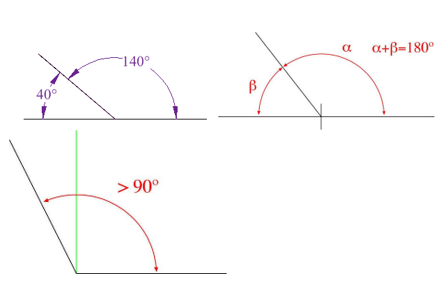
Two Angles are Supplementary when they add up to 180 degrees. supplementary angles 40 and 140
These two angles (140° and 40°) are Supplementary Angles because they add up to 180°:Notice that together they make a straight angle. supplementary angles 60 and 120But the angles don't have to be together.
These two are supplementary because60° + 120° = 180°
Acute angle:
An angle whose measure is less than 90 degrees.
Right angle:
an angle whose measure is 90 degrees.
Obtuse angle:
An angle whose measure is bigger than 90 degrees but less than 180 degrees. Thus, it is between 90 degrees and 180 degrees.
Straight angle:
An angle whose measure is 180 degrees. Thus, a straight angle looks like a straight line.
Reflex angle:
An angle whose measure is bigger than 180 degrees but less than 360 degrees.


In the worksheet on angles, you will solve 10 different types of questions on angles.
1. Classify the following angles into acute, obtuse, right and reflex angles:
(i) 35°
(ii) 185°
(iii) 90°
(iv) 92°
(v) 260°
2. Measure these angles:
3. Use your protractor to draw these angles:
(i) 40°
(ii) 125°
(iii) 25°
4. Identify which of the following pairs of angles are complementary or supplementary?
(i) 70°, 20°
(ii) 20°, 170°
(iii) 50°, 145°
(iv) 125°, 55°
(v) 105°, 75°
(vi) 55°, 35°
5. Find the complement of each of the following angles:
(i) 40°
(ii) 27°
(iii) 35°
6. Find the supplement of each of the following angles?
(i) 100°
(ii) 90°
(iii) 110°
(iv) 107°
7. Draw a pair of supplementary angles such that one of them measures:
(i) 120°
(ii) 90°
8. Construct the angles of the following measures with the help of a compass:
(i) 150°
(ii) 90°
(iii) 120°
9. An angle whose measure is less than 90° is called an ……………….
10. An angle measuring 0° is called a ……………...
