
Socio-Political Structure of the Ancient Songhai Empire
WEEK 2:
TOPIC: Socio-Political Structure of the Ancient Songhai Empire
Military Might:
Regular Army
Powerful navy
Speedy transport by canoes
Consistent Military conquest and expansion
Security from the Tuaregs and Fulani from Mali/
Jenne and Timbuku were the centre of trade and Muslim education, taking over in 1473
Constructed a canal to Walata in 1480
Established a government in the Empire
The Songhai Empire operated a centralised and monarchical system of government. The king, known by the title Sunni or Askiya, depending on the era and dynasty, was the ruler of the whole realm. Being an empire which was very large and highly populated, the king ruled the kingdom with the help of some aristocrats and noblemen who acted as governors, administrators and members of the royal court. Governors ruled five popular city-states created by the Sunni, while other small city-states were granted some level of autonomy but required to pay tributes and report to the Sunni. The main sources of ancient Songhai's government income were from gold, exports, tributes, farm produces and taxes on trade.
The Songhai society was divided into different socio-political and economic class. The Sunnis created specialised political offices and appointed their heads. The ruling class was made up of some noblemen of the army and aristocrats who had financial control of the empire. Then the local noblemen acted as intermediaries between the upper ruling class and the common people. They were also administrators at the local level among the common people, helping in solving minor problems.
Next in order were the Muslim freemen and citizens of the land, who had very little to do with the administration and control of the empire. They were recognised for their religious duties in the society as Islam was at first the religion adopted by the aristocrats, the ruling and noble class. For this, they earned the respect and honour accorded to religious leaders and teachers. They taught the people and directed them on matters concerning the Islamic faith and beliefs.
The working class was grouped below the religious leaders. Among the working class were the traders, artists and craftsmen, such as merchants and people into ironwork, woodwork, pottery, weaving, cloth-dying, masonry, etc. They were respected and considered important in society, although that was based on the income generated and their financial status. The class also included goldsmiths, rich textile merchants, blacksmiths, etc.
Similar to the griots of the ancient Mali Empire, the Songhai people had the Gesere, whose function in their society involved the preservation of different forms of histories, arts, cultures and entertainment. Some of the Askiya kings had a chief oral artist called the Gesere-dunka. The chief oral artist was selected by the Askiya due to proficiency in oral traditions and history. Sometimes, the Gesere-dunka also offered counsel in some political matters.
Next were the farmers who were responsible for the agricultural produce in the kingdom. The last were the slaves who were either purchased, born and bred in captivity or captured in battle. They were the least considered in their society. The slaves' status in the empire was determined by their occupation or economic position before their capture.
In addition to the class, the society was male-dominated. The men were the major custodians of the empire. Clan-heads were men, and property was mostly owned and divided by the men of the empire. Gender played a lot of roles in their society as men and women had different roles assigned to them.
Among the number of kings who ruled the empire, two were prominent, and they are: Sunni Ali and Askiya the Great.
(i) Sunni Ali
Sunni Ali took over after Sunni Sulayman Dama died in 1464. He was a competent military leader who rallied his forces of cavalry, infantry and navy to hold off the enemies of the Songhai Empire. When Sunni Ali assumed rulership of the Songhai Empire, the empire was in disarray and poorly controlled by former rulers. He made an effort to unify the people and enlarge the kingdom. In order to unite and stabilise the empire, he engaged in both the traditional local religion and Islam to ensure peaceful coexistence among the citizens of the empire. Eventually, he succeeded in motivating the people of Songhai to work together in peace, and they raised a stable empire.
The Songhai Empire had a vast army under Sunni Ali's leadership. Sunni Ali's army was known to be disciplined and highly skilled. The navy especially played a prominent role in all of his conquests.
After defeating the enemies of Gao, he proceeded to gain the trade centres of the Niger River, which included both Timbuktu and Djenne. Timbuktu and Djenne were famous city-states for the gold and salt trade. Initially, in 1468, the Mali rulers asked Sunni Ali to assist in the battle against Tuareg invaders trying to conquer Timbuktu. Sunni Ali helped the Mali rulers to drive away the invaders, but he went on and took the Timbuktu city-state for the Songhai Empire by claiming rulership over the city.
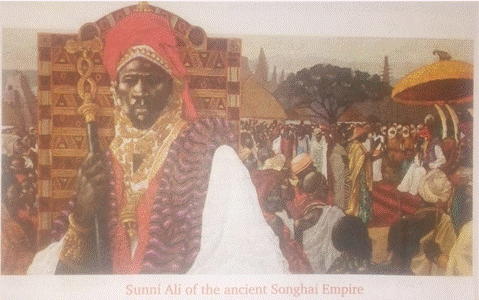
Having ruled the Songhai Empire for twenty-eight years, Sunni Ali died in 1492 while returning from battle. His son, Sunni Baru, took over the administration and control for just five months before Muhammad Ture I seized power to rule the Songhai Empire. Thus ending the Sunni dynasty.