
ANATOMY AND PHYSIOLOGY OF FARM ANIMALS
AGRICULTURAL SCIENCE SSS1 Second Term
WEEK 1
ANATOMY AND PHYSIOLOGY OF FARM ANIMALS
PERFORMANCE OBJECTIVES
At the end of this chapter, students should be able to:
- Draw and label parts of farm animals.
- Dissect a farm animal.
- Identify important organs like the heart, livers and lungs.
Sketch those parts and mention their functions.
Content
MEANING OF ANATOMY AND PHYSIOLOGY
Anatomy refers to the form and structure of the body while physiology refers to the functions of the forms and parts of the body. It is very important for the farmer to understand the anatomy and physiology of farm animals because it will enable him to know more about the nutrition, reproduction and management of his animals.
MAJOR PARTS OR DIVISION OF FARM ANIMALS
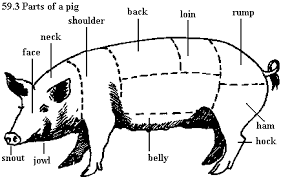
parts of a pig
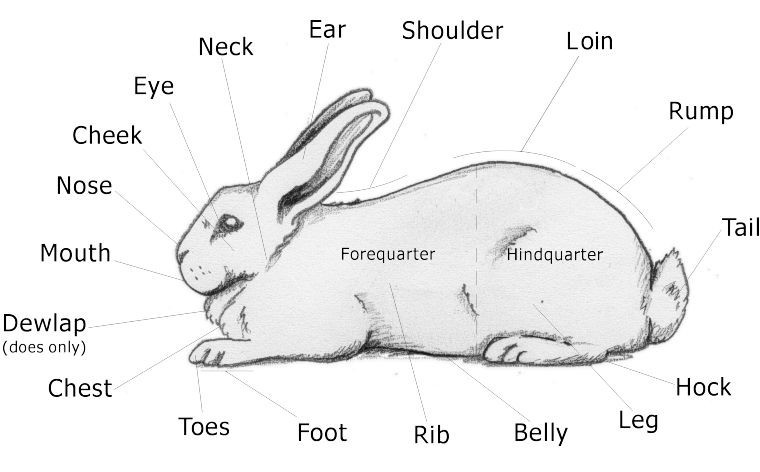
Parts of a rabbit
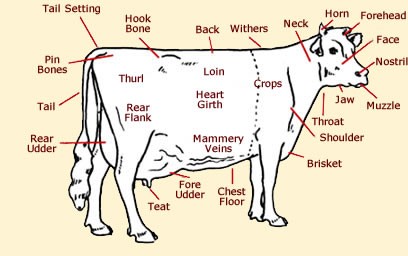
parts of a cattle
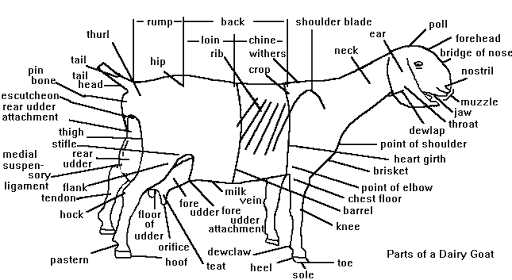
Parts of a goat
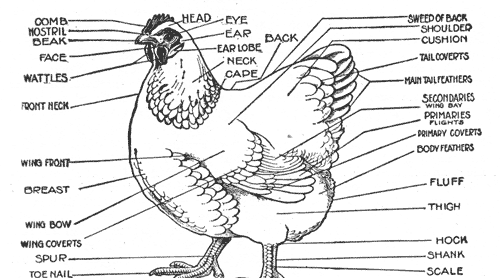
Parts of a fowl.
The body of farm animals is divided into four major groups. These are Head, Thoracic cavity, Abdominal cavity, The limbs.
- Head: The head is the upper part of the body. The major organs found in the head region include the brain, the eyes, ear, tongue and nose.
- Thoracic Cavity: The thoracic cavity refers to the chest region of the body. The major organs in the thoracic cavity include the heart, lungs and trachea.
- Abdominal Cavity: The abdominal cavity refers to the stomach region of the body. The major organs in the abdominal cavity include liver, uterus, stomach, oviduct or fallopian tube, kidney, ovary, spleen, intestine, gall bladder and pancreas.
- Limbs: The limbs include the forelimbs (hands) and hind limbs (legs). They are used by farm animals for walking.
Some of the systems which maintain the body are digestive system, circulatory system, respiratory system, nervous system and reproductive system.
DIGESTIVE SYSTEM
The digestive system of a farm animal includes all the organs and tissues associated with the breaking down or digestion of food in the body. It includes the teeth or beak, tongue, the alimentary canal or digestive tract and all the associated gland, secretory enzymes and other body fluids.
Farm animals are grouped into two main classes based on the nature of their alimentary canal or digestive tracts. These are:
- Monogastric or Non-ruminant Animals: These are animals which possess only one stomach and they do not ruminate.(i.e. they do not chew the cud). In other words, these animals have a simple stomach and cannot digest cellulose and fibres properly. Examples include pig, rabbit and poultry birds like the domestic fowl.
- Polygastric or Ruminant Animals: These are farm animals which possess four stomach compartments (complex stomach) and hence, they can ruminate or they chew the cud. The four stomach compartments are rumen (the largest), reticulum, omasum and abomasums (true stomach).
The rumen (punch): It has several tongue-like projections called papillae. It also has a soft towel-like appearance. It is the largest and the first compartment of the stomach.
Reticulum (Honeycomb): This is lined with a mucosal layer which is formed into a hexagonal chamber that looks like a honeycomb. It is the second compartment.
Omasum (many piles): The omasum is the third and smallest compartment. It has several ‘leaves’ or laminae/layers.
Abomasum: This is the only glandular stomach. It is synonymous with the simple stomach of monogastric animals. The abomasums are the fourth and last compartment of the stomach.
Functions of the first compartment (the rumen) of the stomach of a ruminant animal are:
- Fermentation brought about by micro-organisms takes place in the rumen.
- It is used for the temporary storage of food before regurgitation for proper rechewing.
- Volatile fatty acids and other gases are produced in the rumen as a result of fermentation.
- Absorption of volatile fatty acids takes place through the walls of the rumen.
- Some vitamins, e.g. vitamin B, are produced in the rumen.
- Breakdown of cellulose takes place in the rumen.
Examples are the cattle, sheep and goat. They are all herbivores.
Digestion in Ruminants
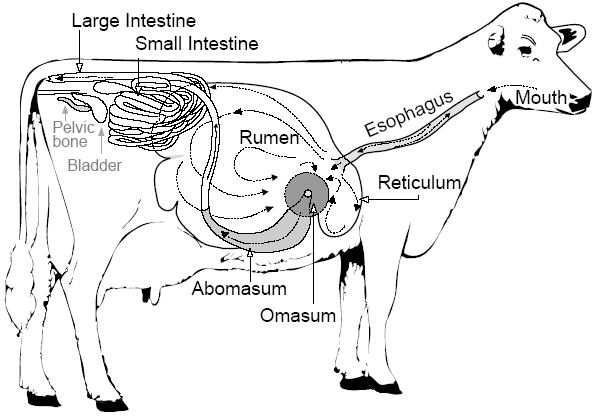
Digestion in ruminant animals like cattle, sheep, and goat feed mainly on grasses and they can ruminate or chew the cud because of the complex nature of their stomach.
When a ruminant animal like a cow wants to feed, it cuts the grass and swallows it with minimal chewing. The grass passes from the mouth through the oesophagus to the rumen where the grass is stored. In the rumen, the grass is acted upon by, micro-organisms like bacteria and protozoa which digest the cellulose and synthesize some amino acids needed by the animal from non-protein nitrogenous substances.
When the cow has finished filling the rumen, it finds a cool place and lies down quietly. By the anti-peristaltic movement of the stomach, the undigested grass passes from the rumen to the reticulum from where it re-enters the oesophagus (regurgitate) back to the mouth. The food is now chewed properly by using the molar and the premolar teeth (chewing the cud) into a semi-liquid cud which is re-swallowed. This liquid cud then moves to the omasum from where it passes to the abomasum (the true stomach). The whole process is called rumination.
In the abomasum, enzymes are secreted which act on the food. Further digestion and absorption of the food take place progressively along the digestive tract. The digested food is then absorbed into the blood through the villi in the small intestine, while the undigested food passes to the large intestine where they are removed through the anus as dung or faeces.
Digestion in Non-ruminant (Pig)
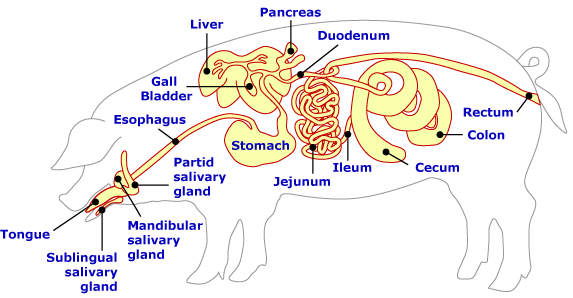
A pig has only one stomach. It does not chew the cud either does it utilize roughages properly.
The pig feeds mainly on basal foods like maize, cassava and other mashed foods. Digestion of the food takes place in four areas of the tract.
- Mouth: In the mouth, the food is chewed and mixed with saliva which contains an enzyme called ptyalin. The ptyalin converts starch to maltose. The food is now swallowed and moves by the peristaltic movement to the stomach.
- Stomach: In the stomach, two enzymes, renin and pepsin, are present. Renin acts on milk or it helps curdle milk while pepsin converts proteins to peptones under the influence of an acid medium. The thick liquid called chime now passes to the duodenum
- Duodenum: Digestion also takes place here. Three enzymes are present and they act on different food.
- Amylase: This enzyme converts starch to maltose.
- Lipase: This converts fats and oils to fatty acids and glycerol
- Trypsinogen: This converts protein and peptones to polypeptides. These enzymes are secreted by the pancreas. The digestion of fats and oil is aided by bile which is secreted by the liver and stored in the gall bladder. The bile helps in the emulsification of fats. at the end of digestion in the duodenum, the food (now in liquid form) called chyle passes to the ileum or small intestine.
- Small intestine: The wall of the small intestine secretes many enzymes which completes the process of digestion. The enzymes are :
- Lipase, they convert fats and oils to fatty acids and glycerol.
- Erepsin converts polypeptides to amino acids.
- Maltase converts maltose to glucose.
- Sucrase converts sucrose to glucose and fructose
- Lactase converts lactose to glucose and galactose.
The end product in the digestion include the conversion of protein to amino acids, starch to glucose and fats and oil to fatty acids and glycerol
The end products are absorbed in the small intestine by a structure called the villi. The undigested food materials are passed to the large intestine from where they are ejected through the anus as faeces or dung.
The digestion of food in the rabbit is just like that of the pig except that rabbit can feed properly on grasses which are digested in the large caecum which contains micro-organisms like bacteria and protozoa.
Digestion in Domestic Fowl
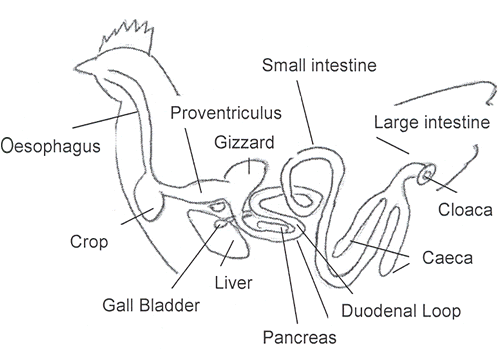
The domestic fowl is a monogastric animal and has a simple stomach. The fowl has no teeth but the food it is picked up by the beak. The food then passes on to the crop through the oesophagus. The food is stored temporarily in the crop where it is moistened and fermented by some bacteria. The food now passes on to the proventriculus where digestive enzymes are secreted on the food.
The proventriculus is often regarded as the glandular stomach because it secretes digestive enzymes on the food like pepsin and amylase.
From the proventriculus, the food moves to the gizzard where grinding takes place. With the aid of small stones or grits, the food is ground by the gizzard. From the gizzard, the food now moves to the duodenum and small intestine where further digestion and absorption takes place while the undigested food materials are removed from the track as faeces.
Differences between Monogastric and Ruminant Animal Digestive System
|
Monogastric Animals |
Ruminant Animals |
|
Possesses only one stomach |
Possesses four stomach compartments |
|
It cannot ruminate or chew the cud |
It can ruminate and chew the cud |
|
It cannot digest cellulose and fibres properly. |
It can digest cellulose and fibre very well. |
|
Digestion is not aided by bacteria |
Digestion is aided by bacteria. |
|
Its diet is mainly basal and concentrates feeds. |
Its diet is mainly grasses and other cellulose legumes e.g. legumes. |
|
It cannot synthesize its own proteins unless supplied in the feed. |
It can synthesize its own protein through microbial activities in the rumen. |
|
It has no rumen |
It has a rumen |
|
Poultry, rabbits and pigs are examples |
Cattle, sheep and goats are examples |
Importance of the Digestive System
- It aids the ingestion of feed.
- It promotes the digestion of feed.
- It ensures the absorption of digested feed.
- It helps in the ejection of undigested feed.
- It aids the secretion of productive hormones and digestive enzymes.
MEANING OF REPRODUCTION
Reproduction is the ability in animals to give birth to young ones. The purpose of reproduction is to ensure continuity of life.
The reproductive system includes all the organs and tissues concerned with reproduction in animals.
Farm animals reproduce sexually and are mostly viviparous because they bear their young ones alive. Poultry birds, on the other hand, are oviparous because they produce their young ones by hatching eggs after an incubation period.
Male Reproductive System
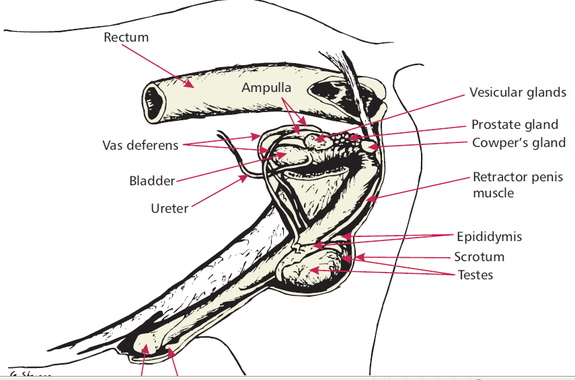
The male reproductive system includes the testes which produce spermatozoa and sex hormone called testosterone which aids the development of male sexual secondary characteristics. The spermatozoa are specifically produced in the seminiferous tubules of testes during meiotic cell division by a process called spermatogenesis. The testes are suspended or protected by scrotal sac (scrotum) outside the abdominal cavity to enable sperm cells to be produced at the desired temperature. The epididymis ensures the storage and maturation of sperm cells in the testes. The testes are connected to the uterus masculine by vas deferens which transports sperms from testes to the uterus masculine where matured spermatozoa are stored until they are released during coitus or mating. Blood vessels called spermatic cord supply nutrients and oxygen to the testis. Located along the urethra are accessory glands which are the Cowper's gland, seminal vesicle and prostate glands. They produce slimy alkaline fluid which aids the movement of spermatozoa. This fluid together with the spermatozoa results in the formation of semen. The urethra is a urogenital organ which helps to inject sperms into the vagina as well as the removal of urine. The urethra ends externally in the penis.
Female Reproductive System
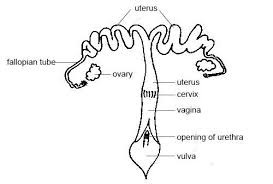
The female reproductive system includes the ovaries which produce the ovum or ova (eggs) enclosed by the gryphon follicles and some hormones such as oestrogen.
A matured egg or ovum is released from the follicle in the ovary into the oviduct period this process is called ovulation. As the ovum or egg is released from the ovary, the female animal comes into ‘heat’ and is willing to mate with the male animal. Fertilization, which is the fusion of the male sex cell (spermatozoa) and the female sex cell (egg or ovum), takes place in the fallopian tube or the oviduct. When the egg is fertilized by the spermatozoa, the fertilized egg anchors itself to the wall of the uterus. This process is called implantation. The development of the foetus takes place in the uterus. Below the uterus is the vagina which receives the spermatozoa during copulation. The female reproductive system terminates with an external opening called the vulva.
Development of the Embryo (Foetus):
The fertilized egg is implanted in the uterus where the development of the embryo takes place. Soon, a number of embryonic membranes develop around the embryo. These are the chorion, the allantois and the yolk sac. The amnion forms a sac in which the embryo lies and is filled with amniotic fluid. Hence, the embryo is held in a liquid environment which acts as a buffer or shock absorber. This ensures the protection of the embryo. The allantois form a sac which is excretory, respiratory and nutritive in function. It contributes to the formation of the placenta. The yolk sac provides the food during the early stages of embryonic development. The chorion forms the outermost membrane enveloping all the structures.
The placenta establishes an intimate connection between the embryo and the mother which aids nutritional, respiratory and excretory needs of the embryo (foetus). The placenta and the embryo are connected by the umbilical cord which develops from the allantois. The parental blood supply is linked to the foetal blood supply through the umbilical cord. At the end of the gestation period (from fertilization to birth) parturition (giving birth) takes place during which the young animal is pushing out through the vagina. The remaining parts of the embryonic membrane known as after birth is sent out after the birth of the foetus.
Reproductive Systems in Birds
In the male bird, the two testes are located inside the body. A narrow tube connects them to the cloaca in which the tube ends as a small waist papilla. In the female-only, the left ovary is functioning. The single ovary produces ova (eggs) in capsules attached to the ovary that short stalks. The ovary also produces the yolk. The infundibulum receives the yolk released by the ovary. Albumen and chalaza (which hold the yolk and germ cell in position) are formed in the magnum. The two shell membranes and the shape of the egg are formed in the isthmus. The eggshell is finally formed in the uterus after which the egg is laid through the cloaca. Fertilization of the egg can take place as soon as the egg enters the oviduct when spermatozoa are presents.
Fertilization occurs before the formation of the albumen.
Functions of the Reproductive System
- It ensures the continuation of species by gametes formation, coitus, mating or servicing.
- It ensures the formation of eggs and spermatozoa (sperm cells).
- It ensures the production of reproductive hormones.