
REPRODUCTIVE SYSTEM IN HUMANS - FERTILIZATION
BIOLOGY SSS 3 FIRST TERM
WEEK TWO
REPRODUCTIVE SYSTEM IN HUMANS - FERTILIZATION
PERFORMANCE OBJECTIVE
Students should be able to;
- Explain fertilization
- Discuss the development of embryo and gamete fusion
- CONTENT
Fertilization
Fertilization, union of a sperm nucleus, of paternal origin, with an egg nucleus, of maternal origin, to form the primary nucleus of an embryo. In all organisms, the essence of fertilization is, in fact, the fusion of the hereditary material of two different sex cells, or gametes, each of which carries half the number of chromosomes typical of the species. The most primitive form of fertilization, found in microorganisms and protozoans, consists of an exchange of genetic material between two cells.
The first significant event in fertilization is the fusion of the membranes of the two gametes, resulting in the formation of a channel that allows the passage of material from one cell to the other. Fertilization in advanced plants is preceded by pollination, during which pollen is transferred to, and establishes contact with, the female gamete or macrospore. Fusion in advanced animals is usually followed by penetration of the egg by a single spermatozoon. The result of fertilization is a cell (zygote) capable of undergoing cell division to form a new individual.
The fusion of two gametes initiates several reactions in the egg. One of these causes a change in the egg membrane(s), so that the attachment of and penetration by more than one spermatozoon cannot occur. In species in which more than one spermatozoon normally enters an egg (polyspermy), only one spermatozoal nucleus actually merges with the egg nucleus. The most important result of fertilization is egg activation, which allows the egg to undergo cell division. Activation, however, does not necessarily require the intervention of a spermatozoon; during parthenogenesis, in which fertilization does not occur, activation of an egg may be accomplished through the intervention of physical and chemical agents. Invertebrates such as aphids, bees, and rotifers normally reproduce by parthenogenesis.
Growth and Development of the Embryo
After implantation occurs, the blastocyst is called an embryo. The embryonic stage lasts through the eighth week following fertilization. During this time, the embryo grows in size and becomes more complex. It develops specialized cells and tissues and starts to form most organs.
- Formation of Cell Layers
During the second week after fertilization, cells in the embryo migrate to form three distinct cell layers, called the ectoderm, mesoderm, and endoderm. Each layer will soon develop into different types of cells and tissues.
- Differentiation of Cells
A zygote is a single cell. How does a single cell develop into many different types of cells? During the third week after fertilization, the embryo begins to undergo cellular differentiation. Differentiation is the process by which unspecialized cells become specialized.
- Organ Formation
After cells differentiate, all the major organs begin to form during the remaining weeks of embryonic development. A few of the developments that occur in the embryo during weeks 4 through 8 are listed in Figure below. As the embryo develops, it also grows in size. By the eighth week of development, the embryo is about 30 millimetres (just over 1 inch) in length. It may also have begun to move.
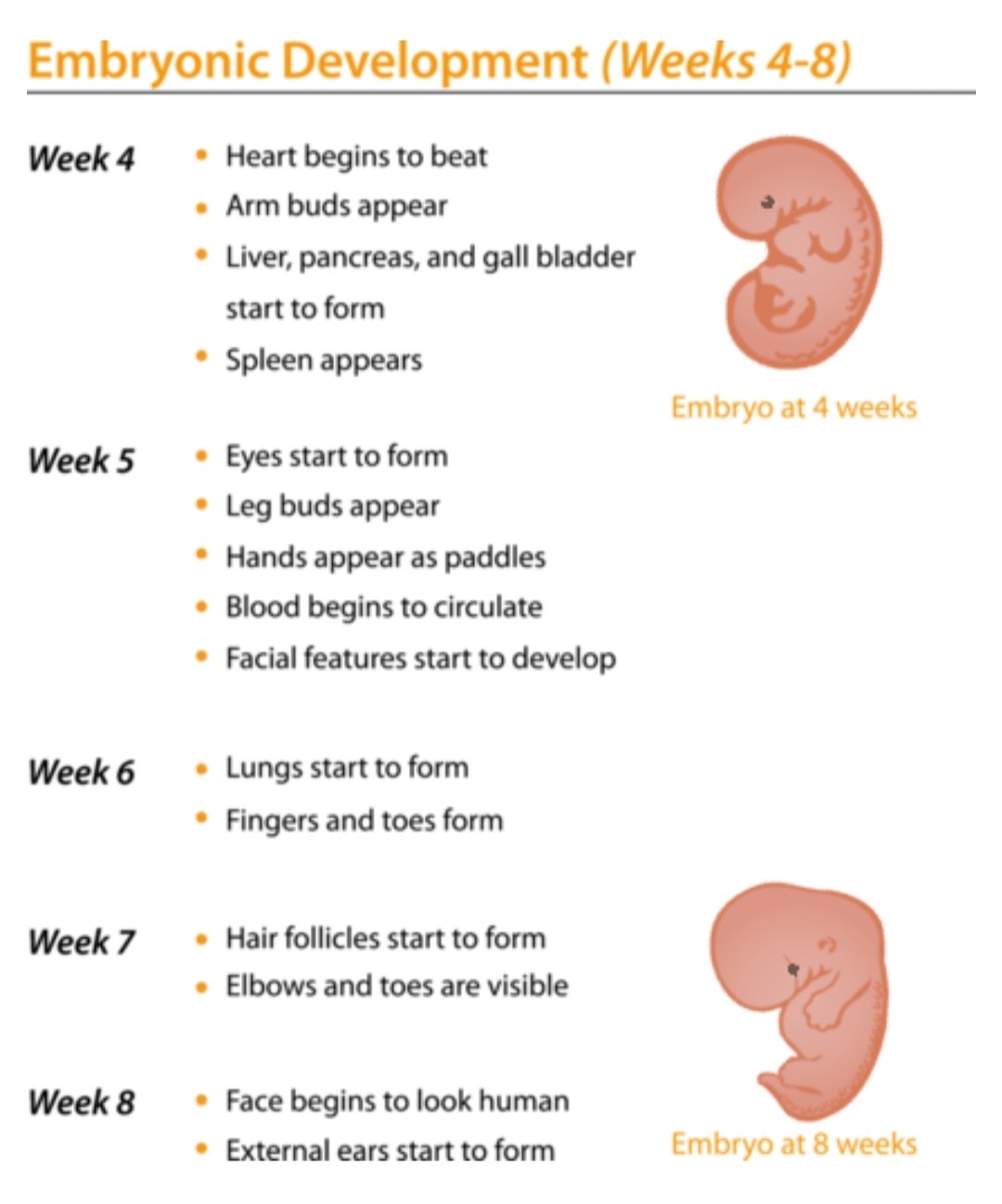
Embryonic Development (Weeks 4–8). Most organs develop in the embryo during weeks 4 through 8. If the embryo is exposed to toxins during this period, the effects are likely to be very damaging.
Summary
- The embryonic stage begins with implantation.
- An embryo forms three distinct cell layers, and each layer develops into different types of cells and organs.