
MATRICES II
Mathematics SSS 3 First Term
WEEK 2
MATRICES II
Performance Objectives
Student should be able to:
- Perform matrix multiplication of 2
 2 and 3
 3 matrices.
 - Find the transpose of a matrix.
- Calculate the determinant of matrices.
- Solution to simultaneous equation using determinant method.
- Inverse of 2
 2 matrix.
Content
Let 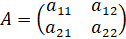 and
and 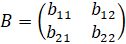
The product of the matrices  and
and  wriiten as
  or
or  is a matrix
 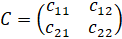 such that




Therefore, two matrices  and
and  can be multiplied together only when the number of columns of the first matrix
  is equal to the number of rows of the second matrix
  . Now suppose
  is a matrix of order
  and
and  is a matrix of order
  , the product of
  and
and  , written
  can be obtained since the number of columns of
  i.e. 2 is equal to the number of rows B
 i.e. 2 and this product
  is a matrix of order
 .
.
Example 1: Let A= 230-245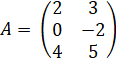 and B=132-106
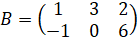 . Find
- AB
 ii. BA
Solution:
- AB
 is defined since the number of colums of A
 is equal to the number of row of B
 and AB
 is a 3 ×
 3 matrix therefore
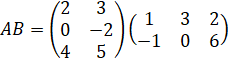

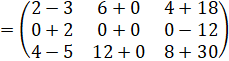
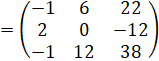
- Since
 is a (2
  3) matrix and
  is a (3
  2) then
  is defined and is a (2
 2) matrix. Therefore
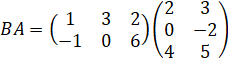



Note that for two matrices  and
and 

Example 2: Given that and
and 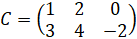 . Compute the following:
 ii.
ii.  iii.
iii. 
Solution:
- Since
 is a (2
  2) and
  is (2
is (2  3) then
  is defined and it is a (2
  3) matrix. therefore



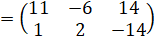
- Since
 is a (2
  3) and
  is (2
is (2  2), the number of columns of
  (i.e. 3) is not equal to the number of rows of
  (i.e. 2, hence (
 ) is not defined and thus cannot be computed.
 , solve the bracket first


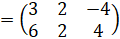
 is defined since
  is a (2
  2) matrix and
  is of order


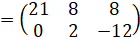
Using  and
and  as stated in example 2(iii) above show that
Transpose of a Matrix
The transpose of a matrix A written as AT
 is a matrix gotten by interchanging the row and columns of A
 i.e. the first row become the first column while the second row become the second column etc.
Example 3: if 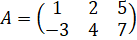 and
and  Find
Find
 ii.
ii.  iii.
iii.  iv.
iv. 
Solution
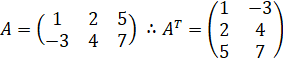
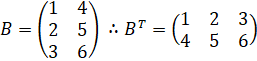
 is defined since
  is (2
is (2  3) and
  is (3
is (3  2)
2)


- From i. and ii.
 is defined since
  is of order (2
  3) and
  is of order (3
  2)
2)
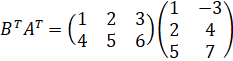

Ask students to say what they notice about the result in iii. And iv.
Determinant of (2 × 2) and (3 ×
 3)Matrices
Determinant of (2 × 2)
2)
Let 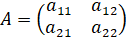 be a 2 by 2 matrix
then the determinant of  denoted by
  or det
  is given by

Determinant of (3 × 3)
3)
Let 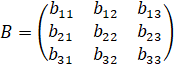 be a 3 by 3 matrix, then


Where
 are called minors and they are obtained by deleting respective leading row and column
- The sign attached to b11, b12, b13
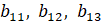 on and on is the cofactor signs given by the chess board format
 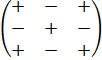 or
or  where
where  is row and
-

 and so on
Example 4: If 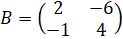 and
and  Find
Find
- det
 ii. det
  iii.
iii. 
Solution
- ∴det

- ∴det

- From i. and ii. above

Example 5: If 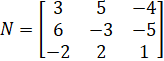 , Find N
Solution





Example 6: Find the determinant of the following matrix in terms of x
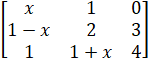
Solution






Inverse of (2 × 2) Matrix
If  then the inverse denoted as
  is given as exchanging
  and
and  and negating
  and
and 
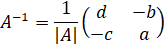
Example 7: Find the inverse of matrix 
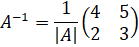
Where 

Given that  show that
Solution of Simultaneous Equation Using Determinant Method
(Crammer’s Rule)
Two Equation in Two Unknown
Given the equations


Where  are all constants. To solve for
  and
and  , we put the coefficient in determinant form as follows:
Find the determinant 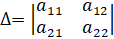 , then
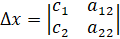 is obtained by replacing the column of
  by
by  .
.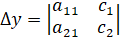 is obtained by replacing the column of
  by
by 
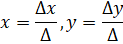
then divide  by
by to get
  and
and  by
by  to get
  . i.e.
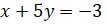
Example 8: use the determinant method to solve the following simultaneous equation

Solution
Putting the coefficients in determinant form, we have




Therefore x=2 and y=-1

Three Equation in Three Unknown
Given the equations



Where  are all constants. To solve for x, y
 and z
and z , we put the coefficient in determinant form as follows:
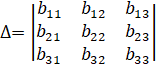
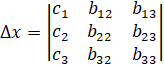 is obtained by replacing
 by
by 
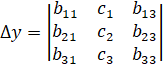 is obtained by replacing
  by
by
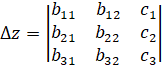 is obtained by replacing
  by
by 
Therefore
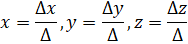
Example 9: Solve the following simultaneous equations using the determinant method



Solution
Putting the coefficient in the determinant form we have













Therefore 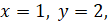 and
and 