INTEGRATION
Mathematics SSS 3 Second Term
WEEK 1
INTEGRATION
Performance Objectives
Student should be able to:
- Understand integration as the reverse of differentiation.
- Understand the various techniques of integration.
- Apply these techniques to solve problems.
Content
In integration, we wish to find back the function y when its differential coefficient dxdx
 is given. Therefore the process of finding y
 when dydx
 is given is called integration. So in general if
dydx=gx then gxdx=y+C
Where C or K
or K is a constant called the arbitrary constant of integration, arbitrary because it can take any numerical value which can be determined when additional information is given. Given that 2xdx=x2+C
 , the function to be integrated (i.e. 2x
 ) is called the integrand, while the solution (x2+C)
 is called the integral. The symbol dx
 attached beside the integrand shows that the integration is with respect to x
 .
.
The general rule of integration is given as
dydx=xn ∴ y=xndx=xn+1n+1+C (n≠-1)
Some Standard Integrals
dydx=anxn-1 ∴ y=axndx=axn+1n+1+C (n≠-1)
dydx=cosx ∴ y=cosxdx=sinx+C 
dydx=sinx ∴ y=sinxdx=-cosx+C 
dydx=ex ∴ y=exdx=ex+C 
dydx=1x ∴ y=1xdx=lnx+C 
dydx=a, where a is a constant ∴ y=adx=ax+C 
Example 1: Find the integral of the following with respect to x
 ii.
ii. 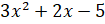 iii.
iii.  iv.
iv. 
Solution






C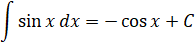







Some Techniques of Integration
- Integration by Substitution (Change of Variable)
Example 2: Evaluate the following integral
 ii.
ii. 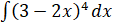
iii. 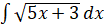
Solution

Let  therefore
By substituting we have

Replacing u then
then

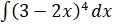
Let  therefore
By substituting we have


Replacing u then
then

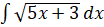
Let  therefore
By substituting we have


Replacing u then
then

ASSESSMENT
Evaluate the integral below

Answer ln(3x2-4)+C
- Integration by Part
This method is used to integrate functions that are in the form of products. However, this method can also be used for certain single functions. Recall that in differentiating a product function uv where u
 and v
and v are functions of x
 , we have
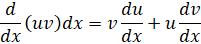
Integrating both sides of the equation we get

Since u and v
and v are functions of x
 and for convenience we have
uv=vdu+udv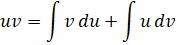
Therefore on rearranging, we have
udv=uv-vdu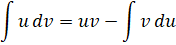
This is the integration by part formula
Example 3: Evaluate the following integrals using integration by parts
- xlnxdx
 ii. x3sinxdx
Solution
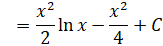
- xlnxdx

Let u=lnx since it can be differentiated easily ∴du=1xdx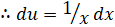
Let dv=xdx ∴ 
Using the integration by parts formula:
Substituting we have

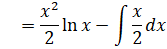

Let u=x3 since it can be differentiated easily ∴ du=3x2dx
Let dv=sinxdx ∴ v=sinxdx=-cosx 
By integration by parts we have


By repeating the process of integration by parts twice for the integral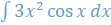 we have




Therefore

Note:
When using the integration by part formula, when a function is given we consider the order of priority below in choosing u


 or cosx
ASSESSMENT
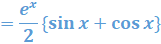
Evaluate the following integral 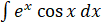
Answer
- Integration by Partial Fraction
This is a method of integrating a rational function which is neither the standard type nor whose numerator is the differential coefficient of the denominator. Such functions are first expressed into simpler partial fractions which we can integrate separately without difficulty.
Example 4: Evaluate the following
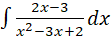 ii.
ii. 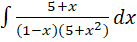
Solution
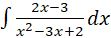
Express the integrand  into partial fractions, we have



If 
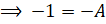

If 


Therefore



Alternatively: Notice that if we differentiate the denominator, we shall obtain the numerator, so this can be evaluated using substitution method
Let u=x2-3x+2





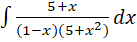
But



If 





Equating coefficients of x2 we have:
Equating constant terms we have: 
∴ A=1, B=1, C=0
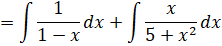
Therefore