
Metals and their Compounds 2
CHEMISTRY SSS3 First term
WEEK 2
Metals and their Compounds 2
Performance objectives
Students should be able to:
- Explain the properties of alkaline earth metals
- Explain the extraction of calcium.
- State the properties and uses of calcium.
- Explain the extraction of aluminium.
- Give at least three uses of aluminium
Content
Alkaline earth metals
These are group II elements and they include beryllium, magnesium, calcium, strontium, barium, radium. They are divalent elements because they have two valence electrons and they ionize by donating two valence electrons.
Mg ----à Mg2+ + 2e-
They are reducing agents and they form electrovalent compounds. Beryllium does not react with cold water or steam, magnesium reacts with only steam while calcium reacts with cold water, liberating hydrogen gas forming magnesium oxide and calcium oxide respectively.
Mg(s) + H2O(g) ----à MgO(s) + H2(g)
Ca(s) + H2O(g) ----à Ca(OH)2 + H2(g)
Calcium oxide dissolves in water to form calcium hydroxide solution, which is a very weak alkali.
CaO(s) + H2O(l) ----à Ca(OH)2(aq)
Magnesium oxide is insoluble in water. Trioxonitrate (v) salt of group II decompose easily on heating to form oxides, oxygen and brown fumes of Nitrogen(IV)oxide gas.
2Mg(NO3)2(s) ----à 2MgO(s) + O2(g) + 4NO2(g)
Calcium
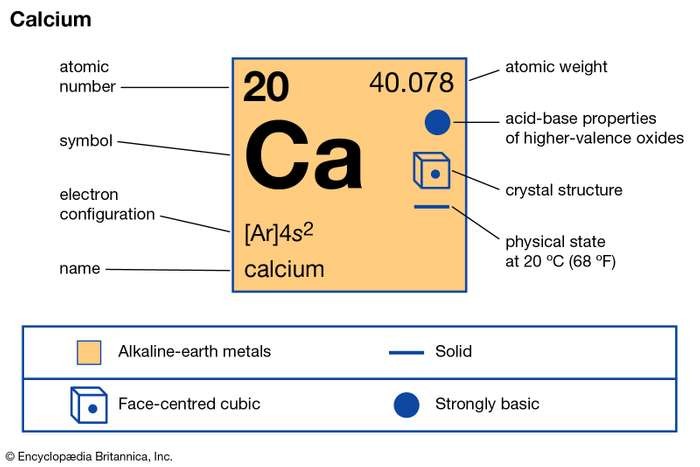
Calcium (Ca), chemical element, one of the alkaline-earth metals of Group 2 (IIa) of the periodic table. It is the most abundant metallic element in the human body and the fifth most abundant element in Earth’s crust.
Calcium does not occur naturally in the Free State, but compounds of the element are widely distributed. One calcium compound, lime (calcium oxide, CaO) was extensively used by the ancients. The silvery, rather soft, lightweight metal itself was first isolated (1808) by Sir Humphrey Davy after distilling mercury from an amalgam formed by electrolyzing a mixture of lime and mercuric oxide. The name for the element was taken from the Latin word for lime, calx.
Calcium constitutes 3.64 percent of Earth’s crust and 8 percent of the Moon’s crust, and its cosmic abundance is estimated at 4.9 × 10⁴ atoms (on a scale where the abundance of silicon is 106 atoms). As calcite (calcium carbonate), it occurs on Earth in limestone, chalk, marble, dolomite, eggshells, pearls, coral, stalactites, stalagmites, and the shells of many marine animals.
Extraction of calcium
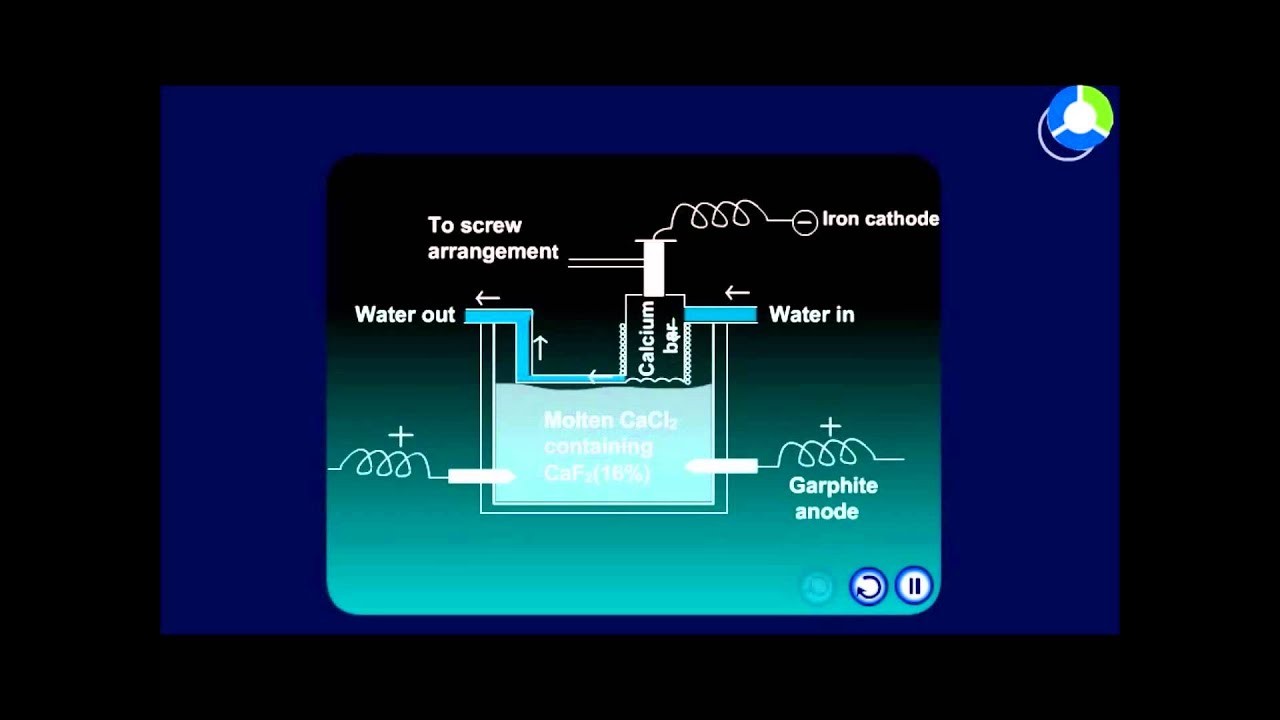
Metallic calcium is extracted by electrolysis of fused anhydrous calcium chloride. In the electrolytic cell, calcium chloride is added to lower the melting point from 8500c to about 6500c. The mixture is placed in a crucible lined on the inside with graphite which serves as the anode of the cell. The cathode is an iron rod which just dips below the surface of the calcium chloride. The calcium chloride is melted and the electrolysis begins, as the electrolysis proceeds metallic calcium is deposited on the cathode. Chlorine is liberated at the anode.
Chemistry of the reaction:
Calcium chloride contains calcium and chlorine ions.
CaCl2 -----à Ca2+ + 2Cl-
At the cathode:
The calcium ions receive two electrons each to become reduced to the metallic calcium
Ca2+ + 2e- ----à Ca
The metallic calcium forms deposits on the cathode.
At the anode:
The chlorine ions give up electrons each to become chlorine atom. Two chlorine atoms then combine to form a chlorine molecule which is then liberated.
Cl- ----à Cl + e-
Cl + Cl -----à Cl2
 Physical properties of calcium
- It is a soft silvery grey metal.
- It is malleable and ductile
- It is a good conductor of heat and electricity.
- It has a melting point of 8510c and a boiling point of 14870c
Chemical properties of calcium
Reaction with water:
Calcium reacts slowly with cold water and rapidly with warm water to form calcium hydroxide and hydrogen.
Ca(s) + 2H2O (aq) ----à Ca(OH)(aq) + H2(g)
Reaction with acids:
Calcium reacts vigorously with dilute acid to liberate hydrogen.
Ca(s) + 2HCl(aq) ------à CaCl(aq) + H2(g)
Reaction with ammonia: when calcium is heated with ammonia, nitride is formed and hydrogen gas is liberated.
3Ca(s) + 2NH3(g)-----à Ca3N2(s) + H2(g)
Uses of calcium
- It is used in the extraction of uranium.
- It is used to remove impurities from petroleum.
- It is used to manufacture calcium fluoride and calcium hydride.
- It is used as a dehydrating agent in the preparation of ethanol.
Aluminium
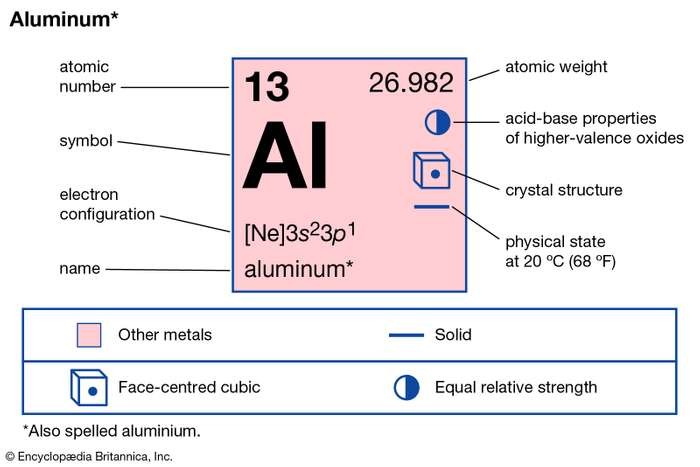
Aluminum (Al), also spelled aluminium, chemical element, a lightweight, silvery-white metal of main Group 13 (IIIa, or boron group) of the periodic table. Aluminum is the most abundant metallic element in Earth’s crust and the most widely used nonferrous metal. Because of its chemical activity, aluminum never occurs in the metallic form in nature, but its compounds are present to a greater or lesser extent in almost all rocks, vegetation, and animals. Aluminum is concentrated in the outer 10 miles (16 km) of Earth’s crust, of which it constitutes about 8 percent by weight; it is exceeded in amount only by oxygen and silicon. The name aluminum is derived from the Latin word alumen, used to describe potash alum, or aluminum potassium sulfate, KAl(SO4)2∙12H2O.
Aluminum occurs in igneous rocks chiefly as aluminosilicates in feldspars, feldspathoids, and micas; in the soil derived from them as clay; and upon further weathering as bauxite and iron-rich laterite. Bauxite, a mixture of hydrated aluminum oxides, is the principal aluminum ore. Crystalline aluminum oxide (emery, corundum), which occurs in a few igneous rocks, is mined as a natural abrasive or in its finer varieties as rubies and sapphires. Aluminum is present in other gemstones, such as topaz, garnet, and chrysoberyl. Of the many other aluminum minerals, alunite and cryolite have some commercial importance.
Extraction of aluminium
Aluminium is too high in the electrochemical series (reactivity series) to extract it from its ore using carbon reduction. The temperatures needed are too high to be economic.
Instead, it is extracted by electrolysis. The ore is first converted into pure aluminium oxide by the Bayer Process, and this is then electrolyzed in solution in molten cryolite - another aluminium compound. The aluminium oxide has too high a melting point to electrolyze on its own.
Aluminium ore
The usual aluminium ore is bauxite. Bauxite is essentially an impure aluminium oxide. The major impurities include iron oxides, silicon dioxide and titanium dioxide.
Purifying the aluminium oxide - the Bayer Process
Reaction with sodium hydroxide solution
Crushed bauxite is treated with moderately concentrated sodium hydroxide solution. The concentration, temperature and pressure used depend on the source of the bauxite and exactly what form of aluminium oxide it contains. Temperatures are typically from 140°C to 240°C; pressures can be up to about 35 atmospheres.
High pressures are necessary to keep the water in the sodium hydroxide solution liquid at temperatures above 100°C. The higher the temperature, the higher the pressure needed.
With hot concentrated sodium hydroxide solution, aluminium oxide reacts to give a solution of sodium tetrahydroxoaluminate.
Al2O3 + 2NaOH + 3H2O -----à 2NaAL (OH)4
Precipitation of aluminium hydroxide
The sodium tetrahydroxoaluminate solution is cooled, and "seeded" with some previously produced aluminium hydroxide. This provides something for the new aluminium hydroxide to precipitate around.
NaAl(OH)4 -----à Al(OH)3 + NaOH
Formation of pure aluminium oxide
Aluminium oxide (sometimes known as alumina) is made by heating the aluminium hydroxide to a temperature of about 1100 - 1200°C.
2AlOH3 ------à Al2O3 + 3H2O
Conversion of the aluminium oxide into aluminium by electrolysis
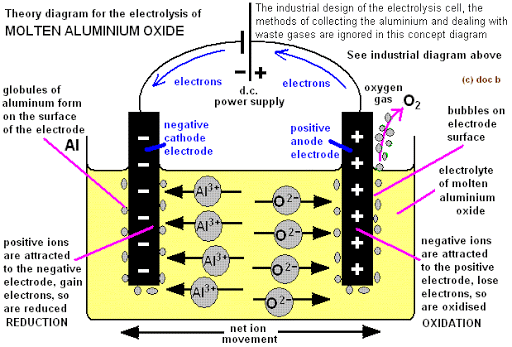
The aluminium oxide is electrolyzed in solution in molten cryolite, Na3AlF6. Cryolite is another aluminium ore, but is rare and expensive, and most is now made chemically.
The electrode reactions
These are very complicated - in fact one source I've looked at says that they aren't fully understood. For chemistry purposes at this level, they are always simplified (to the point of being wrong! - see comment below).
This is the simplification:
Al3+ + 3e- -----àAl
Aluminium is released at the cathode. Aluminium ions are reduced by gaining 3 electrons.
Oxygen is produced initially at the anode.
2O2- ------à O2 + 4e-
However, at the temperature of the cell, the carbon anodes burn in this oxygen to give carbon dioxide and carbon monoxide.
Continual replacement of the anodes is a major expense.
Uses of aluminium
Aluminium is used in a huge variety of products including cans, foils, kitchen utensils, window frames, beer kegs, and airplane parts. This is because of its particular properties. It has low density, is non-toxic, has high thermal conductivity, has excellent corrosion resistance, and can be easily cast, machined, and formed. It is also non-magnetic and non-sparking. It is the second most malleable metal and the sixth most ductile.
It is often used as an alloy because aluminium itself is not particularly strong. Alloys with copper, manganese, magnesium, and silicon are lightweight but strong. They are very important in the construction of airplanes and other forms of transport.
Aluminium is a good electrical conductor and is often used in electrical transmission lines. It is cheaper than copper and weight for weight is almost twice as good a conductor.
When evaporated in a vacuum, aluminium forms a highly reflective coating for both light and heat. It does not deteriorate, like a silver coating would. These aluminum coatings have many uses, including telescope mirrors, decorative paper, packages, and toys.