
Metals and their Compounds
CHEMISTRY SSS3 First term
WEEK 1
Metals and their Compounds
Performance objectives
Students should be able to:
- State the general characteristics of metals.
- State the compounds of metals.
- Explain the principle of extraction of metals.
- Explain the extraction of sodium.
- Give at least three uses of sodium.
Content
Metals and their compounds
General characteristics of metals
Metals are a class of substances characterized by high electrical and thermal conductivity as well as by malleability, ductility, and high reflectivity of light.
Approximately three-quarters of all known chemical elements are metals. The most abundant varieties in the Earth’s crust are aluminum, iron, calcium, sodium, potassium, and magnesium. The vast majority of metals are found in ores (mineral-bearing substances), but a few such as copper, gold, platinum, and silver frequently occur in the free state because they do not readily react with other elements.
Characteristics of metals
Metals are lustrous, malleable, ductile, good conductors of heat and electricity. However, some other characteristics include:
- State: Metals are solids at room temperature with the exception of mercury, which is liquid at room temperature (Gallium is liquid on hot days).
- Luster: Metals have the quality of reflecting light from their surface and can be polished e.g., gold, silver, and copper.
- Malleability: Metals have the ability to withstand hammering and can be made into thin sheets known as foils. For example, a sugar cube-sized chunk of gold can be pounded into a thin sheet that will cover a football field.
- Ductility: Metals can be drawn into wires. For example, 100 g of silver can be drawn into a thin wire about 200 meters long.
- Hardness: All metals are hard except sodium and potassium, which are soft and can be cut with a knife.
- Valency: Metals typically have 1 to 3 electrons in the outermost shell of their atoms.
- Conduction: Metals are good conductors because they have free electrons. Silver and copper are the two best conductors of heat and electricity. Lead is the poorest conductor of heat. Bismuth, mercury, and iron are also poor conductors
- Density: Metals have high density and are very heavy. Iridium and osmium have the highest densities whereas lithium has the lowest density.
- Melting and Boiling Points: Metals have high melting and boiling points. Tungsten has the highest melting and boiling points whereas mercury has the lowest. Sodium and potassium also have low melting points.
Compounds of metals
Most metals do not occur in their natural state. They are often found as compounds such as metal oxides, sulfides and halides.
- Aluminum oxide is the main metal compound present in the ore known as bauxite.
- Iron pyrites or ‘fool’s gold’ is mainly iron sulfide.
- The Lake Grassmere salt works in Marlborough produces the metal compound known as sodium chloride from ‘salty’ seawater.
Metals can be produced (smelted) from their ores by a variety of methods:
- Aluminum is produced from its ore (bauxite) by passing a very large electric current through a molten mixture of the ore and a compound called cryolite.
- Titanium is mostly produced from its ore (rutile) by the Kroll Process, where the ore is treated with chlorine gas followed by a reaction with magnesium metal.
General Principles of Extraction of Metals
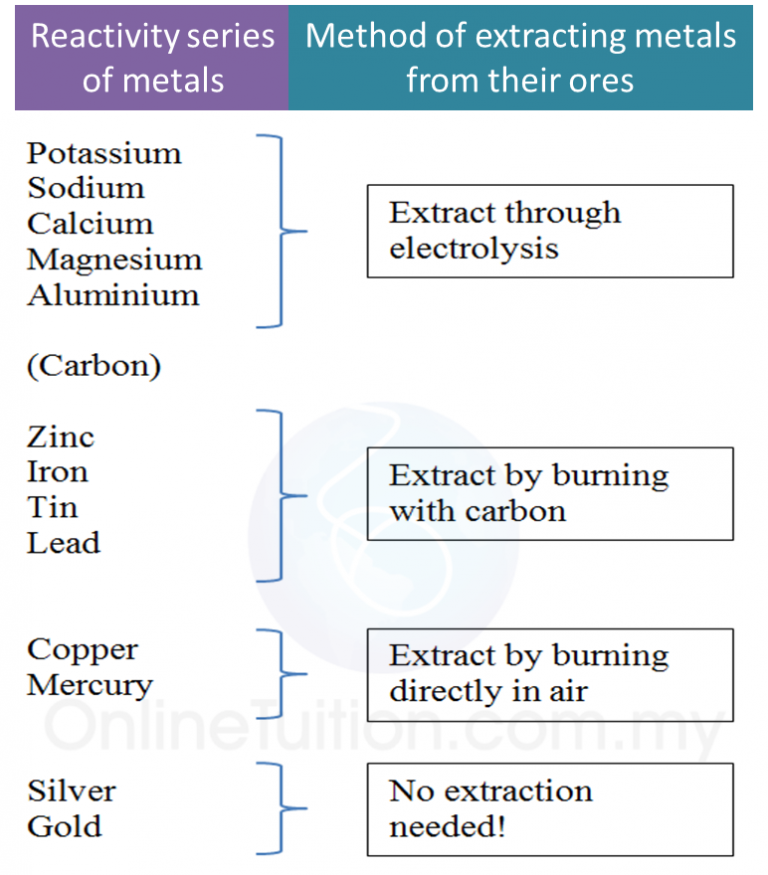
In order to extract the metal from ores, several physical and chemical methods are used. The method used depends upon the nature of the ore, the properties of the metal, and the local conditions, Thus, it is not possible to have a universal method for the extraction of all the metals from their ores.
What are "ores"?
An ore is any naturally-occurring source of a metal that you can economically extract the metal from. Aluminum, for example, is the most common metal in the Earth's crust, occurring in all sorts of minerals. However, it isn't economically worthwhile to extract it from most of these minerals. Instead, the usual ore of aluminum is bauxite - which contains from 50 - 70% of aluminum oxide.
Copper is much rarer, but fortunately can be found in high-grade ores (ones containing a high percentage of copper) in particular places. Because copper is a valuable metal, it is also worth extracting it from low-grade ores as well. Ores are common oxides, for example:
- bauxite (Al2O3)
- haematite (Fe2O3)
- rutile (TiO2 )
. Or sulfides, for example:
- pyrite (FeS2 )
- chalcopyrite (CuFeS2 )
Concentrating the ore
This simply means getting rid of as much of the unwanted rocky material as possible before the ore is converted into the metal. In some cases, this is done chemically. For example, pure aluminum oxide is obtained from bauxite by a process involving a reaction with sodium hydroxide solution. This is described in detail on the aluminum page in this section. Some copper ores can be converted into copper (II) sulfate solution by leaving the crushed ore in contact with dilute sulphuric acid for a long time. Copper can then be extracted from the copper (II) sulfate solution. But, in many cases, it is possible to separate the metal compound from unwanted rocky material by physical means. A common example of this involves froth flotation.
Froth flotation
The ore is first crushed and then treated with something which will bind to the particles of the metal compound that you want and make those particles hydrophobic. "Hydrophobic" literally means "water fearing". In concentrating copper ores, for example, pine oil is often used. The pine oil binds to the copper compounds, but not to the unwanted rocky material.
The treated ore is then put in a large bath of water containing a foaming agent (a soap or detergent of some kind), and air is blown through the mixture to make a lot of bubbles. Because they are water-repellent, the coated particles of the metal compound tend to be picked up by the air bubbles, float to the top of the bath, and are allowed to flow out over the sides. The rest of the rocky material stays in the bath.
Reducing the metal compound to the metal
Why is this reduction?
At its simplest, where you are starting from metal oxides, the ore is being reduced because oxygen is being removed.
Fe2O3 -------à Fe
Removal of oxygen = Reduction
Al2O3 --------à Al
Removal of oxygen = Reduction
However, if you are starting with a sulfide ore, for example, that's not a lot of help! It is much more helpful to use the definition of reduction in terms of addition of electrons. To a reasonable approximation, you can think of these ores as containing positive metal ions. To convert them to the metal, you need to add electrons - reduction.
Al3+ + 3e- -----à Al (addition of electron = reduction)
Fe3+ + 3e- -----à Fe (addition of electrons = reduction)
Choosing a method of reduction
There are various economic factors you need to think about in choosing a method of reduction for a particular ore. These are all covered in detail on other pages in this section under the extractions of particular metals. What follows is a quick summary.
You need to consider:
- The cost of the reducing agent;
- energy costs;
- The desired purity of the metal.
There may be various environmental considerations as well - some of which will have economic costs.
Chemical Reduction
Carbon (as coke or charcoal) is cheap. It not only acts as a reducing agent, but it also acts as the fuel to provide heat for the process. However, in some cases (for example with aluminum) the temperature needed for carbon reduction is too high to be economic - so a different method has to be used. Carbon may also be left in the metal as an impurity. Sometimes this can be removed afterward (for example, in the extraction of iron); sometimes it can't (for example in producing titanium), and a different method would have to be used in cases like this.
Other more reactive metals can be used to reduce the ore. Titanium is produced by reducing titanium (IV) chloride using a more reactive metal such as sodium or magnesium. As you will see if you read the page about titanium extraction, this is the only way of producing high purity metal.
TiCl4 + 4Na → Ti + 4NaCl (1)
The more reactive metal sodium releases electrons easily as it forms its ions:
4Na → 4Na+ + 4e− (2)
These electrons are used to reduce the titanium (IV) chloride:
TiCl4 + 4e− → Ti + 4Cl− (3)
The downside of this is expense. You have first to extract (or to buy) the sodium or magnesium. The more reactive the metal is the more difficult and expensive the extraction becomes. That means that you have to use a very expensive reducing agent to extract the titanium. As you will see if you read the page about titanium extraction, there are other problems in its extraction which also add to the cost.
Reduction by electrolysis
This is a common extraction process for the more reactive metals - for example, for aluminum and metals above it in the electrochemical series. You may also come across it in other cases such as one method of extracting copper and in the purification of copper. During electrolysis, electrons are being added directly to the metal ions at the cathode (the negative electrode). The downside (particularly in the aluminum case) is the cost of the electricity. An advantage is that it can produce very pure metals.
General properties of Alkali Metals
Alkali metals are metals present in group 1 elements and they include sodium, lithium, potassium, caesium, rubidium, and francium. They are univalent elements because they have one valence electron. They ionize readily by donating one electron.
Na ----à Na+ + e-
They form positive ions. Hence, they are good reducing agents.
They form electrovalent compounds. They are good conductors of electricity and are very electropositive.
They react vigorously with cold water to alkalis.
Na2O + H2O ----à 2NaOH (aq)
Sodium
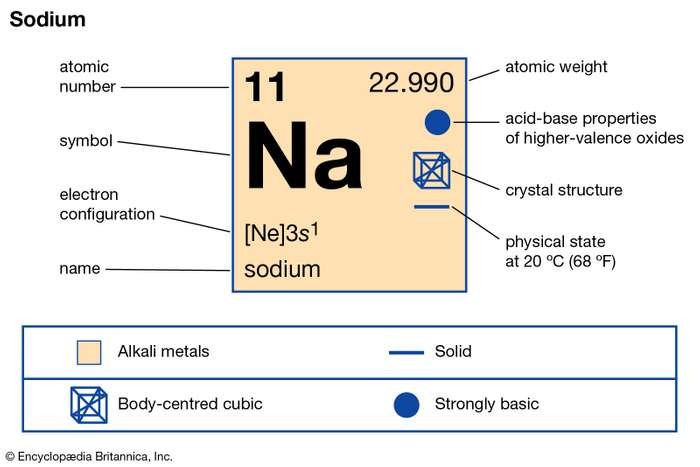
Sodium (Na), chemical element of the alkali metal group (Group 1 [Ia]) of the periodic table. Sodium is an element in the 1ˢᵗ group of the 3ʳᵈ period of the Periodic Table. It is in the subgroup of alkaline metals; Na₂O sodium oxide and NaOH sodium hydroxide display typical base properties. The most important natural compounds of sodium are table salt NaCl, Glauber’s salt Na₂SO₄·10H₂O and sylvanite NaCl·KCl. Sodium is a very soft silvery-white metal. Sodium is the most common alkali metal and the sixth most abundant element on Earth, comprising 2.8 percent of Earth’s crust. It occurs abundantly in nature in compounds, especially common salt—sodium chloride (NaCl)—which forms the mineral halite and constitutes about 80 percent of the dissolved constituents of seawater.
Extraction of sodium
|
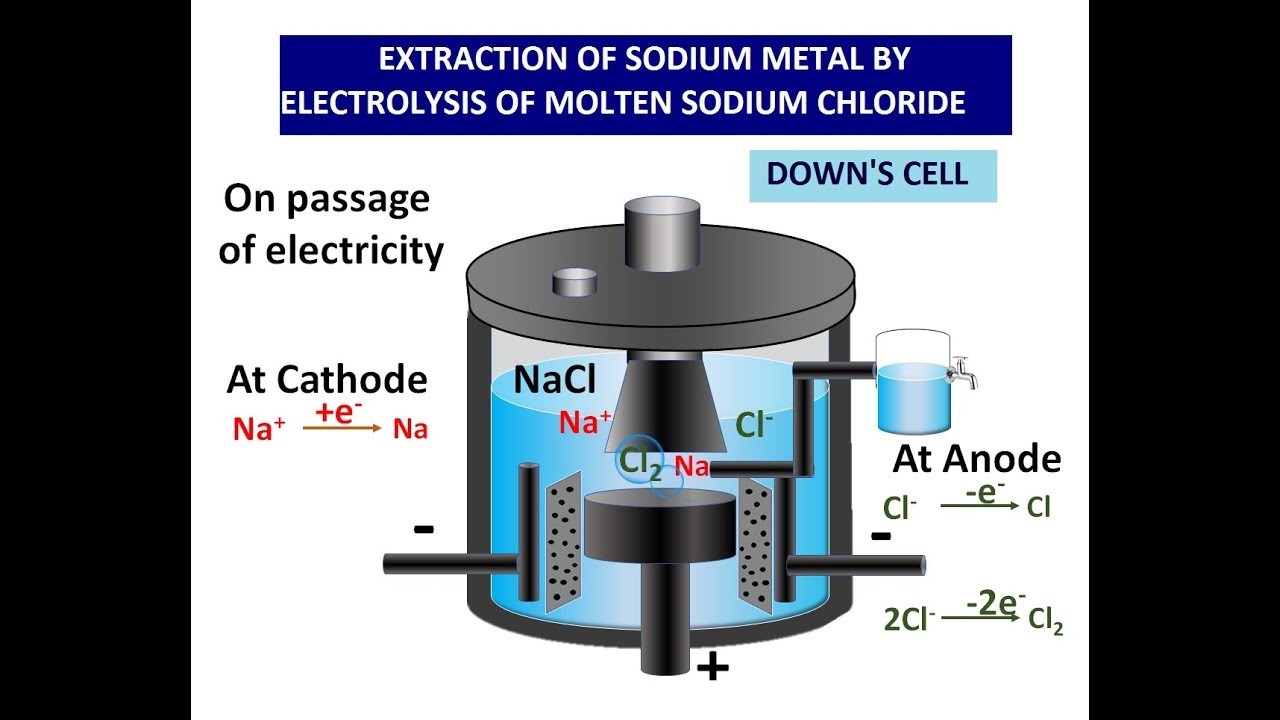
On industrial scale, sodium metal is extracted by "Down's Process. Principle |
|
|
Down's Process is based on the electrolysis of fused NaCl. Construction of down cell |
|
|
Down's cell consists of a rectangular container of steel.
Down’s cell |
|
|
Draw backs on down’s cell The melting point of NaCl is 801C. At this temperature, molten NaCl and Na form a metallic fog in the container which is impossible to separate. |
|
|
Steps to overcome this difficulty In order to overcome this difficulty instead of only NaCl, a mixture of NaCl and CaCl2 is electrolyzed in down's cell. The melting point of this mixture is 600C. At 600C no metallic fog is formed. |
|
|
COMPOSITION OF CHARGE: |
|
|
The process When an electric current is passed through the molten mixture of NaCl and CaCl2, NaCl decomposes into Na+ and Cl- ion. Na+ ions migrate towards the cathode while Cl- ions towards the anode. The molten sodium collects in the cathode compartment where it rises to the top and is tapped off by a pipe. Chlorine is collected at the anode. |
|
|
The chemistry of reaction Fused NaCl contains sodium and chloride ions. |
|
|
2NaCl ---à 2Na+ + 2Cl- |
|
|
Electrochemical changes |
|
|
At cathode Na+-ions migrate to the cathode where they are reduced to Na. |
|
|
2Na+ + 2e- ----à 2Na (Reduction) At anode |
|
|
Cl--ions migrate to the anode and oxidized to form chlorine gas. |
|
|
2Cl- -----à Cl2 + 2e- (Oxidation) |
|
Overall reaction
|
2Na+ + 2e- -----à 2Na 2Na+ + 2Cl- -----à 2Na + Cl2 |
Properties of Sodium
Physical properties
Like other alkaline metals, sodium is a silvery-white metal. It is quite malleable and soft (metallic sodium can easily be cut with a knife or scalpel, and a fresh cut shines in air). It has a high electroconductivity.
Chemical properties of metallic sodium
Metallic sodium is usually stored under a layer of kerosene, as it has high chemical reactivity (Na can react violently with oxygen and air moisture even at room temperature). The presence of sodium ions in salt can be determined by the color of a flame – Na⁺ turns flame yellow.
Reaction of sodium with oxygen
When sodium burns in oxygen, the main product of reaction will not be sodium oxide, but sodium peroxide:
2Na + O₂ = Na₂O₂ (sodium oxide Na₂O also forms in this reaction, but in trace quantities).
In air, sodium can also swiftly oxidize to sodium oxide (the oxide will not be pure, as a considerable (sometimes greater) quantity of peroxide Na₂O₂ will be present among the products):
4Na + O₂ = 2Na₂O.
The reaction of sodium with oxygen may be written as follows:
6Na + 2O₂ = Na₂O₂ + 2Na₂O.
Reaction of sodium with non-metals
Sodium, besides combustion, is capable of taking part in many other reactions with non-metals:
Reaction with hydrogen with formation of hydride:
2Na + H₂ = 2NaH (reaction takes place with heating to 250-400 ᵒC (482-752 ᵒF) and at increased pressure);
Reaction with sulfur with formation of sulfides:
2Na + S = Na₂S (sodium sulfide);
Reaction with halogens:
2Na + Cl₂ = 2NaCl (sodium chloride);
2Na + Br₂ = 2NaBr (sodium bromide);
Metallic sodium reacts poorly with nitrogen (the reaction may be conducted in a glow discharge – a burning discharge formed in a low current and with low gas pressure):
6Na + N₂ = 2Na₃N.
Reaction of sodium with metals
When the surface of metallic sodium contacts mercury, an amalgam is formed – an alloy of metal with mercury.
With potassium, the metal forms an alloy with the formula NaK. It is quite aggressive – it may combust in air. If the content of potassium in the alloy varies from 40% to 90% in relation to sodium, the alloy remains liquid at room temperature. The sodium-potassium alloy NaK is obtained by alloying liquid potassium hydroxide KOH with melted metallic sodium. This reaction is carried out at a temperature of 400-450 ᵒC (752-842 ᵒF).
Owing to its chemical reactivity, sodium may enter into reactions with various compounds, for example:
Reaction of sodium with acids (diluted):
2Na + 2HCl = 2NaCl + H₂ (sodium chloride NaCl and hydrogen gas H₂ form).
Reaction with nitric and sulfuric acids:
8Na + 8H₂SO₄ = NaHS + 7NaHSO₄ + 4H₂O (with heating, concentrated acid);
8Na + 10HNO₃ = 8NaNO₃ + NH₄NO₃ + 3H₂O (diluted acid – 3-5%);
11Na + 14HNO₃ = 11NaNO₃ + NO + N₂O + 7H₂O (acid of 20% concentration).
Reaction with water (reaction takes place vigorously):
2Na + H₂O = 2NaOH + H₂.
Uses of Sodium
- It also used in improving the structure of certain alloys; soaps, purification of molten metals, and in sodium vapor lamps.
- Sodium is a component of sodium chloride, which is a very important compound found in the living environment.
- Sodium is important in the manufacturing of organic compounds and in making esters.
- Solid sodium carbonate is required in making glass.