
DIGESTIVE SYSTEM
BIOLOGY SSS TWO FIRST TERM
WEEK TWO
DIGESTIVE SYSTEM
PERFORMANCE OBJECTIVE
Students should be able to;
- Describe with illustration different types of alimentary tracts
- Explain the feeding mechanism of some animals
- Explain how some insectivorous plants feed
CONTENT
Human digestive system, the system used in the human body for the process of digestion. The human digestive system consists primarily of the digestive tract, or the series of structures and organs through which food and liquids pass during their processing into forms absorbable into the bloodstream. The system also consists of the structures through which wastes pass in the process of elimination and other organs that contribute juices necessary for the digestive process.
What is the Alimentary Canal?
The alimentary canal is mainly referred to as the pathway by which food enters our body and moves out through the anus during digestion. It is a tube-like structure which starts from the mouth and ends in the anus. The alimentary canal plays a primary role in the human digestion and is also termed as the digestive tract.
Organs of the Alimentary Canal
The main organs of the alimentary canal are:
- The Mouth and Oral cavity.
- Oesophagus.
- Stomach.
- Small intestine.
- Large intestine.
The structure and functions of these organs are discussed below.
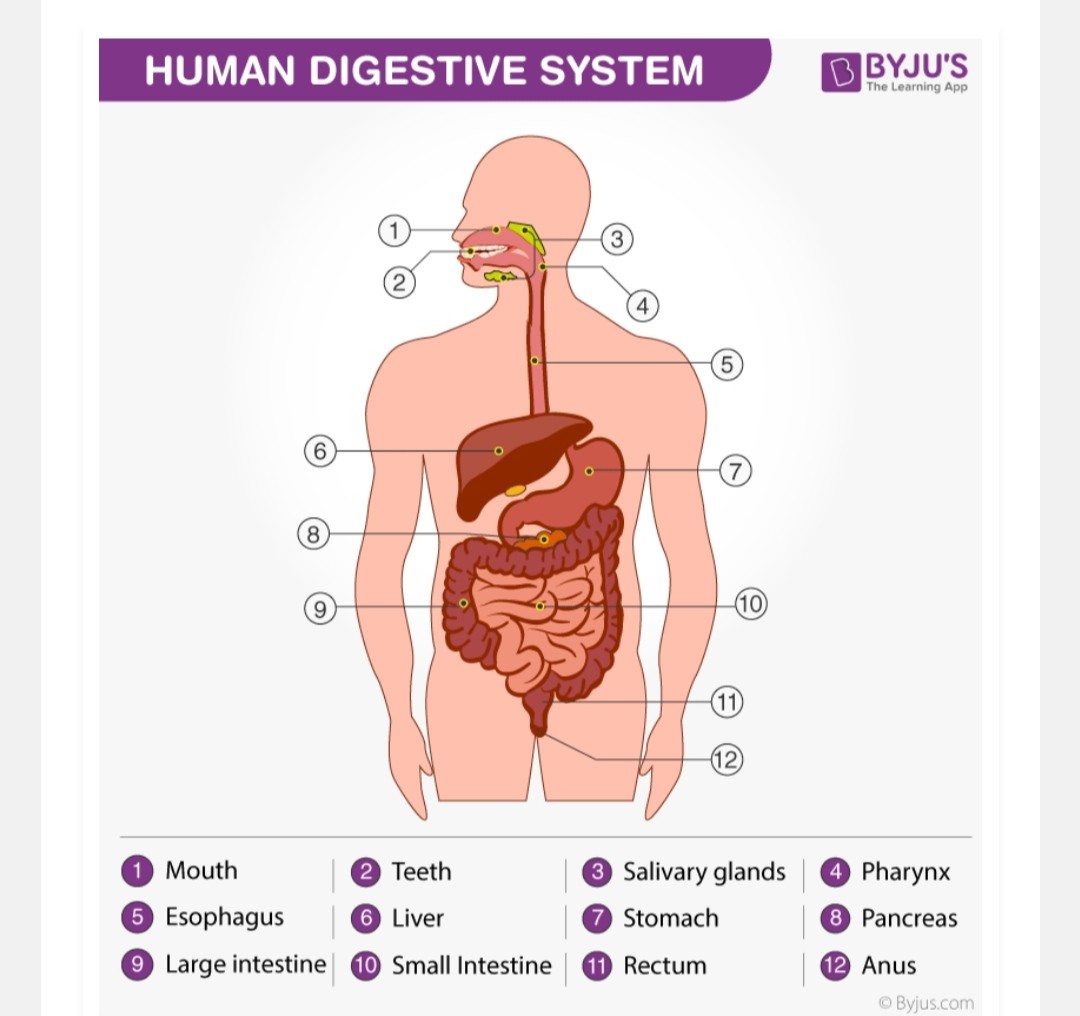
The parts of the human digestive system include – mouth, oral cavity, teeth, oesophagus, pharynx, stomach, small intestine, large intestine, and anus.
- Mouth
The mouth is the opening through which the intake of food occurs.
- Oral cavity
The oral cavity has three parts –the palate, tongue, and teeth.
- Palate
It forms the roof of the oral cavity. The anterior part is called hard palate and the posterior part is called the soft palate.
- Tongue
The tongue is a muscular and glandular structure attached to the base of the oral cavity. On the upper surface, it has a V-shaped furrow called sulcus terminalis. It divides the tongue into the anterior oral part and posterior pharyngeal part. Its upper surface also consists of tiny projections called lingual papillae. Lingual papillae are of three kinds in humans-
(i) Vallate or circumvallate papillae -have gustatory receptors to sense taste
(ii) Filiform papillae- smallest and contain touch receptors.
(iii) Fungi-form papillae- Rounded and mostly present at the tip of the tongue.
- Teeth
Humans are diphyodont i.e. they have two sets of teeth- milk or deciduous and permanent teeth. Here is the list of different types of teeth in humans with their functions.
Type of teeth Function
Incisors Used for cutting
Canines Used for tearing
Premolars Used for Chopping
Molars Used for Grinding and Chewing
The structure of the tooth is made up of three parts- the crown, neck, and root. The exposed part of the tooth is called the crown, the region where it is covered with gums is known as neck and root is embedded in the socket of the jaw bone.
- Pharynx
It forms the common passage for food and air.
- Oesophagus
It is a muscular tube through which small bolus of food passes from the mouth to the stomach. It is sharply bent at the point at which it meets the stomach. This prevents the backward movement of food from the stomach into it. Food in the digestive tract moves by an involuntary movement of alternate contraction and relaxation of muscles called peristalsis.
- Stomach
It is a muscular bag which has three parts- cardiac part, fundus, and body.
- Cardiac part– It is so-called because it is present close to the heart. The opening of the oesophagus to the stomach is regulated by the cardiac sphincter.
- Fundus– It is dome-shaped and is usually filled with air.
- Body– This is the main part of the stomach. The opening of the stomach into the small intestine is regulated by the pyloric sphincter.
- Small Intestine
It is the longest part of the alimentary canal and comprises three parts- Duodenum, Jejunum, and Ileum.
Duodenum– It is C- shaped and receives the hepatopancreatic duct formed by the union of bile and pancreatic duct.
Jejunum– Middle part of small intestine with thick walls and more vasculature.
Ileum– The lower part of the small intestine with thin walls and less vasculature.
- Large Intestine
The small intestine leads into the large intestine which has three parts- Caecum, Colon, and Rectum.
- Caecum– It is a small sac-like structure at the point where the small intestine meets the large intestine.
- Colon– It is divided into four regions- transverse colon, sigmoid colon ascending colon and descending colon.
- Rectum– It opens into the anus.
Four Main Feeding Mechanisms of Animals
- Suspension-Feeders and Filter Feeders
- Fluid Feeder
- Substrate Feeders
- Bulk Feeders
- Suspension-Feeders and Filter Feeders
Many aquatic animals are suspension feeders, which eat small organisms or food particles suspended in the water. For example, clams and oysters feed on tiny morsels of food in the water that passes over their gills; cilia sweep the food particles to the animal's mouth in a film of mucus. Filter feeders such as the humpback whale shown above move water through a filtering structure to obtain food. Attached to the whale's upper jaw are comblike plates called baleen, which strain small invertebrates and fish from enormous volumes of water
- Fluid Feeder
Fluid feeders suck nutrient-rich fluid from a living host. This mosquito has pierced the skin of its human host with hollow, needlelike mouthparts and is consuming a blood meal Similarly, aphids are fluid feeders that tap the phloem sap of plants. In contrast to such parasites, some fluid feeders benefit their hosts. For example, hummingbirds and bees move pollen between flowers as they fluid-feed on nectar.
- Substrate Feeders
Substrate feeders are animals that live in or on their food source. This leaf miner caterpillar, the larva of a moth, is eating through the soft tissue of an oak leaf, leaving a dark trail of faeces in its wake. Some other substrate feeders include maggots (fly larvae), which burrow into animal carcasses
- Bulk Feeders
Most animals, including humans, are bulk feeders, which eat relatively large pieces of food. Their adaptations include tentacles, pincers, claws, poisonous fangs, jaws, and teeth that kill their prey or tear off pieces of meat or vegetation. In this amazing scene, a rock python is beginning to ingest a gazelle it has captured and killed. Snakes cannot chew their food into pieces and must swallow it whole—even if the prey is much bigger than the diameter of the snake. They can do so because the lower jaw is loosely hinged to the skull by an elastic ligament that permits the mouth and throat to open very wide. After swallowing its prey, which may take more than an hour, the python will spend two weeks or more digesting its meal.
What are Insectivorous Plants?
Insectivorous plants are the ones that derive most of their nutrition from the insects they trap and consume. These plants grow in humid areas where plenty of sunlight and moisture is found. The nutrients in the moist soil are scarce. That is why they trap and digest insects to absorb nutrients. Venus flytrap, pitcher plant and cobra lily are some of the insectivorous plant's names found in North America. They are often called Carnivorous plants.
Insectivorous Nutrition
Some plants have special structural features that help them to trap insects and are commonly known as carnivorous or heterotrophic plants. These plants digest the insects by secreting digestive juices and absorb the nutrients from them. These plants grow on the soil that lacks minerals.