
Concepts of Demand and Supply – Price System, Demand, Schedule, Curves and Laws.
Economics SSS1 First Term
WEEK 4
Concepts of Demand and Supply – Price System, Demand, Schedule, Curves and Laws.
Performance Objectives
Student should be able to:
- Explain the meaning of price system, demand, draw schedules and curves of a given commodity.
- State the law of demand.
Content
Meaning of Price system
In a free-market economy, all the decision-makers are free to make their own choices; no one will interfere. In this pursuit of self-interest and the general good of all, every economic agent (i.e., households and firms) is guided by a hidden hand of an invisible hand. The invisible hand mechanism, as was called by Adam Smith, operates due to free play of competition.
The price system is one in which all economic decisions are taken through the medium of prices which are, by nature, self-adjusting and self-correcting. An economy consisting of households and firms is connected by markets in which they exchange goods and input services. For this exchange relationship, both the parties charge a price that reflects the desires of the households and the capacities of producers. Price system can now be the result of the behaviour of firms and the behaviour of markets. As there is no critical regulating authority, decisions are taken by an invisible hand or price system. The decisions of what, how and for whom to produce are determined by the demand and supply conditions of commodities and input services.
Concept of demand
Demand is an economic principle refers to a consumer's desire to purchase goods and services and willingness to pay a price for a specific good or service. Alternatively, it may be defined as the quantity of goods and services that consumers are willing and able to buy at a given price over a given period. In economics, demand is formally defined as ‘effective’ demand meaning that it is a consumer want or a need supported by an ability to pay.
Law of Demand
The law of demand states that all things being equal, the higher the price, the lower the quantity of goods that will be demanded or the lower the price, the higher the quantity of God's that will be demanded.
This law will hold under the following assumptions:
i. That the consumers income remains constant.
ii. That no close substitutes of the commodity exist.
iii. That there will be no change in the taste and preference if the consumers
iv. That there is no change in the quality of the product
v. That the habits of consumers remain unchanged.
Demand Schedule
A demand schedule is a table that shows the quantity demanded of a good or service at different price levels.
There are two types of Demand Schedule
1. Individual demand schedule: Individual demand schedule refers to a tabular statement showing various quantities of a commodity that a consumer is willing to buy at various levels of price, during a given period.
|
Price per quantity of commodity X |
Quantity demanded of commodity X |
|
100 |
50 |
|
200 |
40 |
|
300 |
30 |
|
400 |
20 |
|
500 |
10 |
2. Market demand schedule: Market demand schedule refers to a tabular statement showing various quantities of a commodity that all the consumers are willing to buy at various levels of price, during a given period. It is the sum of all individual demand schedules at every price.
|
Price per unit of commodity X |
Quantity demanded by consumer A |
Quantity demanded by consumer B |
Market demand |
|
100 |
50 |
70 |
120 |
|
200 |
40 |
60 |
100 |
|
300 |
30 |
50 |
80 |
|
400 |
20 |
40 |
60 |
|
500 |
10 |
30 |
40 |
Demand Curve
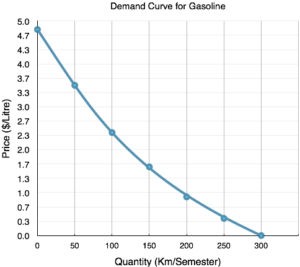
The demand curve is a graphical representation of the relationship between the price of a good or service and the quantity demanded for a given period. In a typical representation, the price will appear on the left vertical axis, the quantity demanded on the horizontal axis. Demand Curve is derived from a demand schedule.
Factors affecting demand
a. Income: when consumer`s income increases, he or she usually buys more goods which increases the demand.
b. Prices of substitutes goods: when the price of a substitute good (e.g. banana) increases, a consumer normally gives up at least some of its consumption and as a result the demand (e.g. for pineapple) increases.
c. Consumer’s taste and preferences: Tastes and preferences of the consumer have a direct influence on the demand for a commodity. This can be applied for products in fashion, customs, habits, etc. For example, if a commodity in fashion is on-trend and is preferred by the consumers, the demand for such a commodity will rise. On the other hand, demand for it will fall, if the consumers have no taste or preference for that commodity.
d. Consumer’s expectation: Another factor which influences the demand for goods is consumers’ expectations concerning future prices of the goods. If the price of a certain commodity is expected to increase soon, the consumer will buy more of that commodity than what they normally buy. In that situation, they won't have to pay a higher price in the future. If the price of petrol is expected to rise in the next few days, people will rush for fuel. Similarly, when the consumers expect that in the future the prices of goods will fall, then in the present they will postpone a part of the consumption of goods with the result that their present demand for goods will decrease.
e. Advertisement Expenditure: Advertisement expenditure made by a firm to promote the sales of its product is an important factor determining demand for a product, especially of the product of the firm which gives advertisements. The purpose of an advertisement is to influence the consumers in favour of a product. Advertisements are given in various media such as newspapers, radio, and television. Advertisements for goods are repeated several times so that consumers are convinced about their superior quality. When advertisements prove successful they cause an increase in the demand for the product.