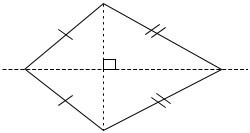
Plane Figure/Shapes
Mathematics J.S.S 2 Third Term
Theme: Mensuration and Geometry
Sub Theme: Shapes
WEEK 1
Plane Figure/Shapes
Performance Objectives
Students should be able to;
- State the properties of parallelogram, Rhombus and kite
- Identify these shapes in their environment
Properties of Quadrilaterals
Content
Quadrilateral just means “four sides”, (quad means four, lateral means side). Any four-sided shape is a Quadrilateral.
But the sides have to be straight, and it has to be 2-dimensional.
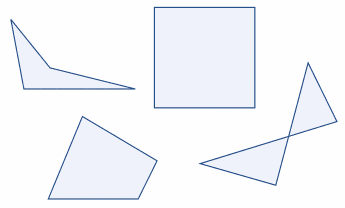
Examples of quadrilaterals are: parallelogram, rhombus, rectangle, e.t.c
Properties of Quadrilateral are;
They have four sides (edges)
They have four vertices (corners)
Their interior angles add up to 360 degrees
Types of Quadrilaterals
There are special types of quadrilaterals and they include:
A. Parallelogram
A parallelogram is a quadrilateral whose pairs are equal and parallel.
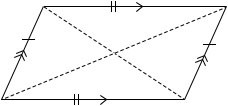
Properties of Parallelogram
- Its opposite sides are parallel and equal
- Its opposite angles are equal
- Its diagonals bisect each other
- Each diagonal bisects the parallelogram into two congruent triangles
- The (4) angles together add up to 3600
NOTE: Squares, Rectangles and Rhombuses are all Parallelograms!
Consider the parallelogram below:
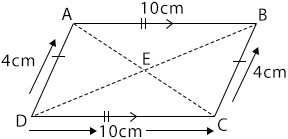
Line AB = Line DC = 10cm
Line AB is parallel to line DC
Line AD = Line BC = 4cm
Line AD is parallel to line BC
Angle BAD = Angle BCD
Angle ADC = Angle ABC
Diagonal AC divides the parallelogram ABCD into two congruent triangles ABC and ADC
Diagonal DB divides the parallelogram ABCD into two congruent triangles DAB and DCB
The diagonals bisect each other at point E i.e.
AE = EC = and DE = EB
B. Rhombus
A rhombus is a quadrilateral which has four sides equal length.
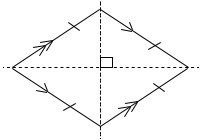
Another interesting thing is that the diagonals (dashed lines in the second figure) meet in the middle at a right angle. In other words, they “bisect” (cut in half) each other at right angles.
A rhombus is sometimes called a rhombus or a diamond.
Properties of Rhombus
- All four sides are equal in length.
- The opposite angles are equal.
- The diagonals are the lines of symmetry.
- The diagonals bisect each other at right angles.
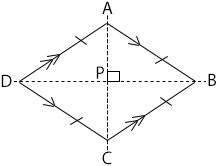
Line AB = line BC = line DC = line AD, i.e.
AB = BC= DC = AD
AD is parallel to BC
AB is parallel to DC
<DAB = <BCD, and <DPC = <APD
<APB = <BPC = <DPC = <APD = 900
PA = PC and PB = PD
C. Kite
A kite is a quadrilateral in which one diagonal is a line of symmetry
Properties of a Kite
- It has one line of symmetry
- Opposite angles of a kite are equal
- The diagonals of a kite meet at a right angle
- Adjacent sides of a kite are equal.