
Plane Figure/Shapes
Mathematics J.S.S 2 Third Term
Theme: Mensuration and Geometry
Sub Theme: Shapes
WEEK 2
Plane Figure/Shapes
Performance Objectives
Students should be able to;
- State the properties of parallelogram,
- State the properties of Rhombus and kite
- Identify these shapes in their environment
Scale Drawing and Patterns
Content
A scale simply means the dimension or proportion of objects in comparison to its original or actual size after the drawing. It is widely use in sciences especially in Geography, Biology, Mathematics, Physics, etc.
A drawing that shows a real object with accurate sizes except they have all been reduced or enlarged by a certain amount (called the scale).
The scale of a drawing is determined by comparing the length of the drawing with the actual length of the object.
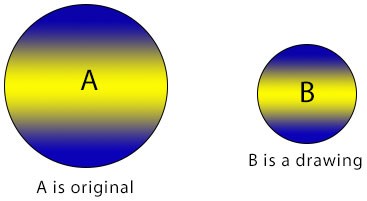
Scale = length of the object after drawingcorresponding length of object before drawing
Diameter of A = 25cm
Diameter of B = 10cm
Scale = 1025=25
∴ the scale is 2 to 5, i.e 2 : 5 meaning 2cm represents 5cm.
Example: this drawing has a scale of “1:10”, so anything drawn with the size of “1” would have a size of “10” in the real world, so a measurement of 150mm on the drawing would be 1500mm on the real horse.
Since it is not always possible to draw on paper the actual size of real-life objects such as the real size of a car, an airplane, we need scale drawings to represent the size like the one you see below of a van.
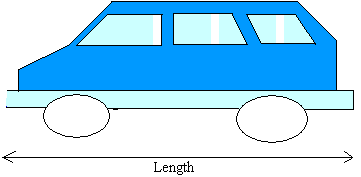
In real-life, the length of this van may measure 240 inches. However, the length of a copy or print paper that you could use to draw this van is a little bit less than 12 inches
Since 240/12 = 20, you will need about 20 sheets of copy paper to draw the length of the actual size of the van
In order to use just one sheet, you could then use 1 inch on your drawing to represent 20 inches on the real-life object
You can write this situation as 1:20 or 1/20 or 1 to 20
Notice that the first number always refers to the length of the drawing on paper and the second number refers to the length of real-life object.
Application of Scale Drawing in Solving Problems
In scale drawing the materials needed are pencil, ruler and set square. The drawings should be on plane sheets or white papers. The dimensions of the actual object should be written on the drawing and a title has to accompany it. However, a rough sketch must be drawn first.
Example:
1. A measurement of 8000m is drawn to a scale where 1cm represents 500m. Find its length on the drawing.
Solution:
500m is represented by 1cm.
1m is represented by 1500cm
8000m is represented by 8000×1500cm = 16cm
Length on drawing = 16cm.
2. The length of a chalkboard drawn to scale is 2cm. If the scale used is 1cm to 3cm, what is the actual length of the chalkboard?
Solution:
Scale = length of image length of actual object
Length of image = 2cm; scale = 13; let the actual length be x.
So, 13 = 2x
Cross multiplying, we have
X = 2cm x 3 = 6cm.
Therefore, actual length of the chalkboard is 6cm.
Example
Suppose a problem tells you that the length of a vehicle is drawn to scale. The scale of the drawing is 1:20
If the length of the drawing of the vehicle on paper is 12 inches, how long is the vehicle in real life?
Set up a proportion that will look like this:
Length of drawing/Real length = 1/20
Do a cross product by multiplying the numerator of one fraction by the denominator of the other fraction
We get :
Length of drawing × 20 = Real length × 1
Since length of drawing = 12, we get:
12 × 20 = Real length × 1
240 inches = Real length
Example
The scale drawing of this tree is 1:500
If the height of the tree on paper is 20 inches, what is the height of the tree in real life?
Set up a proportion like this:
Height of drawing/Real height = 1/500
Do a cross product by multiplying the numerator of one fraction by the denominator of the other fraction
We get :
Height of drawing × 500 = Real height × 1
Since height of drawing = 20, we get:
20 × 500 = Real length × 1
10000 inches = Real height