
Basic Operations with Binary
Mathematics J.S.S 3 First Term
Theme: Number and Numeration
Sub Theme: Whole Number
WEEK 2
Basic Operations with Binary
Performance Objectives
Students should be able to;
- Use a computer to do simple mathematical calculations
- Simplify Word problems
Arithmetic Operations on Binary
Content
Basic operations of addition, subtraction, multiplication and division are carried out in other bases exactly the same as base 10.
To add, subtract and multiply binary number, use the method that you use with base ten numbers. However, you must remember that you are working with powers of two, not powers of ten. The following identities are very useful:
Addition in Base two
To add in a binary number, the following steps are important:
- Arrange the numbers as in the addition of decimal numbers.
- Add the elements of the column starting with the rightmost column.
- Divide the sum by two.
- Record the remainder, which is either 0 or 1.
- Add the quotient to the sum of the next column and repeat the process for the next column.
NOTE:
0 + 0 = 0 1 + 0 = 1
0 + 1 = 1 1 + 1 = 10
Examples:
1. Add 111two to 11two
Solution:

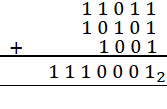
2. 110112 + 101012 + 10012
Solution:
3. 10012 + 10112
Solution
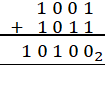
Note: 1st column: 1 + 1 = 10; write down 0, carry 1
2nd column: as above
3rd column: 1 + 0 + 0 = 1
4th column: 1 + 1 = 10; write down 0, carry 1
Subtraction in Base Two
Subtractions in binary numbers are the same as subtraction in denary numbers. When the digit of the number to be subtracted is larger than the corresponding digit above it, we transfer one 2 from the next left column. If the immediate next column has zero digits, the transfer will be from the further left column. The same principle is applicable to other bases other than base 2.
Examples:
1. Subtract 1012 from 1112
Solution:

2. 11102 - 1012

Note: 1 st column: 1 from 0’won’t go’. Move the 1 in the 2nd column to the 1st column: 10 – 1 = 1; write down 1
2nd column: the 1 has been removed, leaving 0; 0 – 0 = 0; write down 0
3rd column: 1 – 1 = 0; write down 0
4th column: 1 – 0 = 1; write down 1
3. Find the missing numbers in this subtraction in base 2.
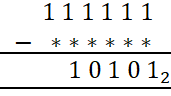
Solution:
We subtract 101012 from 1111112 to get the missing numbers.
Hence, 1111112 – 101012 = 1010102
Therefore, the missing numbers are 1010102
Multiplication in Base Two
Multiplication is repeated addition. This principle is always applied while multiplying binary numbers and other number bases. The important thing we must note is that if we are working in base two and other bases, all the figures we use in the working should be less than 2 or the number base under consideration.
Note
0 X 0 = 0 1 X 0 = 0
0 X 1 = 0 1 X 1 = 1
Examples:
1. Simplify 11012 x 1112
Solution:
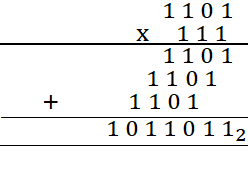
11012 × 1112 = 1011011two
2. Simplify 1111 x 111
Solution
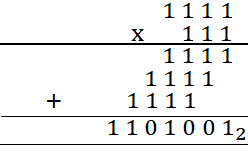
Note: Set out as in a normal long multiplication, multiplying by 1 or 0 as necessary. Take care of placing the digits. Add as explained in part a. All calculations may be checked by converting to base ten.
Division in Base Two
Division in base two is very similar to division in base ten. If the two numbers are in the same base, we divide using the long division method. However, if both numbers are not on the same base, we convert to base ten and then to the base required before solving.
Examples:
1. Divide 101002 by 1002
Solution:
Method 1:
Convert both numbers to base 10 and divide, then convert back to base 2.
101002 = 2010 and 1002 = 410
2010 ÷ 4010 = 510
510 = 1012
Method 2:
Long division.
∴ 101002 ÷ 1002 = 1012