
Whole Numbers 1
Mathematics J.S.S 3 First Term
Theme: Number and Numeration
Sub Theme: Whole Number
WEEK 1
Whole Numbers 1
Performance Objectives
Students should be able to;
- Use computer to do simple mathematical calculations
- Simplify Word problems
Number Base System
Content
Number Base is a system of counting natural numbers in bundles. Some languages have their own unique method or way of counting numbers while others have same method. For instance, numbers are counted in bundle of ten digits called base ten or denary. The digits involved in English natural numbers are: 0, 1, 2, 3, 4, 5, 6, 7, 8 and 9.
Most people count in tens. For instance, the place value of the digits in number 4956 in this system
Thousands hundreds tens units
↓ ↓ ↓ ↓
4 9 5 6
The place values are in powers of ten. It is called the base ten system.
4956 = 4 X 1000 + 9 X 100 + 5 X 10 + 6 X 1
= 4 X 10³ + 9 X 10² + 5 X 101 + 6 X 10
Some unique number bases include: Base 2 ( Binary), Base 8 (Octal), Base 10 (Denary or Decimal), Base 16 (Hexadecimal),… there are other bases such as base 3, base 4, base 5, base 6, etc. The bases of number systems are usually written as a subscript either in word or figure. Examples: 1110112 or 111011two, 57348 or 5734eight, 78110 or 781ten, etc.
Some people traditionally count in 5s, other in 20s. Using the method of the base ten system, a base five system is in powers of five. So, for example, in base five, 342 would be
342five = 3 X 25 + 4 X 5 + 2 X 1
= 3 X 52 + 4 X 51+ 2 X 50
Notice that 342five is short for 342 in base five.
NOTE;
Converting base ten numbers to other bases
- To convert from base ten to another base, express the given number in powers of the new base.
- Numbers in base ten can be written without the base indicated. Therefore any number base that is written without base indicated should be considered as denary or base ten numbers.
The Binary Number System
Binary numbers are a system of counting numbers in base two. In a binary system, the greatest digit is 1 and the least or lowest is 0. Hence, the two digits available in binary numbers are 1 and 0. Binary numbers are the most important number bases because of its usage in computer. Examples of binary numbers are 111112, 1000001two, 01012, etc.
Expressing Binary as Sum of Multiples
We can easily express any binary number as power of multiples of two as shown in the following examples;
- 10001tw0 = (1 × 24) + (0 × 23) + (0 × 22) + (0 × 21) + (1 × 20)
- 11112 = (1 × 23) + (1 × 22) + (1 × 21) + (1 × 20)
- 110two = (1 × 22) + (1 × 21) + (0 × 20)
Conversion of Binary Numbers to Decimal Numbers
To express binary numbers in decimals or denary, we write the binary number as a sum of multiples of powers of two, or we multiply each digit by the base and add to the next digit starting from the left.
NOTE: Any number or letter raised to the power of zero is 1
Examples;
- Convert 1111two to denary.
Solution
1111two = (1 × 23) + (1 × 22) + (1 × 21) + (1 × 20)
= 8 + 4 + 2 + 1
= 15ten
- Express 11101two as a decimal number
Solution
11101two = (1 × 24) + (1 × 23) + (1 × 22) + (0 × 21) + (1 × 20)
= 16 + 8 + 4 + 0 + 1
= 29ten
- Convert 1111110two to a number in base ten.
Solution
1111110two = (1 × 26) + (1 × 25) + (1 × 24) + (1 × 23) + (1 × 22) + (1 × 21) + (0 × 20)
= 64 + 32 + 16 + 8 + 4 + 2 + 0
= 126ten
Writing Numbers in Other Base or Conversion From Denary Numbers to Any Other Base
In converting a denary number to base two (binary) or any other base, we divide by that new base keeping the remainder in each step until there is nothing more to divide. The result is the list of remainders from the last to the first.
Examples:
- Convert 41ten to base five
- Convert 243ten to base eight
- Express 2610 as a binary number
Solutions:
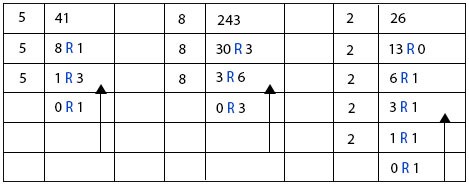
a. ∴ 41ten = 131five
b. ∴ 243ten = 363eight
c. ∴ 26ten = 11010two
Or
Convert 37ten a. to base eight, b. to base five.
a. Since 37 < 64, there are no sixty-fours in 37. To find the number of eights in 37, divide by 8.
37 ÷ 8 = 4, remainder 5
37 = 4 eights + 5 units
37ten = 45eight
Check: 45eight = 4 X 8 + 5 X 1
= 32 + 5
= 37
Since 37 > 25, there must be a twenty-five in 37.
37 ÷ 25 = 1, remainder 12
37 = 1 twenty - five + 12 units.
Consider the 12 units. Since 12 > 5, there must be some fives in 12.
12 ÷ 5 = 2, remainder 2
12 = 2 fives + 2 units
∴ 37 = 1 twenty-five + 2 fives + 2 units
= 1 x 52 + 2 X 51 + 2 X 1
37ten = 122five
Check: 122five = 1 X 25 + 2 X 5 + 2 X 1
= 25 + 10 + 2
= 37
The method in part b of Example 2 can be shortened as follows:
5 | 37
5 | 7 + 2 (i.e 7 X 5 + 2 X 1)
5 | 1 + 2 ( i.e. 1 X 52 + 2 X 51)
5 | 0 + 1 ( i.e. 0 X 53 + 1 X 5 2)
↑ ↑
Continued division by 5 gives remainders. Reading the remainders upwards gives 37ten = 122five
(see the arrows above).
To change from base ten to another base:
1. Divide the base ten number by the new base number.
2. Continue dividing until 0 (zero) is reached, writing down the remainder each time.
3. Start at the last remainder and read upwards to get the answer.
Converting in Other Bases to Base Ten, Base Two and Other Bases
To do this, two steps are involved:
Step 1: Convert the given base to base ten.
Step 2: Convert the result gotten from step1 above to the required base.
Example:
1. Convert 3041five to base four.
Solution:
First convert 3041five to base 10
3041five = (3 × 53) + (0 × 52) + (4 × 51) + (1 × 50)
= 375 + 0 + 20 + 1 = 395ten
Now, convert 395ten to base 4.
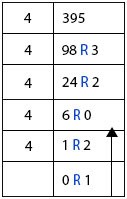
∴ 3041five = 395ten = 12023four
2. Convert 10111two to base 6.
Solution:
Step 1: We first convert 10111two to base ten.
10111two = (1 × 24) + (0 × 23) + (1 × 22) + (1 × 21) + (1 × 20)
= 16+ 0 + 4 + 2 + 1 = 23ten
Step 2: We now convert 23ten to base 6.
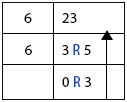
∴ 10111two = 23ten = 35six
Convert an Octal into a Decimal
This is a little bit of the same as before except our base is now 8 instead of 6.
1. Convert 7238 to base ten
Solution
7238 = (7 X 82) + (2 X 81) + (3 X 80)
= 448 + 16 + 3
= 46710
723 octal is 467 decimal. See, that’s not so tough. Now, the astute reader may have noticed another way this can be accomplished using the same information from the original formula.