
Factorization 1
Mathematics J.S.S 3 Second Term
Theme: Algebraic Process
Sub Theme: Algebraic Operation
WEEK 1
Factorization 1
Performance Objectives
Students should be able to;
- Factorize simple algebraic expressions
- Factorize quadratic algebraic expression using quadratic equation box
- Factorize completely
Word problems involving factorization
Content
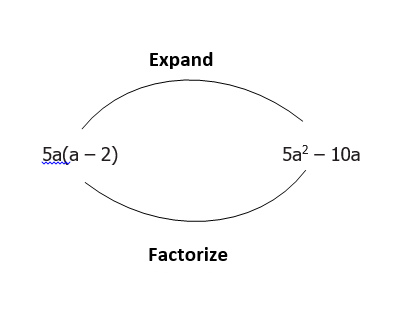
Factorizing an algebraic expression is the opposite process of expanding the brackets.
It works in exactly the same way as finding factors of numbers. When you expand the brackets, you multiply the terms outside the brackets with each of the terms inside the brackets to get one expression (which can have + and/or - symbols in it).
For instance, let’s expand 4y (2y + x).
We do this by multiplying both of the terms in the bracket by 4y:
= 8y2 + 4xy
So to go from: 4y (2y + x) to: 8y2 + 4xy is to expand. To go the other way is to factorize. We can now say that 4y and (2y + x) are factors of the expression 8y2 + 4xy. This process is called factorization because the equation is being expressed as the multiplication of a series of factors. For example, we can factorize the number 15 by expressing it as a multiple of its prime factors: 15 = 3 x 5.
To factorize an algebraic expression, we must determine the highest common factor (HCF) of the terms and insert grouping symbols, usually parentheses.
Worked Examples
- 5y + 15 = 5 × y + 5 × 3 (HCF is 5)
= 5(y + 3)
- 21x − 24y = 3 × 7x − 3 × 8y (HCF is 3)
= 3(7x − 8y) - 12ab + 18a = 6a × b + 6a × 3 (HCF is 6a)
= 6a(b + 3)
- 5x2 − 30x = 5x × x − 5x × 6 (HCF is 5x)
= 5x(x − 6) - −12x2 − 3x = −3x × 4x − 3x × 1 (HCF is −3x)
= −3x(4x + 1)
Factorization By Grouping
For some algebraic expressions, there may not be a factor common to every term. For example, there is no factor common to every term in the expression:
3x + 3 + mx + m
But the first two terms have a common factor of 3 and the remaining terms have a common factor of m. So:
3x + 3 + mx + m = 3(x + 1) + m(x + 1)
Now it can be seen that (x + 1) is a common factor for each term.
3(x + 1) + m(x + 1) = (x + 1)(3 + m)
Therefore:
3x + 3 + mx + m = (x + 1)(3 + m)
The original expression has been factorized by grouping the terms in pairs.
Examples
- 2x + 2y + ax + ay = 2(x + y) + a(x + y)
= (x + y)(2 + a)
- a2 + 3a + ax + 3x = a(a + 3) + x(a + 3)
= (a + 3)(a + x) - ax − bx + am − bm = x(a − b) + m(a − b)
= (a − b)(x + m)
- ab + b2 − a − b = b(a + b) − 1(a + b)
= (a + b)(b − 1) - 5x + 2y + xy + 10 = 5x + 10 + 2y + xy
= 5(x + 2) + y(2 + x)
= (x + 2)(5 + y)
Note: Terms had to be arranged to pair those with common factors
Factorising Using the Difference of Two Squares
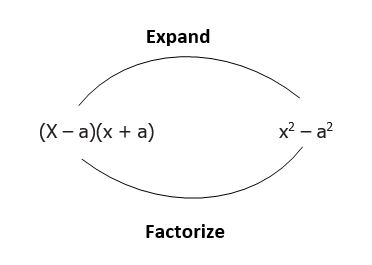
If the expression we want to factorize is the difference of two squares, we can simply reverse the procedure seen in section
Note:
(x − y)(x + y) = (x + y)(x − y)
x2 − y2 = (x − y)(x + y)
Examples
- x2 − 9 = x2 − 32
= (x − 3)(x + 3)
- 25a2 − b2 = (5a)2 − b2
= (5a − b)(5a + b) - a4 − 64 = (a2)2 − 82
= (a2 − 8)(a2 + 8)
- 36m2 − 49n2 = (6m)2 − (7n)2
= (6m − 7n)(6m + 7n)
Factorizing Quadratics Using Box method
A quadratic equation is a polynomial of the form ax2+ bx + c, where a, b, and c are constant values called coefficients. You may notice that the highest power of x in the equation above is x2. A quadratic equation in the form ax2 + bx + c can be rewritten as a product of two factors called the “factored form”. This form resembles (x + ?)(x + ?) and is useful in determining the x-intercepts of a parabola, the graph of a quadratic equation. Factoring a quadratic polynomial can be frustrating, but the techniques described below may provide some assistance.
The Simple Case (a = 1)
For the simple case, a = 1, you will find two numbers that multiply to equal c and add together to equal b. For example:
• Factor x2 + 5x + 6
We need to find factors of 6 (the c term) that add up to 5 (the b term). Since 6 can be written as the product of 2 and 3, and since 2 + 3 = 5, we'll use 2 and 3. This quadratic is formed from multiplying the two factors (x + 2)(x + 3).
• If c is positive, the signs of both factors are the same as the b term.
• If c is negative, the signs of both factors are opposites, and the largest factor is the same sign as the b term.
The Box Method can be used to factor quadratics, including the simple case, but it is very useful when a ! 1. Be sure to have the quadratic in its simplest form.
Example
• Factor 4x2 + 4x – 15
Solution
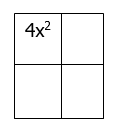
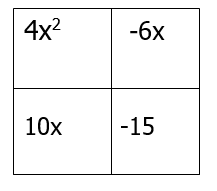
1) Make a box and divide it into 4 squares:

2) Put the 4x2 term in the top left corner
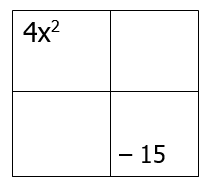
3) Put the c term in the bottom right corner:
4) Multiply both terms (ax2 and c) → generate a list of factors.
4x2 x -15 = -60x2 → ± 2x, ± 30x
3x, 20x
4x, 15x
5x, 12x
6x, 10x
5) Determine which sum or difference of these factors will give you the bx term:
bx = 4x → -6x+10x = 4x
6) Put these terms in the remaining boxes:
7) Factor out common terms to the outside of the box:
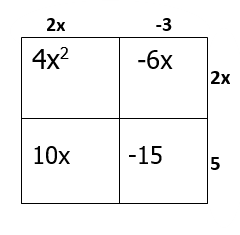
8) Read factors from the sides of the box:
(2x – 3) (2x + 5)
9) Double-check—each box will be a product of the outside terms.