
Demand and supply – Types of demand
Economics SSS 2 Second Term
WEEK 4
Demand and supply – Types of demand
Performance Objectives
Student should be able to:
- List and explain the types of demand.
- Differentiate between change in demand and change in quantity demanded
Content
Types of Demand
- Derived demand: This refers to when the demand for one commodity necessitates the demand for another commodity. For example, money is demanded because people need it to purchase other commodities.
- Joint or complementary demand: Two commodities are said to be complementary to each other as a change in the demand for one commodity will bring about a similar change in the demand for the other. Joint demand occurs when two commodities that are related to each other are demanded at the same time. Examples are car and petrol, stove and kerosene.
- Competitive demand: When two commodities are fairly close substitutes to each other, they are in competitive demand. In order words, they serve the same purpose or perform a similar function such that an increase in the demand for one will result in a fall in the demand for the other. Examples are Milo and Bournvita, butter and margarine.
- Composite demand: Demand is said to be composite when a commodity is required to serve two or more purposes. For example, sugar is widely used in the home for beverages as well as in industries for making pastries and confectionery.
Change in quantity demanded
A change in the quantity demanded of a commodity means a movement along the same demand curve. The cause of the changes in the quantity demanded is due to changes in the price of the commodity under consideration.
A change in quantity demanded is in two parts:
-
- Increase in the quantity demanded: This is also known as expansion of demand. It refers to an increase in the quantity demanded when the quantity purchased increases as a result of a decrease in the price of the commodity.
- The decrease in the quantity demanded: This is also known as contraction of demand. There is decrease or contraction in the quantity demanded if the quantity of the commodity purchased decreases as a result of an increase in price.
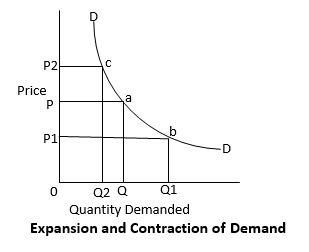
When the price changes from OP to OP1 and demand moves from OQ to OQ1, it shows the expansion of demand. However, the movement of price from OP to OP2 and the movement of demand from OQ to OQ2 show the contraction of demand
Shift or change in demand
There is a change or shift in demand when the curve shifts entirely to a new position. In this case, there is a completely new demand schedule and demand curve. A shift or change in demand is determined by other factors affecting demand except the price of the commodity.
A shift or change in demand is also in two parts:
- Increase in demand: When there is an increase in demand, the demand curve shifts to the right, indicating that if price remains unchanged, more of the commodity will be purchased. For example, if the income of the consumer increases, more of the commodity is likely to be purchased if the price remains unchanged.
In the diagram above, the movement from DD to D1D1 shows the increase in demand with price at constant (OP). However, the quantity has also increased from OQ to OQ1.
- Decrease in demand: When there is a decrease in demand, the demand curve will shift to the left, indicating that if the price remains unchanged, less of the commodity would be purchased. For example, if there is a change in the taste of a commodity, the demand for it will fall at the former price.
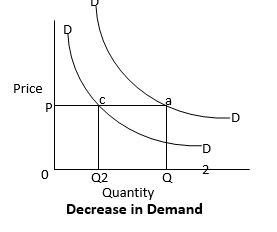
In the diagram above, the movement from DD to D2D2 shows the decrease in demand with price at constant (OP). However, the quantity has also decreased from OQ to OQ2.