
Market Structures II
Economics SSS 2 Second Term
WEEK 7
Market Structures II
Performance Objectives
Student should be able to:
- Draw graph to illustrate price and quantity determination under
- Perfect competition
- Monopoly market
- Oligopoly market
Content
PERFECT MARKET STRUCTURE
A perfect market structure also known as perfect competition is characterized by a very large number of buyers and seller of homogeneous products. Information is freely available to all market participants that each can act as a price taker; there is free entry and exit to the market. In reality, it is difficult to identify a perfect market; however, agricultural markets are examples of nearly perfect competition.
Assumptions and features of perfect competition
- All goods are homogeneous
- Information is available to all buyers and sellers, and no individual has control over the prices.
- Buyers and sellers want to maximize profit.
- Firms are free to enter and exit the market.
- There is no government intervention in the market.
Price and quantity determination under perfect market
In perfect competition, the price and quantity of a product is determined by the market forces of demand and supply i.e. a point at which the demand and supply curve intersect each other. Firms and industry should be in equilibrium at a price level in which quantity demand is equal to the quantity supplied. This point is known as equilibrium price and quantity. They make maximum profit if firm and industry are in equilibrium.
Price determination can be explained using the diagram below;
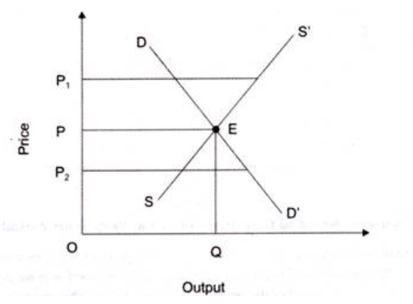
In the diagram, both the demand curve and supply curve are intersected at a point E. So, the point E is the equilibrium point. The price is fixed at OP. At OP, the demand and supply are equal to OQ. If the price rises from OP to OP1, the supply increases. At this price, supply exceeds the demand. Due to this, the price should be reduced and finally, the price comes to remain at OP. if the price is decreased from OP to OP2 then there will be excess demand as a result price again rise to OP.
IMPERFECT MARKET
An imperfect market is a competitive market situation where prices of goods and services can easily be influenced by the sellers or buyers. Alternatively, it is a competitive market situation where there are many sellers, but they sell heterogeneous goods and there is a lack of product information.
Conditions for imperfect market
The conditions necessary for the imperfect market are:
- There is no common price.
- There are few buyers and sellers
- The goods are not homogenous i.e they are not the same
- There is no perfect information.
- There is no free entry and exit.
- There use to be preferential treatment.
Imperfect market structure can be broken down into four types:
- Monopoly market: in the monopoly market a single firm represents the entire market with significant barriers to entry for other firms. The distinguishing characteristics of a monopoly are that the firm produces highly specialized products that no other firm can produce because of which there is no competition at all. There exist a barrier to exit and a barrier to entry in this kind of market.
Characteristics of monopoly market
- Single seller.
- Profit maximizer.
- Price maker.
- Price discrimination.
- Homogenous product.
- No entry of new seller.
Causes of monopoly
- Level of technology: when a firm has a high level of technology which makes him to produce at a low cost and therefore sells at a lower price than other firms in the market it can make other firms close down their operation.
- Natural cause: some firm may be located at a particular area where raw materials are available to them at a cheap rate which makes the cost of production lower than firms that not located near the raw materials
- Effective advertisement: the success of a firms advertisement may force competitors out of the market
Price and quantity determination under monopoly
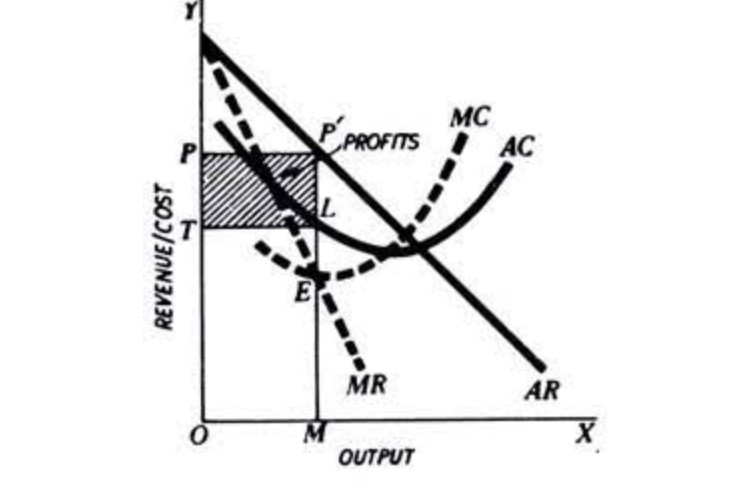
A firm under monopoly faces a downward-sloping demand curve or average revenue curve. Under monopoly, the MR curve lies below the AR curve. The equilibrium level in monopoly is the level of output in which marginal revenue equals marginal cost. The producer will continue to produce as long as marginal revenue exceeds the marginal cost. At the point where MR is equal to MC, the profit will be maximum and beyond this point, the producer will stop producing.
- Monopolistic competition: This refers to a situation in which many firms with slightly different products compete. In this type of market, firms offer products or services that are similar, but not perfect substitutes. The barriers to entry and exit are low and decisions of anyone firm do not directly affect those of its competitors. Production costs are above what may be achieved by perfectly competitive firms, but society benefits from the product differentiation.
- Oligopoly: This refers to an industry with only a few firms. It is a type of market structure with a small number of firms, none of which can keep the others from having significant influence. Firms in this type of market may collude to form a cartel to reduce output and drive up profits the way a monopoly does. A well-known example of oligopoly market is the organization of petroleum exporting countries (OPEC) where very few oil-producing countries meet and decide crude oil supply worldwide and hence indirectly control crude oil prices.
- Monopsony: This refers to a market structure in which a single buyer controls the market as the major purchase of goods and services offered by many sellers. In this type of market, buyers have significant control over the market and in some cases; prices are decided by the buyer rather than the sellers.