
Types and uses of different farm records I
Agricultural Science JSS 3 Second Term
WEEK 2
Types and uses of different farm records I
Performance Objectives
Student should be able to
1. List the types of farm records.
2. Explain the types of farm records.
Content
Types of farm records
Different types of farm records are kept depending on the size of the farm enterprise. Such farm records include:
1. Farm diary
2. Farm inventory
3. Input record
4. Production record
5. Consumption record
6. Sales record
7. Profit and loss account
Farm diary
A diary is a record of daily happening. A farm diary is a record of important day-to-day activities or events on the farm. Important events that happen in the farm such as the purchase of a tractor, purchase of bulldozer, disease out-break, inoculation of birds, pest and disease control, Introduction of day-old chicks, fertilizer application etc are recorded in the farm dairy. It is centred mainly on labour activities on the farm. An example of farm diary is given below.
|
Date |
Activities |
Labour |
Quantity |
Rate |
Remark |
|
10/04/08 |
Fertilizer application on yams |
10 labourers at N500/day |
10 bags of NP 15:15:15 |
One milk tin on a heap |
Finished work |
|
30/04/08 |
Weeding of maize plant |
control |
|
|
Observation Pest attack on maize plot |
Function of farm diary
1. The diary is a reference material showing activities completed and activities yet to be completed.
2. It shows when certain activities were carried out.
3. Forms the basis for planning of operations.
4. Indicate when subsequent activities may be done.
Farm inventory
An inventory is a record of all the resources owned by the farmer. This is a record containing all the assets of the farm. Items in farm inventory include land, machinery, economic trees, produce in storage, livestock, farm buildings and structures etc. The farmer lists the items and values them in monetary terms. Also, growing crops that were purchased are included in an inventory. Farm inventory is usually taken twice a year at the beginning of the farming season and the end of the year. As a farmer becomes more experienced, he may decide to take inventory once a year. An example of farm inventory is given below.
|
Items/Assets |
Quantity |
Date of purchase |
Value in naira |
|
Land |
2 |
10/12/2000 |
10,000.00 |
|
Growing maize |
3 hectares |
04/03/2011 |
15,000.00 |
|
Tractors |
2 |
02/01/2011 |
600,000.00 |
|
Dryer |
1 |
02/02/2011 |
15,000.00 |
|
Chemicals |
10 litres |
26/04/2012 |
10,000.00 |
|
Bags of rice |
2 |
06/05/2012 |
15,000.00 |
|
Bags of maize |
2 |
30/02012 |
5,000.00 |
|
Total |
|
|
760,000.00 |
Functions of farm inventory
1. Helps the farmer to know the worth of his farm at any given time.
2. Shows the total assets of the farmer at a glance.
3. Shows the farmer newly purchased capital assets and non-functional ones.
4. Gives the farmer an accurate record of the various farm assets and their quantities.
5. It also gives the farmer cash values of items produced on his farm.
Input records
These are records of items invested in the running of the farm. Items listed in an input record include seeds, seedlings, fertilizer, lime, crop protectant, feeds, day-old chicks and labour. An example of input record is given below.
|
Date used |
Input/quantity |
Value (N) |
|
02/06/12 |
100-day old broiler chicks |
30,000 |
|
02/06/12 |
20 bags of broiler starter mash |
14,000 |
|
16/06/12 |
10 bottles of dewormer |
1,000 |
|
19/06/12 |
20 bags of broiler finisher mash |
15,000 |
|
|
Total |
60,000 |
Functions of input record
1. Shows the farmer items used for production.
2. Shows the quantities of various production materials.
3. Shows the cost of production materials (past and present).
4. Enables the farmer to assess his profits and losses.
5. Gives the farmer at a glance the total expenses for production.
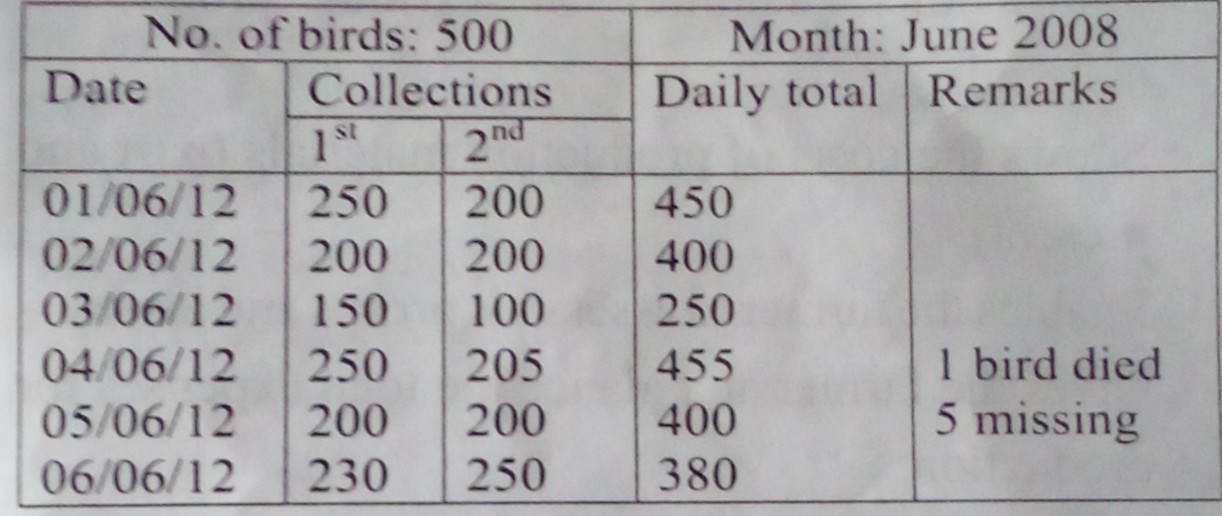
Production records
This is a record which shows everything that is produced on the farm and how the farm is run. This includes crops, livestock and products. A production record may be kept daily, weekly, fortnightly or monthly. An example of a production record is a daily egg collection. Below is a production record for June, 2008.