
Heat Energy
Physics SSS1 Second Term
WEEK 1
Heat Energy
Performance Objectives
Students should be able to:
- Explain the concept of Temperature
- Determine the change of state and expansion in solids, its consequences and application
Content
Knowing the difference between heat and temperature is important. It can lead to a clearer understanding of energy. Below is a picture of an ice cube melting in a small dish. The ice, water, dish, and are experience heat exchanges and temperature changes.
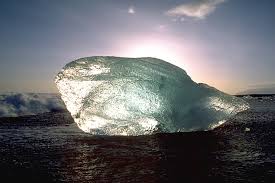
Often the concepts of heat and temperature are thought to be the same, but they are not.
Perhaps the reason the two are usually and incorrectly thought to be the same is that as human beings on Earth our everyday experience leads us to notice that when you add heat to something, say like putting a pot of water on the stove, then the temperature of that something goes up. More heat, more temperature-they must be the same, right? Turns out, though, this is not true.
Initial Definitions
Temperature is a number. That number is related to energy, but it is not energy itself.
Temperature is a number that is related to the average kinetic energy of the molecules of a substance.
Read that last sentence carefully. It does not say that temperature is kinetic energy, nor does it state exactly what is the relation between temperature and kinetic energy?
Here is the relation: If the temperature is measured in Kelvin degrees, then its value is directly proportional to the average kinetic energy of the molecules of a substance. Note that temperature is not energy; it is a number proportional to a type of energy.
Heat, on the other hand, is actual energy measured in Joules or other energy units. Heat is a measurement of some of the energy in a substance. When you add heat to a substance, you are adding energy to the substance. This added heat (energy) is usually expressed as an increase in the kinetic energies of the molecules of the substance. If the heat (energy) is used to change the state of the substance, say by melting it, then the added energy is used to break the bonds between the molecules rather than changing their kinetic energy.
So, the temperature is not energy. It is, though, a number that relates to a type of energy possessed by the molecules of a substance. Temperature directly relates to the kinetic energy of the molecules.
Temperature can be measured in a variety of units.
If you measure it in degrees Kelvin, then the temperature value is directly proportional to the average kinetic energy of the molecules in the substance.
Notice we did not say that temperature is the kinetic energy. We said it is a number, if in degrees Kelvin that is proportional to the average kinetic energy of the molecules of a substance. That means if you double the Kelvin temperature of a substance, you double the average kinetic energy of its molecules.
When the average kinetic energy of the molecules goes up (a rise in temperature), the average speed of the molecules increases. A change in average kinetic energy is not directly proportional to a change in average speed.
More about Heat
Heat is energy. When you add heat to a substance, you are adding energy.
When heat (energy) goes into a substance one of two things can happen:
1. The substance can experience a rise in temperature. The heat (the added energy) can be realized as an increase in the average kinetic energy of the molecules. The molecules now, on average, have more kinetic energy. This increase in average kinetic energy is registered as a number called temperature that changes proportionally with it. Note that this increase in the average kinetic energy of the molecules means that they will now, on average, be travelling faster than before the heat arrived.
2. The substance can change state. For example, if the substance is ice, it can melt into water. Perhaps surprisingly, this change does not cause a rise in temperature. At the exact moment before melting, the average kinetic energy of the ice molecules is the same as the average kinetic energy of the water molecules at the exact moment after melting. That is, the melting ice and the just melted water are at the same temperature. Although heat (energy) is absorbed by this change of state, the absorbed energy is not used to change the average kinetic energy of the molecules, and thus proportionally change the temperature. The energy is used to change the bonding between the molecules. Changing the manner in which the molecules bond to one another can require absorption of energy (heat) as in the case of melting, or require a release of energy (heat) as in the case of freezing.
So, when heat comes into a substance, energy comes into a substance. That energy can be used to increase the kinetic energy of the molecules, which means an increase in their temperature which means an increase in their speed. Or at certain temperatures, the added heat could be used to break the bonds between the molecules causing a change in state that is not accompanied by a change in temperature.
Changes of State/Changes of Phase
The term ‘change of phase’ means the same thing as the term ‘change of state’.
There are four stages, or phases, of matter. They are:
- Solid
- Liquid
- Gas
- Plasma
We will not be discussing the plasma state here.
When a substance changes from one state, or phase, of matter to another we say that it has undergone a change of state, or we say that it has undergone a change of phase.
These changes of phase always occur with a change of heart. Heat, which is energy, either comes into the material during a change of phase or heat comes out of the material during this change. However, although the heat content of the material changes, the temperature does not.
Here are the five changes of phase, listed below:
|
Description of Phase Change |
Term for Phase Change |
Heat Movement During Phase Change |
Temperature Change During Phase Change |
|
Solid to liquid |
Melting/Fusion |
Heat goes into the solid as it melts. |
None |
|
Liquid to solid |
Freezing |
Heat leaves the liquid as it freezes. |
None |
|
Liquid to gas |
Vaporization, which includes boiling and evaporation |
Heat goes into the liquid as it vaporizes. |
None |
|
Gas to liquid |
Condensation |
Heat leaves the gas as it condenses. |
None |
|
Solid to gas |
Sublimation |
Heat goes into the solid as it sublimates. |
None |
So, how could there be a change in heat during a state change without a change in temperature? During a change in state the heat energy is used to change the bonding between the molecules. In the case of melting, added energy is used to break the bonds between the molecules. In the case of freezing, energy is subtracted as the molecules bond to one another. These energy exchanges are not changes in kinetic energy. They are changes in bonding energy between the molecules.
If heat is coming into a substance during a phase change, then this energy is used to break the bonds between the molecules of the substance. Whenever ice melts into water, immediately after the molecular bonds in the ice are broken the molecules are moving at the same average speed as before, so their average kinetic energy remains the same, and, thus, their Kelvin temperature remains the same.
The molecule of ice and the molecule of water move with the same rate of vibration. This is meant to show that they have the same average speed and thus the same average kinetic energy (since they have the same mass) and thus the same Kelvin temperature. The motions are, though, greatly exaggerated. Actually, the motions of the molecules should be considered tiny vibrations.
In the ice the molecules are strongly bonded to one another, thus forming a rigid solid. When heat is added to the ice it melts, and these bonds are broken, the molecules afterward bond to one another with less strength, and water is formed.
Now, before the melting, the molecules were actually moving when in the solid-state. They were vibrating back and forth. They had average kinetic energy. So they had a Kelvin temperature proportional to this average kinetic energy.
After the melting the water molecules are moving, also. And they have the same average kinetic energy as they had before the melting. So, the water is at the same temperature the moment after the melting that the ice was at the moment before the melting.
Heat came into the situation, but it was not used to change the kinetic energy of the molecules. It was used to change the bonding between the molecules. Breaking the bonds between the molecules of the ice requires energy, and this energy is the added heat.
In a similar way, heat enters a liquid to change the molecular bonding when the liquid boils or evaporates into a gas, and heat enters a solid to change the molecular bonding when it sublimates into a gas.
In an inverse way, heat leaves a gas to change the molecular bonding when the gas condenses into a liquid, and heat leaves a liquid to change the molecular bonding when it freezes into a solid.
In none of these changes of state is the heat (energy) that is input or output used to change the speed of the molecules. The average speed of the molecules is the same before and after a phase change, and so is the average kinetic energy. And so, again, note that the temperature does not change during a change in phase, since it is proportional, in Kelvin degrees, to the average kinetic energy, which does not change.
Sources and Uses
We consume energy in dozens of forms. Yet virtually all of the energy we use originates in the power of the atom. Nuclear reactions energize stars, including our sun. The energy we capture for use on Earth comes largely from the sun or from nuclear forces local to our own planet.
Sunlight is by far the predominant source, and it contains a surprisingly large amount of energy. On average, even after passing through hundreds of kilometres of air on a clear day, solar radiation reaches Earth with more than enough energy in a single square meter to illuminate five 60-watt light bulbs if all the sunlight could be captured and converted to electricity.
The sun’s energy warms the planet’s surface, powering titanic transfers of heat and pressure in weather patterns and ocean currents. The resulting air currents drive wind turbines. Solar energy also evaporates water that falls as rain and builds up behind dams, where its motion is used to generate electricity via hydropower.
Most Americans, however, use solar energy in its secondhand form: fossil fuels. When sunlight strikes a plant, some of the energy is trapped through photosynthesis and is stored in chemical bonds as the plant grows. We can recover that energy months or years later by burning wood, which breaks the bonds and releases energy as heat and light. More often, though, we use the stored energy in the much more concentrated forms that result when organic matter, after millions of years of geological and chemical activity underground, turns into fossil fuels, such as coal, oil, or natural gas. Either way, we’re reclaiming the power of sunlight.
The only other original source of energy on Earth’s surface is found in more local nuclear reactions, where atoms of radioactive elements such as uranium split apart into smaller atoms and liberate energy in the process. Harnessed as heat, the released energy boils water, producing steam that turns turbines, thereby being converted to mechanical energy that generates electricity. Nuclear energy currently provides 20% of total electricity generation in the United States.
Finally, the heat of Earth’s molten interior, itself largely the result of the nuclear decay of radioactive elements, provides geothermal energy. At present, it is chiefly used in only a few places, such as California and Iceland, where proximity to high-temperature geothermal fields makes it practical.