Energy and society
Physics SSS3 Second Term
WEEK 1
Energy and society
Performance Objectives
Students should be able to;
- Identify dams for producing electricity in Nigeria
- Describe how electricity is produced from a dam
Users of machine
Content
Dams are physical barriers constructed across rivers and underground streams to trap the flowing water. A pool or reservoir of water is formed as a result.
Dams are erected for several purposes. The reservoirs of dams are used to store water. This water is used in the irrigation or dry agricultural land and distributed to areas with a Scarcity of water.
Dams are sometimes constructed to control flooding. Dams also help in the generation of hydroelectricity by harnessing the force of the flowing water.
A dam
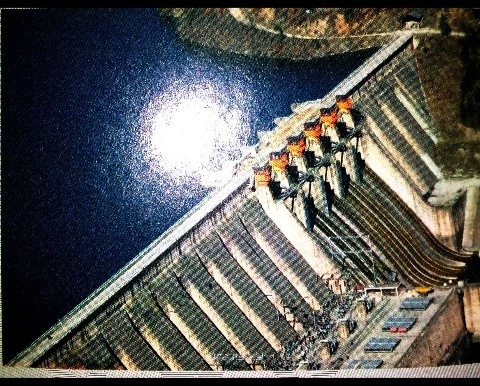
The dams in Nigeria serve different purposes. For example, the Kanji dam, Nigeria's oldést hydroelectric plant, across the Niger River generates electricity for large cities in Nigeria and for Niger. The Kainji Lake fomed by the dam supplies water to the surrounding regions and supports the wildlife in the kainji National park. Other dams in Nigeria include the Tiga Dam and the Jebba Dam.
Although dams have many uses, they can also have serious ecological and environmental consequences. The reservoirs formed by dams destroy terrestrial plant life and forests and cause the death and displacement of animals. Greenhouse gases are also produced by these dying plants. Dams have led to a loss of biodiversity by changing the flow and the course of rivers.
Production of electricity by dams
The process is based on the Principle of Conversion of Energy.
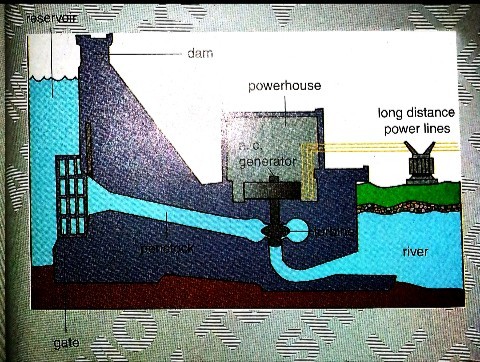
The gravitational potential energy of the stored water in dams is converted into the kinetic energy of the turbines in the dams.
These spinning turbines, in turn, transrer energy to a.c. generators. which then produce electricity.
The process of hydroelcctricity production can be broken down as follows:
(a) The dam stores a large quantity of water in its reservoir. This water possesses a great amount of gravitational potential energy due to its great height.
b) Near the base of the dam's wall, there is a gate. This gate opens into a passage known as the penstock, which leads the water to a turbine. Gravity causes the water in the reservoirs to fall through the penstock, and the high pressure causes the water to flow through the penstock at a very high speed. The turbine at the end of the penstock is rotated by the moving water.
(c) The turbine is connected to an a.c. generator by a shaft.
Electricity is produced when the coils in the a.c. generator are rotated.
(d) The water continues past the turbine into the river behind the dam.