
Nigerian satellites
Physics SSS3 Second Term
WEEK 2
Nigerian satellites
Performance Objectives
Students should be able to;
- Identify the component parts of rockets and satellites
- Describe the function of rockers and sat ellites
- State the uses of rockets and satellites.
Components of rockets
Content
A rocket is a vehicle that obtains its thrust by ejecting a stream of fast-moving fluid through its rear end. Rockets are used for various purposes such as for fireworks, as weapons and in space exploration. They are also used to launch artificial satellites into space.
The motion of a rocket is an application of Newton s Second and Third Laws of motion. We learnt that when the fuels in the combustion chamber of a rocket engine are mixed and burned, the high-pressure gases are ejected at high velocities through nozzles at the rear of the rocket. The action force involved in ejecting the gases from the rear causes a reaction force or thrust on the rocket, thus enabling the rocket to propel forward. Guidence system provídes stability for the rocket.
The diagram below shows a simplified diagram of the components of a rocket.
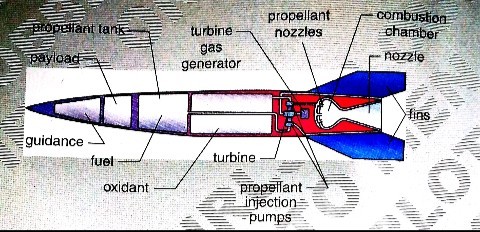
The following are thc basic components of rockcts:
(a) Propellant tank
(b) Combustion chamber
(c) Nozzle
(d) Fins
(e) Payload
Propellant tank
The propellant or fuel is stored in a propellant tank. This fuel (which can be a solid, liquid or gas) is released into the combustion chamber where it is ignited. The common fuels used are liquid- based mixtures of liquid oxygen or nitric acid and liquid hydrogen or kerosene. These fuel mixtures produce the largest volume of gases after the combustion reaction. The propellant tank and the stored fuel account for most of the rocket's mass. Therefore, the propellant tank is usually ejccted from the rocket after the fuel is completely consumed to lower the mass of the rocket-this happens within seconds of lift-off.
Combustion chamber
The fuel is burnt in the combustion chamber, and produces hot, expanded gases. Due to the high pressures and, temperatures created by the combustion reaction, the material used to construct the chamber is strong and has ieiting point.
Nozzle
The nozzle is an opening at one cnd of the combustion chamber for the expanded gases to escape after combustion. The nozzle is usually located at the rear end of the rocket, so that the force of the ejecting gases can propel the rocket forward.
Fins
The fins are located at the sides of a rocket to stabilise it and maintain its direction of motion.
Payload
As in the case of satellites, the payload of a rocket depends on its function. For example, in rockets that are used to launch satellites and nuclear warheads, these components are placed in the payload.