
Whole Numbers I
Mathematics J.S.S 2 First Term
Theme: Numbers & Numeration
Sub Theme: Whole Number
WEEK 1
Whole Numbers I
Performance Objectives
Students should be able to;
- Express any whole number in standard form
- Express decimal numbers in standard form
STANDARD FORM
Content
Standard form is a way of writing down very large or very small numbers easily. 103 = 1000, so 4 × 103 = 4000. So 4000 can be written as 4 × 10³. This idea can be used to write even larger numbers down easily in standard form.
Small numbers can also be written in standard form. However, instead of the index being positive (in the above example, the index was 3), it will be negative.
The rules when writing a number in standard form is that first you write down a number between 1 and 10, then you write × 10(to the power of a number).
Example 1
Write 81 900 000 000 000 in standard form: 81 900 000 000 000 = 8.19 × 10¹³
It’s 1013 because the decimal point has been moved 13 places to the left to get the number to be 8.19
Example 2
Write 0.000 0012 in standard form:
0.000 0012 = 1.2 × 10⁻⁶
It’s 10-6 because the decimal point has been moved 6 places to the right to get the number to be 1.2
On a calculator, you usually enter a number in standard form as follows: Type in the first number (the one between 1 and 10). Press EXP. Type in the power to which the 10 has risen.
Manipulation in Standard Form
This is best explained with an example:
Example 3
The number p written in standard form is 8 × 10⁵
The number q written in standard form is 5 × 10⁻²
Calculate p × q. Give your answer in standard form.
Multiply the two first bits of the numbers together and the two-second bits together:
8 × 5 × 105 × 10-2
= 40 × 103 (Remember 105 × 10-2 = 103)
The question asks for the answer in standard form, but this is not standard form because the first part (the 40) should be a number between 1 and 10.
= 4 × 10⁴
Calculate p ÷ q.
Give your answer in standard form.
This time, divide the two first bits of the standard forms. Divide the two-second bits. (8 ÷ 5) × (105 ÷ 10-2) = 1.6 × 10⁷
WHOLE NUMBERS IN STANDARD FORM
A number is said to be in standard form if it is expressed in the form of A × 10n. Where 1< A < 10 and n is an integer (positive or negative whole numbers). Standard form is very useful in the field of sciences and social sciences for easy presentations and analysis. Examples of numbers in standard form include: 4 × 10⁹, 5.8 × 10², 5.62 × 10⁴, etc.
NOTE: When expressing numbers in standard form, point are either carried from the left-hand side (LHS) or right-hand side (RHS) of it. While the point carried from the left-hand side turns negative the point from right-hand side turns positive.
Another very important thing to note is that when expressing either decimal number or whole number in standard form, points are carried until they are between the 1st and 2nd value.
Example 1; Express 263,000,000 in standard form.
Solution
The value above is a whole number so you carry point (imaginary) from (RHS) towards (LHS). Let’s do it!
= 2.63 × 10⁸.
Example 2; Express 0.0006927 in standard form.
Solution
The value above is a decimal number so points are carried from the left-hand side (LHS) – (RHS).
= 6.927 × 10⁻⁴.
Example 3; Express 34.694 in standard form.
Solution
Even though the value above is also a decimal number, points here will be carried from (RHS) – (LHS).
The result will be; 3.4694 × 101.
OR YOU USE THE MULTIPLE OF TEN METHOD
Examples 4:
1. Write the following in standard form:
(a) 90 000 000
(b) 6 000 000 000 000 000 000
(c) 34256.189
(d) 879.45
Solutions:
(a) 90 000 000 = 9 × 10 000 000 = 9 × 10 × 10 × 10 × 10 × 10 × 10 × 10 = 9 × 10⁷
(b) 6 × 1000 000 000 000 000 000 = 10 × 10 × 10 × 10 × 10 × 10 × 10 × 10 × 10 × 10 × 10 × 10 × 10 × 10 × 10 × 10 × 10 × 10 = 6 × 10¹⁸
(c) 34256.189 = 3.4256189 × 10 000 = 3.4256189 × 10⁴
(d) 879.45 = 8.7945 × 100 = 8.7945 10 × 10 = 8.7945 × 10²
ORDINARY FORM
Ordinary form is the opposite of standard form. When you are expressing numbers in ordinary form it means going the other way round to get your answer.
EXAMPLE 1
Express 3.4694 × 101 in ordinary form.
Solution
You are going to carry the point once from (LHS) – (RHS). Why? Because 10 is raised to the power of 1.
3.4694 × 101 = 34.694.
OR USING THE MULTIPLE OF TEN METHOD
EXAMPLE 2
Express each of the following in ordinary forms or full figures:
(a) 7.879 × 10⁵
(b) 6.209 × 10⁴
(c) 4.231 × 10⁶
SOLUTIONS:
(a) 7.879 × 105 = 7.879 × 10 × 10 × 10 × 10 × 10 = 7.879 × 100 000 = 787900
(b) 6.209 × 104 = 6.209 × 10 × 10 × 10 × 10 = 6.209 × 10 000 = 62090
(c) 4.231 × 106 = 4.231 × 10 × 10 × 10 × 10 × 10 × 10 = 4.231 × 1 000 000 = 42310000
DECIMAL NUMBERS IN STANDARD FORM
Decimal fractions can be expressed in standard form using negative powers of ten (10). This means that the values of when a decimal number is expressed in standard forms are negative. To do this, we move the decimal point to Right Hand Side (RHS) in tenth.
Examples:
1. Express each of these numbers in standard form.
(a) 0.0008
(b) 0.0000 000 7
Solutions:
(a) 0.0008=8÷10000 =  =
= 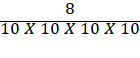 = 8×10⁻⁴
(b) 0.000007=7÷1000000=  =
= 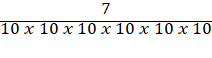 = 7×1O−6
2. Write the following as decimal fractions and standard forms:
(a) 16 thousandths
(b) 60 millionths
Solutions:
(a) 16 thousandths = 1 thousandth × 16 = 0.001 × 16 = 0.0016
In standard form: 0.0016 = 1.6 × 10⁻³
(b) 60 millionths = 1 millionth × 60 = 0.000001 × 60 = 6 × 10⁻⁵