
Whole Numbers II
Mathematics J.S.S 2 First Term
Theme: Numbers & Numeration
Sub Theme: Whole Number
WEEK 2
Whole Numbers II
Performance Objectives
Students should be able to;
- Find prime factors of numbers not greater than 200
- Express Numbers as product of its prime factors
Prime Factors of Numbers
Content
A prime number is a number divisible only by 1 and itself. Examples are 1, 2, 3, 5…e.t.c
Factors are the numbers you multiply together to get another number:
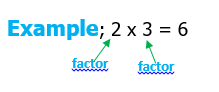
Prime factors of a number are the factors of that number which are not divisible by any other number except that number and 1. For example, the prime factors of 30 are 2,3 and 5 because out of all the factors of 30 (1,2,3,5,6,10,15 and 30), it is only 2,3 and 5 that are not divisible by any other number except themselves and 1.
Examples:
Write the factors of the following numbers and state the prime factors, hence express each number as a product of its prime factors.
(a) 22 (b) 50
Solutions:
(a) 22
Factors of 22 are 1, 2, 11, 22
The prime factors of 22 are 2 and 11
Product of its prime factors of 22 = 2 × 11
(b) Factors of 50 are 1, 2, 5, 10, 25 and 50
The prime factors of 50 are 2 and 5
Product of its prime factors of 50 = 2 × 5 × 5 = 2 × 52
Prime Factorization
Prime Factorization is finding which prime numbers multiply together to make the original number.
Here are some examples:
Example 1: What are the prime factors of 12?
It is best to start working from the smallest prime number, which is 2, so let’s check: 12 ÷ 2 = 6
Yes, it divided evenly by 2. We have taken the first step!
But 6 is not a prime number, so we need to go further. Let’s try 2 again: 6 ÷ 2 = 3
Yes, that worked also. And 3 is a prime number, so we have the answer: 12 = 2 × 2 × 3
As you can see, every factor is a prime number, so the answer must be right.
Note: 12 = 2 × 2 × 3 can also be written using exponents as 12 = 22 × 3
Example 2: What is the prime factorization of 147?
Can we divide 147 evenly by 2?
147 ÷ 2 = 73½
No it can’t. The answer should be a whole number, and 73½ is not.
Let’s try the next prime number, 3:
147 ÷ 3 = 49
That worked, now we try factoring 49, and find that 7 is the smallest prime number that works:
49 ÷ 7 = 7
And that is as far as we need to go, because all the factors are prime numbers.
147 = 3 × 7 × 7
(or 147 = 3 × 72 using exponents)
Example 3: What is the prime factorization of 17?
Hang on … 17 is a Prime Number.
So that is as far as we can go. 17 = 17
ANOTHER METHOD
It is by breaking down into any factors and then those factors down to prime.
Examples
Express 27 as a product of their prime factors in index form.
Solutions:
Divide each of the numbers by the prime factors in turns until it will not divide any further.
- 27
|
3 |
27 |
|
3 |
9 |
|
3 |
3 |
|
|
1 |
∴ 27 = 3 x 3 x 3 = 33