Wood work Hand Tools I
Basic Technology J.S.S 1 Third Term
WEEK 2
Woodwork Hand Tools I
Performance Objectives
Students should be able to:
- Define Wood Work hand tools
- Identify woodwork tools
- Measuring tools
- Setting and marking out tools
- Driving tools
- Boring tools, holding, cutting and paring tools
Content
Boring Tools
In machining, boring is the process of enlarging a hole that has already been drilled (or cast), by means of a single-point cutting tool (or of a boring head containing several such tools). Boring is used to achieve greater accuracy of the diameter of a hole, and can be used to cut a tapered hole. Boring can be viewed as the internal-diameter counterpart to turning, which cuts external diameters.
Boring tools are used to make holes in wooden materials. The wooden material is held firm with braces before the boring is done. Some examples of boring tools are wood brace, ratchet brace, bradawl, etc; some of the boring tools are discussed below.
(I.) The Ratchet Brace:
The Ratchet brace has four (4) parts which are:
- The Head: The head is made of hardwood and shaped to fit the hand of the user. It is screwed to a steel sleeve. It fits over the crank rod and runs on the hardened steel balls.
- The Crank: This is a rectangular bent metal rod. It fits into the hardwood or plastic handle.
- The Chuck: The end of the crank is enlarged, threaded and slotted to receive the socket and jaws respectively.
- The Ratchet: A ratchet is a tool fitted to the ratchet brace so that holes can be drilled (bored) at specific parts that are not really exposed, such as corners where it is impossible to make a complete turn.
Metal-Boring Tools
Metal boring tools are used in metalwork and art. Metal-working applications include drilling holes during car manufacture, precision cutting and roof installation. Some artists, searching for more ways to express themselves, make excellent sculptures and other works using different metals. They produce high-quality using metal-boring machines, including hand drills, drill presses and lathes. Almost all of these tools require external power sources.
The various types of boring tools are classified mostly according to their different functions.
- Post-Hole Tools
The clam-shell post-hole digger, a common tool, is useful for digging holes for fences, mailboxes and planting tasks. Augers, also used for boring holes in the ground, are available in gas-powered and vehicle-mounted types. These are usually used for industrial purposes or in cases where a large number of holes need to be dug.
- Carpentry Tools
Carpenters bore holes in wood when making or repairing furniture. One of the most common tools is the hand drill. A hammer and a nail may also be used, but it is easier to use a hand drill. Carpenters may also use chisels for boring tasks, especially when decorating furniture.
- Borehole Tools
These tools are used mostly to construct residential boreholes to help alleviate water shortages. They may also be used in remote areas and ranches, to provide water to surrounding areas.
Cutting Tools
In the context of machining, a cutting tool or cutter is any tool that is used to remove material from the workpiece by means of shear deformation. Cutting may be accomplished by single-point or multipoint tools. Cutting and paring of woods are regular operation in the woodwork workshop. Saws and planes are used in cutting and smoothing wood in the workshop.
Examples of cutting tools and paring tools are rip saw, cross-cut saw, tenon saw, bow saw, dovetail saw, jack plane, smoothing plane, spokeshave, chisels, etc. Saws. Saws are tools used for paring and cutting wood. There are two main groups of saw i.e. bench saw (hand saws) and curved saws.
- Bench Hand Saws:
- Rip saw is about 750mm long and is used to cut large pieces of timber into small sizes, it is used to cut along the grain of the wood.
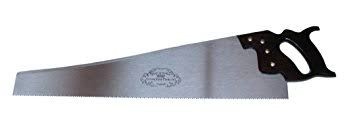
- Cross-cut saw is used for cutting across i.e. at right angles to the grain. It has smaller teeth compared to the rip saw and the length is between 350mm and 700mm. Each tooth is set to alternate with the preceding one.
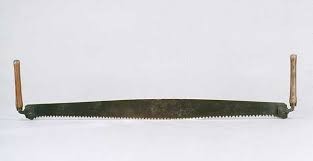
- Tenon saw is similar to the cross-cut saw but shorter with a length ranging from 200mm to 400mm. it is used for cutting shoulders to tenon and recesses inboard.
- Dovetail saw is also similar to tenon saw but is much shorter. Its length ranges from 150mm to 250mm; it is used for cutting fine joints and also light sawing, it usually has an open handle.
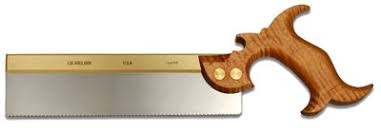
- Light backsaw has a thin small blade strengthened by aback. It is about 100mm to 200mm long and has only a plane round handle, used where extremely fine work is required such as dovetail for cutting of small moulding, etc.
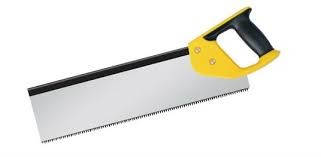
- Panel saw has pointed knife-like teeth similar to the cross-cut saw, but smaller. It is 450mm to 500mm long and used for sawing thin timber across 80 e.g. panels.
Curve-cutting Saws
- Coping saw is used for cutting cured marked lines on wood. The blade can be adjusted to cut in any direction. The wood must be 15mm thick.
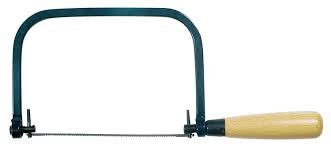
- Fret saw is used to cut curves in thin wood of 8mm thick or less. It is used to cut plywood.
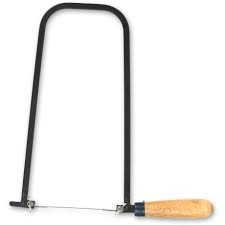
- Bow saw is also used to along curved marked lines but the wood has to be 50mm thick. The frames of the saw are in different sizes such as 200mm, 300mm, 350mm etc.
- Compass saw has a narrow tapering blade of 350mm to 450mm long. It has an open handle. The teeth are adapted for cross-cutting. It is used for cutting large interior and exterior curves.
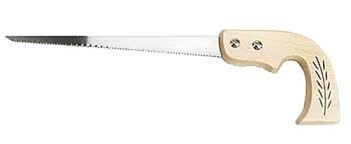
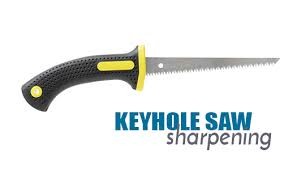
- Keyhole (pad) saw has a narrower blade than a compass saw. The blade is 6mm near the handle and 3mm at the tip. The length is 250-350mm and it has a round handle. It is used mainly for internal curves where the bow saw cannot be used.
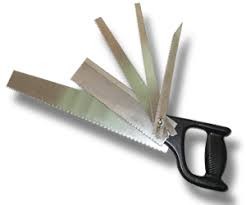
- Nest of saws consist of three serrated blades and a detachable open handle. The blades are pruning blade, compass blade and keyhole blade.
Driving tools
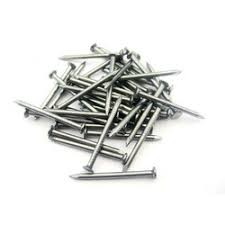
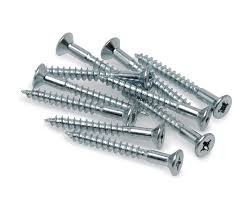
Driving tools include a variety of steel tools used to install, repair and maintain a variety of constructions. Drivers are used to drill, insert and drive screws, nuts and bolts into surfaces with mechanical and manual force. Tools defined as drivers include hammers, screwdrivers, mauls and sledges. Driving tools are used to fix nails and screws into wooden and metal materials. Nails are the iron material with the flat head and a stem with a sharp end. The stem is usually smooth. Screws look like nails but they have turned (twisted) stem. Screws are driven into wood with screwdrivers while nails are driven into wood and metals with the use of hammers.
Hammers
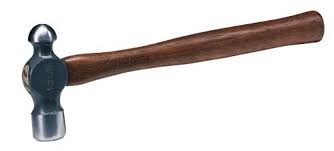
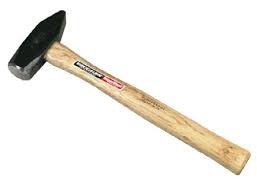
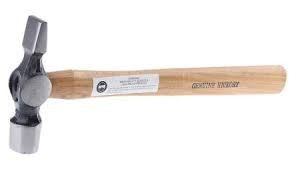
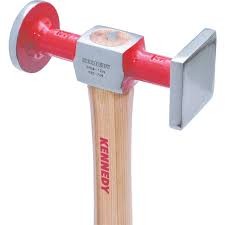
Hammers are driving tools that have two parts ahead which is made of iron and a handle, which is usually wooden. There are five types of hammers and their names are gotten from the type of head they have. These five are:
- Ball Peen hammer
- Straight Peen hammer
- Cross Peen hammer
- Planishing hammer
- Blocking head hammer
Uses of Hammer
- Straight peen hammer is also used for riveting in an awkward position. The other end is used for shaping sheet metals.
- Ball peen hammer is used for general purposes. The ball-peen section is used for riveting.
- Blocking head hammer has polished faces. It is used for shaping sheet metals.
- Cross peen hammer is used for drawing down and for riveting in an awkward position.
- Planishing hammer is generally used by panel beaters. It has a flat face and a convex face. It is used for finishing because the faces are well polished.
Holding Devices
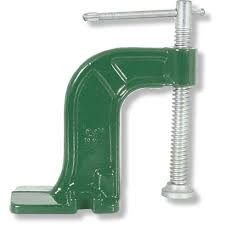
It is necessary that there should be a means of holding wood and metals firmly on a workbench or on a machine tool in order to have a successful operation on them. Examples of some holding devices are bench hook, bench vice, G-Clamp, sash clamp etc. The work holding devices to be considered here include vices and clamps.
Vices
- Bench Vice: Bench vice is used to hold wood and metal for filing, sawing, chiselling and tapping. They are fitted into the edge of the workbench by bolts and nuts. They have serrated jaws for proper gripping, the jaw is tightened by rotating the bar.
- Hand Vice: The hand vice is not fixed to anything as the bench vice, it is held by the hand. The workpiece is put in between the two arms of the vice and it is tightened by means of a screw.
- Machine Vice: The machine vice looks like a bench vice, it is however not fixed on the machine tool bed. It can be rotated for machining at any desired angle.
Cramps/Clamps
- Pliers: Pliers are work holding devices held in the hand of users. It is used for gripping and cutting wire and thin metal sheets. Pliers come in different forms, their forms give them their different names mentioned below:
- Longnose pliers
- Cutting pliers
- Gripping pliers
- Combination pliers
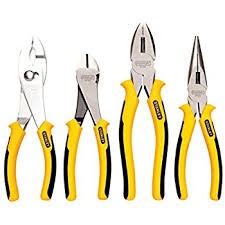
The handle of pliers used by an electrician is insulated with rubber to prevent electric shock.
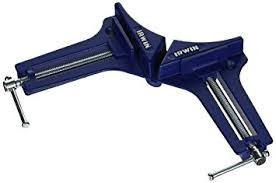
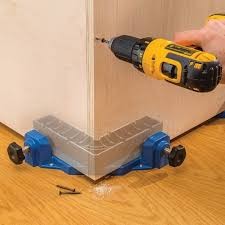
- Corner Clamp (Metre Clamp): This is used to hold workpiece at the right angle while glueing and pinning.
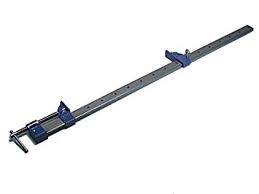
3. Sash Clamp: This is a large clamp used for holding and drawing parts of a workpiece together while glueing. It is also called T-Cramp.
4. Cramp: This is a metal clamp used for holding a workpiece while sawing or chiselling.
5. Bench Holdfast: This is also used to hold job firmly on the bench when moulding or rebating.
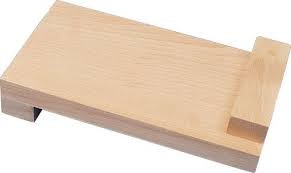
6. Bench Hook: This is another device used to hold a job to the bench while sawing or chiselling. It is also used to protect the bench.