
Living things 2
Theme Learning about the environment
Basic science J.S.S.2 First Term
WEEK 2
Living things 2
Performance Objectives
Student should be able to:
- Give examples of animals found in terrestrial and aquatic habitat.
- Explain the adaptive feature of living things in their habitat.
Content
Terrestrial and aquatic animals with examples
Terrestrial animals are animals that live predominantly or entirely on land (e.g., cats, ants, spiders, monkeys, lions, dogs, birds, elephants, giraffes etc.), as compared with aquatic animals, which live predominantly or entirely in the water (e.g., fish, lobsters, octopuses, whales, crabs etc.), or amphibians, which rely on a combination of aquatic and terrestrial habitats (e.g., frogs, or newts).
Adaptive features of living things in their habitat.
Living organisms are adapted to their environment. This means that the way they look, the way they behave, how they are built, or their way of life makes them suited to survive and reproduce in their habitats. For example, giraffes have very long necks so that they can eat tall vegetation, which other animals cannot reach. The eyes of cats are like slits. That makes it possible for the cat's eyes to adjust to both bright lights, when the slits are narrow, and to very dim light when the slits are wide open.
|
An adaptation is away an animal's body helps it survive, or live, in its environment. Camels have learned to adapt (or change) so that they can survive. |
Animals depend on their physical features to help them obtain food, keep safe, build homes, withstand weather, and attract mates. These physical features are called physical adaptations. They make it possible for the animal to live in a particular place and in a particular way.
Each adaptation has been produced by evolution. This means that the adaptations have developed over many generations.
Behaviour is also an important adaptation. Animals inherit many kinds of adaptive behaviour. In southern Africa, there are small animals called meerkats, which live in large colonies. The meerkats take turns standing on their hind legs, looking up at the sky to spot birds of prey. Meanwhile, the meerkats in the rest of the colony go about their lives. You can probably think of many other features of body or behaviour that help animals to lead a successful life.
Plant adaptations
Plants have adaptations to help them survive (live and grow) in different areas. Adaptations are special features that allow a plant or animal to live in a particular place or habitat. These adaptations might make it very difficult for the plant to survive in a different place. This explains why certain plants are found in one area, but not in another. For example, you wouldn't see a cactus living in the Arctic. Nor would you see lots of really tall trees living in grasslands.
Aquatic Plants
First, seaweed. This is an aquatic plant. It is adapted for underwater life. This plant has its own air bubble in each leaf that provides the necessary space for the exchange of oxygen from the water to the plant. It also helps keep the seaweed upright. The leaves of underwater aquatic plants are also softer then above-ground plants. This softness allows the plant to move easily with the waves without breaking.
|
|
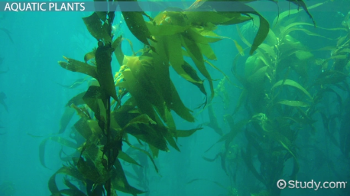
Seaweed
Desert Plants
Now, let's look at our cacti. These are plants adapted for the desert. There are many varieties of cacti. You will see that all of them have very thin leaves. In fact, they aren't called needles anymore; they are called thorns. Look at this barrel cactus and you will see its many leaves in the form of thorns all over its stem. The stem is very thick, and this is where the plant stores its water. Because water is scarce in the desert, the plant soaks up and stores whatever water it can when it rains and then uses its water reserve when there is no water.
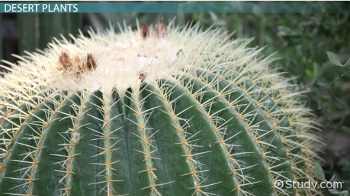
Barrel cactus
Carnivorous Plants
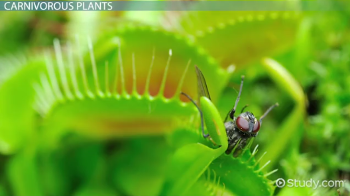
Next, we have the Venus flytrap. This plant is adapted for life in the soil with very little nutrients. This plant gets its nutrients from eating insects. Yes, this is a plant that actually eats! It is a type of carnivorous plant that has leaves that act as a mouth. The Venus fly trap's leaves look like a trap. It has little trigger hairs that, when the fly walks across it, make the leaf close, trapping the fly. The plant then secretes digestive juice that digests the fly for the plant.
|
Venus flytrap |
|
|
Adaptation of animals to their habitat
In Humans:
Long hours of exposure to the sun results in a tan. As the exposure to heat and UV rays increases, the melanocytes present in the skin ramp up the production of melanin.
This pigment helps to absorb the heat and protects the nucleus, thus protecting the DNA from mutation due to UV radiation. Hence, the process of tanning represents how our body adapts to the heat and UV radiation from the sun.
Example 2: In high-altitude environments, the human body signals an increase in the production of red blood cells. This is done to compensate for the relatively low-oxygen content in the air.
But this is not an instantaneous process, hence, people who are not acclimatized to the high altitude environment might feel a shortness of breath.
In Animals:
Animals living in extremely cold environments have thick fur and fat around their body to provide insulation. Pregnant polar bears bulk up on fat before the winter. This is an adaptation that helps them survive the harsh winter where food is very scarce.
Sometimes, adaption is often mistaken for evolution, though both are very different processes. Evolution brings about drastic changes that occur in the genetic level, whereas adaptation is a short-term process where the changes that occur are usually reversible.
Animal Adaptations in Deserts
The desert has extreme temperature fluctuations – searing heat during the day and sub-zero temperatures at night. It also has very limited water bodies and rain is rather scarce. But there are many animals that are well-adapted to life in the desert.
Camels, jackrabbits, foxes, snakes, insects are some of the predominant xerocoles or desert animals. However, these animals in the desert have to face many major challenges, from water conversation to avoiding excess heat.
Various Desert Animal Adaptations:
Conservation of water through reduced sweating
Camels are able to withstand ambient temperatures of 44℃ without sweating. Cold-blooded animals entirely lack sweat glands as they rely on the external environment to regulate body temperature.
Adaption to nocturnal life
The average day time temperatures in the desert often exceed more than 38°C. Nocturnal lifestyle helps to cut down the loss of water, especially in desert biomes. It also enhances osmoregulation. Some animals become active during twilight hours, i.e., during dawn and dusk. Such animals are called crepuscular animals.
Specialized Mode of Excretion
Birds and reptiles in the desert retain water as their metabolic wastes are excreted in the form of an insoluble white compound called uric acid. When compared to mammals, the metabolic wastes are excreted through urea, a considerably more soluble compound.
Other Sources of Water
Natural sources of water such as lakes and river are almost non-existent or are seasonal. So, animals derive water from desert plants such as cactus. Some insects also tap fluids such as saps and nectars from various parts of the plants.
Specialized Appendages
Animals like the jackrabbit have very large ears that have a network of blood vessels. When these animals rest in the shade, their enormous ears dissipate the excess heat from their bodies.
Animal Adaptations in Grassland
Grasslands are areas where the dominant vegetation is grasses. Grasslands are found throughout the world except for Antarctica. The largest grasslands are found in East Africa. One of the characteristic features of grasslands is its wide-open spaces.
This means the average speed of animals is much higher – for predators and prey. Therefore, it is no surprise that two of the fastest land animals in the world are found in grasslands – the cheetah (top speed: 113 km) and the pronghorn antelope (top speed: 98 km)
Few of the Grassland Animals Adaptations
Specialized Digestive systems
Animals that live in the grasslands like the bison have specialized teeth and digestive systems that help in breaking down the tough grass.
Camouflage
Predators that ambush their prey have skin colours that closely resemble their environment. This enables them to blend in and sneak up to their prey.
Feeding Habits
Grasslands near the equator have relatively high ambient temperatures. Hence, some herbivores such as antelopes graze at night, as this is when the vegetation has the most water content. The same can be said for some nocturnal predators too, as they can prevent unnecessary water loss.
Animal Adaptations in Tropical Rainforests
Tropical rainforests are generally hot and humid as it is located near the equator. The average temperature is higher than 15 °C even in the winter and crosses 40 °C in summer. Rainfall is also plenty, with average annual precipitation between 60 inches to 160 inches.
There are also extremes, with some places receiving over 400 inches annually. Tropical rainforests are found in India, Brazil, Central America. The largest tropical rainforests are found in the Amazon River Basin in South America.
Animal Adaptations in Polar Regions
The Polar Regions represent extreme weather conditions and inhospitable environments. Polar Regions include the north and south poles, countries such as Sweden, Iceland, Norway. These regions are usually covered in snow almost the entire year.
Average winters temperatures reach as low as -37 °C. Furthermore, the sun does not set for over 6 months and for the next 6 months; it does not rise at the poles.
Prominent Polar Region Animal Adaptations
Dense Fur:
This is an important adaptation as it protects the organisms from the extreme cold. Animals such as polar bears have fur even covering the soles of their feet. This prevents them from slipping on the ice.
Sometimes, the white colour of the fur helps to camouflage the animal against the background of the snow. This helps in predation or not becoming prey.
Blubber:
In some sea mammals such as whales and seals, a thick layer of fat covers the entire body, except for the fins and flippers. This layer provides insulation from the bitter cold and also aids in buoyancy.
They can also fall back on this fat as a food resource when there is no food available in the environment or during periods of inactivity (such as hibernation). Moreover, research has found that blubber is much more effective at retaining heat than fur.