
Hydrogen
CHEMISTRY SSS2 Second Term
WEEK 2
Hydrogen
Performance objectives
Students should be able to:
- Identify the isotopes of hydrogen and draw their electronic configuration.
- Explain the unique position of hydrogen in the periodic table.
- Explain the laboratory preparation of hydrogen.
- List two physical and chemical properties of hydrogen.
- List three uses of hydrogen.
Content
Hydrogen and its isotopes
Hydrogen (H), a colorless, odorless, tasteless, flammable gaseous substance that is the simplest member of the family of chemical elements. The hydrogen atom has a nucleus consisting of a proton bearing one unit of positive electrical charge; an electron, bearing one unit of negative electrical charge, is also associated with this nucleus. Under ordinary conditions, hydrogen gas is a loose aggregation of hydrogen molecules, each consisting of a pair of atoms, a diatomic molecule, H2. The earliest known important chemical property of hydrogen is that it burns with oxygen to form water, H2O; indeed, the name hydrogen is derived from Greek words meaning “maker of water.”
Although hydrogen is the most abundant element in the universe (three times as abundant as helium, the next most widely occurring element), it makes up only about 0.14 percent of Earth’s crust by weight. It occurs, however, in vast quantities as part of the water in oceans, ice packs, rivers, lakes, and the atmosphere. As part of innumerable carbon compounds, hydrogen is present in all animal and vegetable tissue and in petroleum. Even though it is often said that there are more known compounds of carbon than of any other element, the fact is that, since hydrogen is contained in almost all carbon compounds and also forms a multitude of compounds with all other elements (except some of the noble gases), it is possible that hydrogen compounds are more numerous.
Elementary hydrogen finds its principal industrial application in the manufacture of ammonia (a compound of hydrogen and nitrogen, NH3) and in the hydrogenation of carbon monoxide and organic compounds.
Unique position of hydrogen in the periodic table
Hydrogen is the first element of the periodic table as its atomic number is one, which means it has only one electron in its atom and thus only one electron is present in its outermost shell. The placement of elements in the periodic table is based on their electronic configuration. This structure is similar to that of alkali metals (ns1) which have 1 electron in their outer most shell. It can attain the noble gas configuration of helium, by accepting one electron. This character is very much similar to that of halogen family (ns2 np5) which are also short of one electron to complete the octet of electrons in their shells. When hydrogen loses an electron and forms a cation, it resembles alkali metals but when it gains an electron and becomes a uni-negative ion it shows similarity to halogens. Looking at these properties the position of hydrogen in the periodic table was a big question.
Moving on to the compound formation, hydrogen forms oxides, halides, and sulphides resembling the alkali metals, but unlike the alkali metals it has a very high ionization enthalpy, and so it lacks metallic characteristics under normal conditions. When we look in terms of ionization enthalpy, it is found that hydrogen resembles more to halogens than alkali metals. For example, ΔiH of lithium is 520 kJ mol-1, fluorine is 1680 kJ mol-1 and for hydrogen, it is 1312 kJ mol-1. It exists as a diatomic molecule like that of halogens (for example chlorine Cl2), there is a single hydrogen bond when H2 molecule is formed.
Though hydrogen shows a lot of resemblance to halogens and alkali metals, it is very different from both. So a great thought has to be given for the position of hydrogen in the periodic table. When hydrogen loses electron, the size of its nucleus decreases and becomes almost 1.5 × 10⁻³pm, which is very small as compared to the atomic sizes of normal metals, and hence hydrogen ion does not exist freely in nature. This unique behavior of this atom is the reason for it being placed separately in the periodic table.
What are the Isotopes of Hydrogen?
Three naturally existing isotopes of hydrogen are tritium, deuterium, and protium.
1. Protium ( 1H )
It is one of the common isotopes of hydrogen. It is plenty in nature with an abundance of 99.98%. One of the reasons for this is that the nucleus of this isotope consists of a single proton and this proton at no time; it has been reported to be decayed. Mass of protium is 1.007825 amu.
Deuterium ( 2H )
It comprises of 1 proton and 1 neutron in its nucleus. The nucleus of hydrogen 2 is termed as deuteron. It is not radioactive. Its compounds are used in chemical analysis and solvents for hydrogen 1. Heavy water is enriched with molecules consisting of deuterium instead of protium. It used as a coolant and a neutron moderator. Hydrogen 2 is also used as a fuel in nuclear fusion (commercial). It occurs naturally as deuterium gas.
Applications of Deuterium
- Drugs
- Nuclear weapons
- Contrast properties
- Tracing
NMR spectroscopy
Nuclear reactors and Nuclear Power Plants
3. Tritium ( 3H )
It comprises of 2 neutrons and 1 proton in its nucleus. Small traces of hydrogen 3 or tritium occurs in nature due to the synergy of cosmic rays with atmospheric gases. They are also released in a small amount at the time of nuclear weapons tests. It is radioactive; it decays into helium 3 through beta decay. Hydrogen 3 as an atomic mass of 3.0160492 u.
Applications of Tritium
- Controlled nuclear fusion
- Tritium in hydrogen bomb secondaries
- Boosting
- Neutron initiator
- Nuclear weapons
- Self-powered lighting
- Used as an oceanic transient tracer
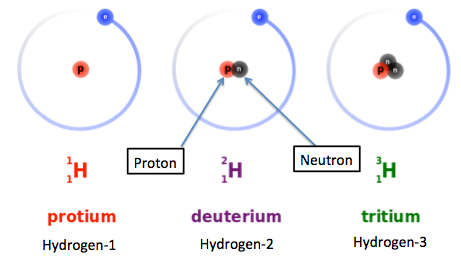
Isotopes of hydrogen
Laboratory preparation of hydrogen
Hydrogen is prepared in the laboratory by the action of the dilute hydrochloric acid or dilute sulphuric acid on granulated zinc.
Use of Granulated Zinc
Granulated zinc contains an impurity like copper which acts as a positive catalyst. A positive catalyst increases the rate of a chemical equation. This is the reason why granulated zinc is preferred over pure zinc for the laboratory preparation of hydrogen gas.
Reaction:
|
Metal + Dilute acid → Salt + Hydrogen
Zn + 2HCl → ZnCl2 + H2 ↑ Zn + H2SO4 → ZnSO4 + H2 ↑ |
Collection of Gas: Hydrogen gas is collected by downward displacement of water.

Laboratory preparation of hydrogen
Industrial preparation of hydrogen
Electrolysis of water
Water is a weak electrolyte. When an electrolyte (acid, base, or salt) is added to water, it conducts electricity. When an electric current is passed, water dissociates into positive and negative ions. Hydrogen is collected at cathode and oxygen at anode.
2H2O -----à 2H2 + O2
Advantage:
Hydrogen gas obtained by the electrolysis of water is 100% pure.
Disadvantage:
It is an expensive method due to electricity costs.
By thermal decomposition of ammonia
When liquid ammonia is vaporized and heated up to 1000C in the presence of a catalyst. It decomposes to produce nitrogen and hydrogen.
2NH3(g)---à N2(g) + 3H2(g)
Physical properties of hydrogen
Chemical properties of hydrogen
Combustion It burns with pale blue flame oxygen with to form water. 2H2 (g) + O2 (g) -----àH2O(l) Reaction with Nitrogen Hydrogen reacts with nitrogen to form ammonia. This process is also known as Bon Haber process 3H2 (g) + N2 (g)-----à NH3 (g) Reaction with metals Hydrogen reacts with metals like Ca, Na, Li, K to form hydrides of the metals Ca + H2 ------à CaH2 Metals like Pd, Pt, Ni, form interstitial hydrides by using up large volumes of hydrogen Reaction with metal oxide Hydrogen reduces oxides of less active metals to form corresponding metals Fe3O4 + 4H2 ------à 3Fe + 4H2O CuO + H2 -------à Cu + H2O
|
|
Uses of hydrogen
1.) It is used as a fuel.
2.) It is used for manufacturing of fertilizers.
3.) It is used as rocket fuel
4.) It is used in the preparation of ammonia and methanol
5.) It is used in filling weather balloons
6.) It is used to prepare low temperature in liquid state
7.) It is used to prepare tungsten filaments.