
Equilibrium
Further Mathematics S.S.S 3 Second Term
WEEK 1
Equilibrium
Performance Objectives
Students should be able to:
- Explain concept and importance of modeling;
- Distinguish between dependent and independent variables in modeling
- State examples of modeling
- Explain solutions of problems in modeling
Content
Translational Equilibrium
If a body remains at rest under the action of given forces, we say that the body is in a state of equilibrium.
From Newton's first law, if a force acts on a body, it changes its state of rest or uniform motion.
Although, not explicitly stated, two kinds of motion are implied in Newton's first law. The first type of motion is called Translation while the second type of motion is called Rotation.
So in effect, if a force acts on a body it changes its state of rest or translational motion or rotational motion.
In this unit, we shall deal with bodies which remain at rest under the action of forces which have the tendency to cause translation. This state of equilibrium is called Translational Equilibrium.
An immediate question is: Under what Conditions will a body have a translational equilibrium? This is what this unit is set to achieve.
First Condition of Equilibrium
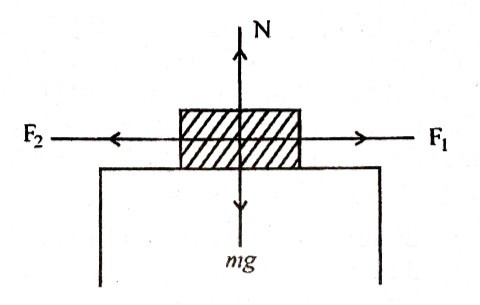
Consider a block placed on a table as shown above Forces F1 and F2 are applied to the block. We note that if F2 is greater than F1 the block moves to the left. If F1 is greater than F2 the block moves to the right.
If the magnitudes of F1 and F2 are equal, then the two forces balance each other. The block therefore remains in translational equilibrium.
If F1 = F2
Then, F1 + F2 = 0
Hence the sum of the horizontal components of the forces is equal to zero.
We also note that the upward force N balances the downward force mg on the block.
We write
N = -mg
N + mg = 0
Hence the sum of the vertical components of the forces is also equal to zero.
In general if R, EFx and EFy denote the resultant, the sum of the horizontal components of forces, the sum of the vertical components of forces respectively, acting on a body, then the body is in translational equilibrium if the following conditions are satisfied:
R = 0, EFx = 0 EFy =0
Example 1
An object P of mass 5kg is suspended by means of two light inextensible strings AP and BP. The strings AP and BP make respectively, angles of 30 and 60° with the downward vertical. The magnitudes of the tensions in AP and BP are respectively T1 and T2 Newtons.
(1) Express as vectors in component form all the forces acting on P
(2) Write down a vector equation connecting all the forces in (1) if P is at rest.
(3) Use the vector equation in (2) to calculate the values of T1 and T2, each correct to one decimal place. (Take g = 9.8ms-2) (WAEC)
Solution
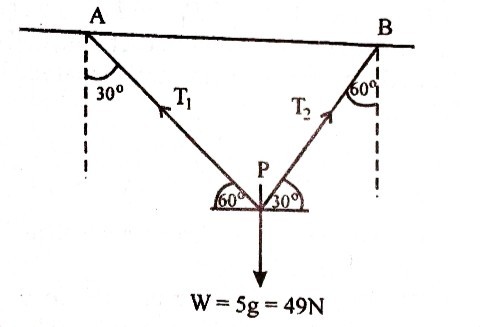



2. if P is at rest, then
T1 + T2 + W = 0
:. 
:. 

From 1. 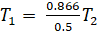
= 1.732T2 …(3)
Substituting the value of T1 in (3) and (2)
0.866(1.732T2 + 0.5T2 – 49 = 0
:. 2T2 – 49 = 0
:. 2T2 = 49
T2 = 49/2
= 24.5N
T1 = 1.734 x 24.5N
= 42.43N
= 42.4N
Example 2
A street lamp of mass 10kg is suspended at a position O by two wires OP and OQ across a road such that each wire is inclined at an angle of 80 to the upward vertical. If the system is in Equilibrium, calculate the tension in one of the two wires. (Take g = 10 ms-2) (WAEC)
Solution
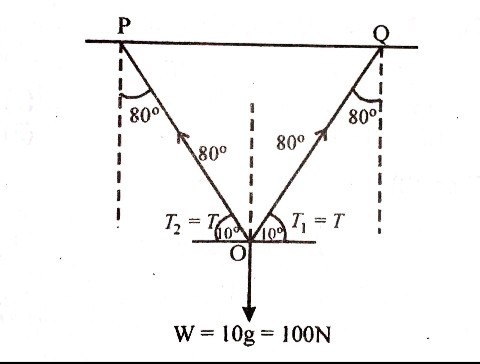


. 
Since the system is in equilibrium:

 ,
, 
Hence 2Tsin 10o - 100 = 0
2Tsin 10o = 100
T = 
= 
= 287.9N
Example 3
A body of weight 5ON is suspended by an inextensible string. The body is pulled aside by a horizontal force SN until the string makes an angle of 47° with the downward vertical. Find:
(1) Force S;
(2) Tension in the string. (WAEC)
Solution
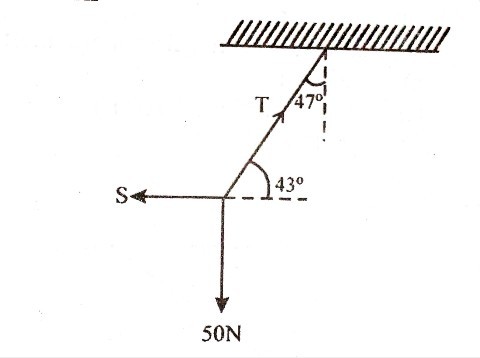


Since the system is in equilibrium:
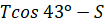 …………………………………………….…………….(1)
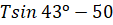 …………………………………………………………..(2)
From (2) 
= 73.31N
from (1) S =  = 73.31 X COS 43O
= 53.62N
Hence:
(1) The force S = 53.62N;
(2) The tension in the string = 73.31N
Triangle of Forces
You will recall that if a system is in equilibrium under the action of a given number of forces, then the resultant force is equal to zero. Let us consider three coplanar forces F1, F2 and F3 acting at a point O as shown below.
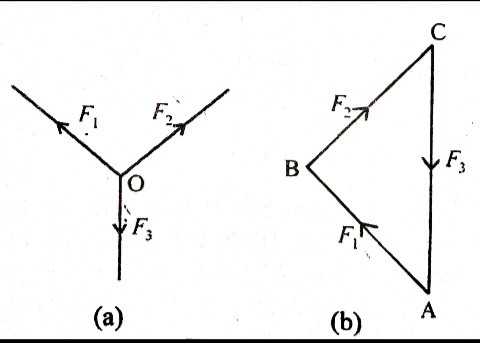
Triangle ABC represents the three coplanar forces. Hence if three coplanar forces act on a body in such a way that the system is in equilibrium, then the forces can be represented in magnitude and direction by the sides of a. triangle taken in order.
The triangle thus drawn representing the three coplanar forces is called a triangle of forces.
Problems involving three forces in equilibrium can be solved by the use of an appropriate triangle of forces.
Lami's Theorem
Lami's theorem provides an alternative method for dealing with problems involving three coplanar forces. The theorem states that if three coplanar forces acting at a point are in equilibrium, then each force is proportional to the sine of the angle between the lines of action of the other two forces.
Consider the coplanar forces F1, F2 and F3 acting at a point O as shown below
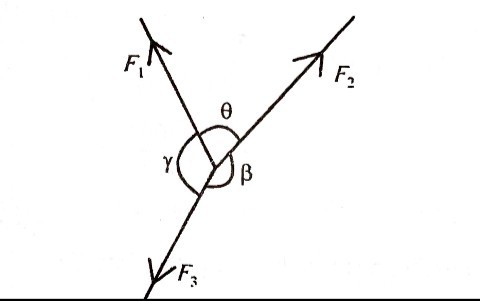
Let the angle between F1 and F2 be ɵ, and the angle between F1 and F2 be β, while the angle between F1 and F2 be y. By Lami's theorem



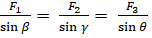 ……………………………………………………………………..(4)
Equation (4) above is very useful in solving problems relating to three forces in equilibrium.
Example 4
A body of mass 6.5kg is supported by two strings. One of the strings is inclined at an angle of 30° and the other 40° to the horizontal. Find the tension in each string, if the system is in Equilibrium. (Take g = 10 ms-2)
Solution
First method (Solution by Triangle of forces)
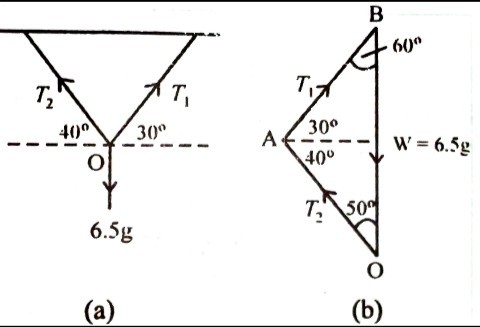
In ∆OAB as shown in the (B) diagram above
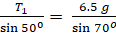
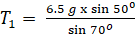

= 52.98N
Similarly
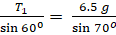
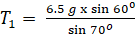


Second method (solution by Lami’s theorem)
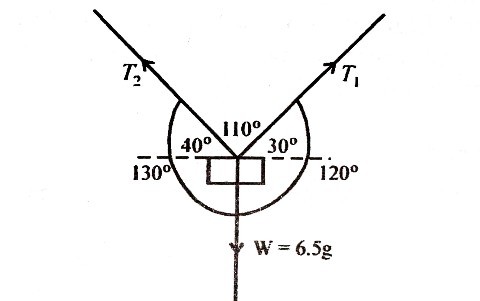
From Lami’s theorem
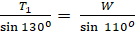
:. 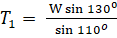
= 
= 52.98N
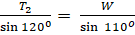
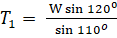
= 
= 59.9N
Third Method ( Solution by resolution into components)
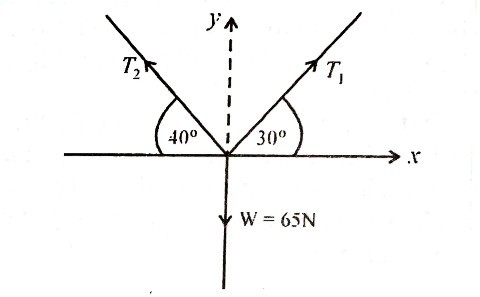


Since the system is equilibrium:
 and
and 
:.  ………… (1)
 = 0 ……..(2)
From (1)  =
= 
= 
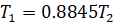 …………………………………………………..(3)
Substituting the value of T1 in (3) into (2)
(0.8845T2) sin 30o + T2 sin 40o – 65 = 0
0.4423T2 + 0.6428T2 – 65 = 0
1.085T2 = 0
:. T2 = 
T2 = 59.9N…………………………………………………………….(4)
Substituting the value of T2 in (4) into (3)
T1 = 0.8845 x 59.9
= 52.98N
Example 5
A body of weight 12N is supported by an inextensible string of negligible weight, inclined at an angle of 60° to the downward vertical and a horizontal force FN. Assuming that the system is in equilibrium, calculate:
(1) the magnitude of F;
(2) the tension in the string.
Solution
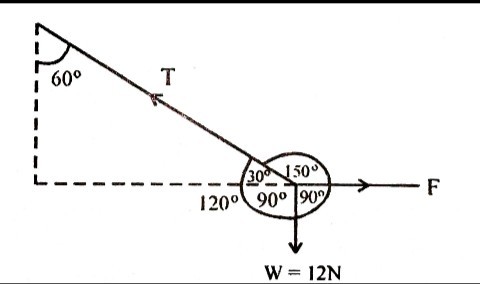
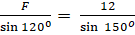
Using Lami’s Theorem

(1) :. 
F = 
= 
= 24 x 0.866
= 20.78N
(2) 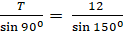
T = 
= 
= 24N
Polygon of Forces
The statement we made in Unit above about a system of three coplanar forces in equilibrium can be generalized for a system of forces that are more than three.
It is important here to emphasize that if three forces keep a body in equilibrium, then either the three forces are parallel to each other, or the three forces are concurrent.
If a system is in equilibrium under the action of three or more coplanar forces, then the forces can be represented in magnitude and direction by the sides of a polygon taken in order.
The polygon which is drawn to represent the system of forces is called a polygon of forces.
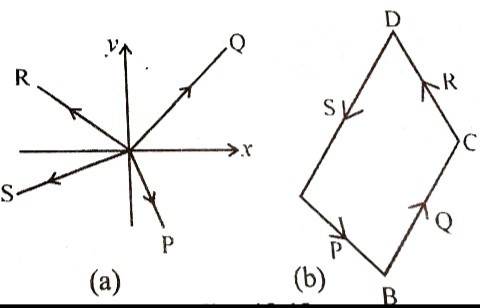
The second diagram above is a polygon of forces for the system of forces in the first diagram.
For any number of forces keeping a body in equilibrium, the first condition of equilibrium still holds. Thus if a body is in equilibrium under the action of any number of forces then:
EFx = 0, EFy = 0
Example 6
Five forces P, 2, 5, Q and 8 newtons acting on a body in the directions 060°, 045°, 000°, 300°and 180 respectively are in equilibrium. Calculate, correct to two decimal places, the values of |P| and |Q| (Adapted from WAEC)
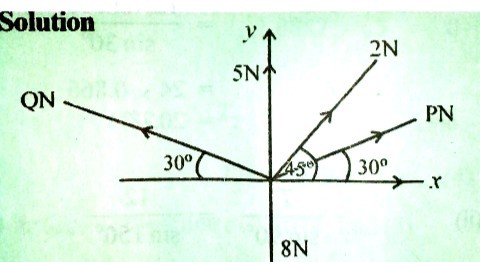

= 0.866P + 1.414 – 0.866Q

= 0.5P + 1.414 + 0.5Q - 3
Since the system is in equilibrium, we have:
 and
and 
Hence
0.866P – 0.866Q + 1.414 = 0 ……………….(1)
0.5P + 0.5Q – 1.586 = 0 ………………………..(2)
Multiply (1) by 0.5
0.443P – 0.433Q + 0.707 = 0 ……(3)
Multiply (2) by 0.866
0.443P + 0.433Q – 1.373 = 0……………(4)
Adding (3) from (4)
0.866Q – 0.666 = 0
:. P = 
= 0.7691N
P = 0.77N (2d.p)
Subtracting (3) from (4)
0.866Q – 2.08 = 0
:. 0.866Q = 2.06
= 
= 2.40N (2d.p)
Rotational Equilibrium
From Newton's first law of motion, we are aware that a force can cause a body to move in the direction in which the force is applied. This movement as we explained earlier can either be translational or rotational. The first condition of equilibrium as we have seen is the embodiment of a body's translational equilibrium.
In this section, we shall address ourselves to the turning effect of a force about a given axis.
Consider a flat sheet which is acted upon by two forces F1 and F2 in the opposite sense, as shown below about an axis through 0, perpendicular to the plane of the sheet.
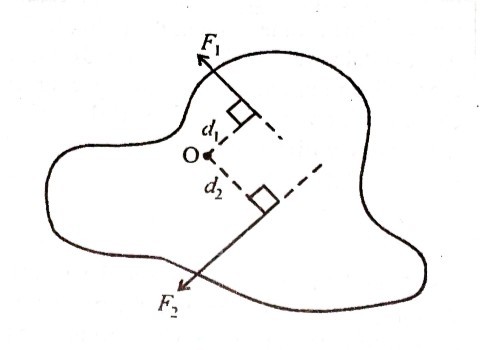
The force F1 has the tendency to rotate the flat sheet about the point O in the counter- clockwise sense while the force F2 has the tendency to rotate the body about the point O in the clockwise sense.
The turning effect of the force F1 depends on d1 which is the perpendicular distance between the axis through O and the line of action of the force F1. This perpendicular distance is usually called the force arm. The greater the force arm, the greater the turning effect of the force F1. Similarly, the turning effect of F2 depends on the force arm d2.
The turning effect of a force about an axis through a point is called the moment of a force about the given point. The moment of a force is at times referred to as a torque. Mathematically, the moment of a force about a reference point is defined as the product of the force and the force arm. From the diagram above, if we denote the magnitude of the moments of forces F1 and F2 about O by M1 and M2 respectively,
then:
|M1| = |F1| x d1 and |M2| = |F2| × d2
Moment of a force is a vector quantity and its unit is Nm.
When taking moments about a given point, we take into consideration, the direction or the sense of the moment about the point. In this wise, we talk of clockwise moment and counter- clockwise moment. By convention, counter- clockwise moments are considered to be positive moments while clockwise moments are considered to be negative about the given point.
Principle of Moments
Let R be the resultant of two coplanar forces F1 and F2. We shall consider the moments of each of the three forces about a point A in the plane of the three forces.
Let the moment of F1 about the point A be M1
Let the moment of F2 about the point A be M2
Let the moment of R about the point A be MR
Then it can be shown that:
M1 + M2 = MR
In other words, the sum of the moments of two coplanar forces about a point in the plane of the forces is equal to the moment of the resultant of the two forces about the same point.
The last mathematical statement:
M1 + M2 = MR can be extended to any number of coplanar forces. Hence, for any number of coplanar forces, the sum of their moments about a given point in the plane of the forces, is equal to the moment of their resultant about the given point.
We are aware that if a system of coplanar forces acting at a point are in equilibrium, then their resultant is zero. It follows immediately that if a system is in equilibrium under the action of any number of coplanar forces, then the sum of their moments about any point in the plane of the coplanar forces is zero. This is known as the principle of moments.
This principle can be restated in different forms. One form of the principle is that: If a system of coplanar forces are in equilibrium, then the sum of the clockwise moment is equal to the sum of the counter clockwise moments about the same point in the plane. If we denote the sum of all the moments at a point A by EMA then a body is in rotational equilibrium, if EMA = 0. EMA = 0 is the second condition of equilibrium. Hence the necessary and sufficient condition for a system to be in equilibrium is that EFx = 0, EFy = 0 and EMA = 0.
Where EFx, is the sum of all the horizontal components of the forces.
EFy is the sum of all the vertical components of the forces.
EMA is the sum of all the moments of forces about the point A in the plane of the forces.
Centre of Gravity
Everybody consists of particles which are attracted towards the Earth. These forces of attraction are parallel and are directed towards the centre of the Earth. For anybody, the forces can be represented by a single force called the resultant. For any uniform body, this resultant force has its line of action passing through a point in the body called its centre of gravity. For a uniform plank or rod, the centre of gravity passes through the midpoint of the plank or rod. We shall not go into the intricacies of finding the centres of gravity of bodies.
Couple
Two equal but opposite parallel forces constitute a couple.
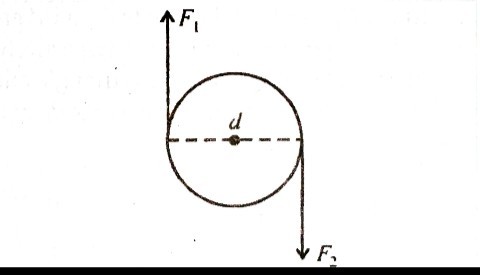
A couple has a tendency to rotate a body about the midpoint of the perpendicular distance between the two forces which constitute the couple. A couple however does not have the tendency to translate a body. Let s denote the moment of the couple, then:
Γ = F1 x d
= F2 x d
where d is the perpendicular distance between the two forces constituting the couple.
Example 7
A uniform plank AB is 10m long and has mass of 14kg. The plank rests on two supports at A and B. A load of mass 8kg is placed on the plank at a point C, 4m away from A. Calculate the reactions of the supports at A and B on the plank. (Take g= 9.8 ms-2)
Solution
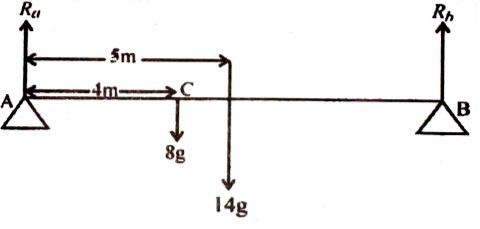
Let the reaction at A be Ra
Let the reaction at B be Rb
Note that the weight of the plank acts downward through the midpoint of the plank, since the plank is uniform.
Taking moments about the point A
Rb x 10 = 8g x 4 + 14g x 5
= 32g + 70g
= 102g
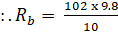
= 99.96N
Taking moments about the point B
Ra x 10 = 8g x 6 + 14g x 5
= 48g + 70g
= 118g
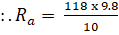 = 115.6N
Example 8
A see-saw consists of a uniform bar 4m long and of mass 2kg. A boy of weight 42N, sits at end A of the see-saw, while another boy of weight 38N sits at the end B of the see-saw. At what point must the see-saw be pivoted if it is to balance. (Take g = 9.8 ms-2)
Solution
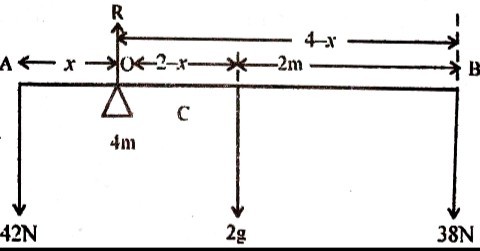
Since the boy with the greater weight sits at the point A, the pivot must be nearer to the point 4 than the point B.
Let the pivot be at a distance xm from A and let the reaction at the pivot be R.
We take moments about the point O
2g(2 - x)+ 38(4 - x) = 42x
2 x 9.8(2 - x) + 38(4 - x) = 42x
19.6(2 - x) + 38(4 - x) = 42x
39.2 - 19.6x + 152 - 38x = 42x
191.2 - 57.6x = 42x
191.2 = 42x + 57.6x
99.6x = 191.2
 = 1.92m
Hence the see-saw must be pivoted at a distance of 1.92m from A and 2.08m from B.
Example 9
A uniform ladder AB of length 6m and mass 40kg rests in a vertical plane with its end B on a smooth horizontal ground and the end A against a smooth vertical wall. A mass of 20kg is hung from a point on the ladder at a distance 2m from B. The ladder is kept in equilibrium by a rope perpendicular to the wall, attached at one end to the point B and the other end to a point C at the foot of the wall. If |BC|= 3m, calculate, correct to one decimal place, the magnitude of:
(1) the reaction of the ground;
(2) the tension in the rope (WAEC)
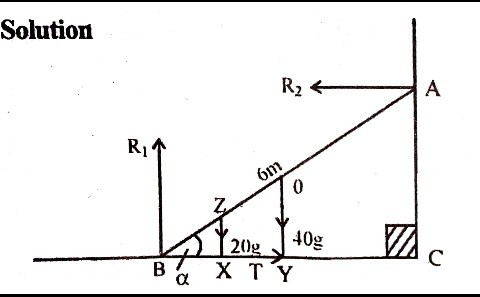
Since the ground and the wall are smooth, the reactions R1 and R2 at the points B and A are normal to the ground and to the wall respectively. Since ∆ABC is a right-angled triangle and BC = 3m while AB = 6m. if we let
Then;
Cos α =  = 0.5
= 0.5
:. α = 60o
From the diagram, BX = BZ cos 60o
= 2 cos 60o
= 1m
BY = BO cos 60o
= 3 x cos 60o
= 1.5m
AC = 6 sin 60o = 3
EFX = 0 and EFy = 0
T – R2 = 0 …………………………………………………………………………………………………………..(1)
R1 – 60g = 0……………………………………………………………………………..……(2)
Taking moments about the point B:
R2 x 3 - 20g x 1 – 40g x 1.5 = 0
5.19R2 – 196 – 588 = 0
:. 5.196R2 – 784 = 0
:. R2 = 784/5.196
= 150.9N
From Equation (2) R1 = 60g
= 588N
From Equation (1)
T = R2
= 150.9N
Hence:
(1) the reaction of the ground is 588N
(2) the tension in the rope is 150.9N