
Historical development of computer II
Computer Science JSS1 First Term
WEEK 2
Historical development of computer II
Performance Objectives
The student should be able to:
1. Name the mechanical counting and calculating devices.
Content
Mechanical Counting and Calculating Devices
As a result of the disadvantages of the early counting devices, more advanced mechanical counting and calculating devices were invented. Some of these devices are as follows:
1. The Abacus: The abacus was developed in China about 5000 years ago and it was early used for arithmetic tasks. The abacus is made up of beads threaded on iron rods. The iron rods are fixed to a rectangular wooden frame. It is used for addition and subtraction only as It could not carry out complex mathematics. It was successful that its use spread from China to many other countries.
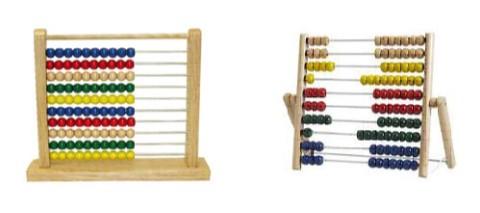
Picture showing up the abacus
2. Napier’s Bone: After the abacus, the next significant development was the Napier’s Bone made by John Napier in the year 1617. John Napier was a mathematician, physicist, and astronomer from Scotland. His most important achievement was the discovery of logarithms. He also made the use of the decimal point in arithmetic and mathematics common. Napier’s bone is a manually-operated calculating device for the calculation of products and quotients of numbers. Using the multiplication tables in the rods, multiplication can be reduced to addition and division to subtractions. More advanced use of the rods can even extract square roots. Napier’s bone is not the same as logarithms, with which Napier’s name is also associated. The complete device usually includes a baseboard with a rim; the user places Napier’s rods inside the rim to carry out multiplication or division. The board’s left edge is divided into 9 squares, holding the numbers 1 to 9. The Napier’s rod is made up of strips of wood, metal, or heavy cardboard. Napier’s bone is three-dimensional, square in cross-section, with four different rods embedded on each one.

Picture showing the Napier’s Bone
3. Slide Rule: The slide rule which is also called the slip-stick in the United States of America was invented around 1620-1630 shortly after John Napier’s publication of the concept of logarithms. It is a mechanical analog computer. The slide rule is used mostly for multiplication, division, and also for functions as roots, algorithms, and trigonometry, but is not normally used for addition or subtraction. Slide rules come in a different range of styles and generally appear in a straight or circular form with a standardized set of markings (scales) essential to performing mathematical operations. The use of slide rule continued to grow through the 1950s and 1960s even as digital computing devices were being gradually introduced.
