
Logarithm
Mathematics SSS 2 First Term
Theme: Numbers and Numeration
WEEK 2
Logarithm
Performance Objectives
Students should be able to;
- Calculate numbers less than 1 involving multiplication and division using log table
- Solve simple logarithm equations
Revision of Logarithm Numbers Greater than 1
Content
Logarithm of numbers is the power to which 10 is raised to give that number. Logarithms used in calculations are normally expressed in base 10.
Rules for the Use of Logarithms
- Multiplication: find the logarithms of the numbers and add them together
- Division: find the logarithm of each number. Then subtract the logarithm of the denominator from that of the numerator
- Powers: find the logarithm of the number and then multiply it by the power or the index
- Roots: find the logarithm of the number and then divide it by the root
Example 1: Evaluate using logarithm tables
19.28 × 2.987 × 195.8
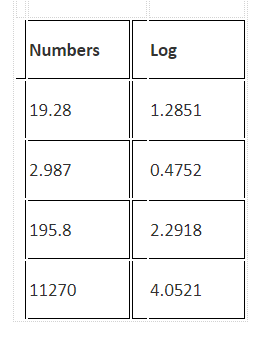
Example 2: Evaluate using logarithm tablesAntilog of 4.0521=11300 to 3 s.f.
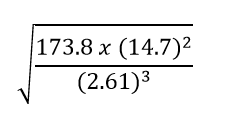
|
Numbers |
Log |
|||||
|
173.8 |
2.2400 |
2.2400 |
||||
|
(14.7)2 |
1.1673 × 2 |
+ 2.3346 |
||||
|
Numerator |
4.5746 |
4.5746 |
||||
|
(2.61)3 |
0.4166 × 3 |
1.2498 |
- 1.2498 |
|||
|
173.8 x (14.7)2(2.61)3 |
3.3248 |
|||||
|
173.8 x (14.7)2(2.61)3 |
|
3.3248 ÷ 2 |
||||
|
|
1.6624 |
|||||

∴ Antilog of 1.6624=45.96 (to 4 s.f.)
Logarithm of Numbers Less than One
To find the logarithms of numbers less than 1, (i.e. numbers between 0 and 1), we use negative powers of 10.
For example, 0.08356=8.356×10⁻² (standard form)
0.08356=100.9220×10⁻² (from log tables)
=10−2+0.9220
So Log0.08356=−2+0.9220
Characteristics (i.e. power) of 10=−2
Mantissa =0.9220
∴ −2+0.9220= 2 .9220
.9220
Note: −2 is called bar 2 i.e. 2
Example 1: Work out the following giving the answers in bar notation
(a) 4 .3 × 5
(b) 1 .6043 × 4
Solution
(a) 4.3 × 5 = (4 + 0.3)5 = 20 + 1.5 = 19.5
(b) 1.6043 × 4 = 1 + 0.6043x 44 + 2.4172 ⇒ 2 . 4172
Example 2: Work out the following giving the answers in bar notation
5 .806÷4
Solution
5.806 ÷ 4= 5 + 0.8064 = 8 + 3.8064=2 + 0.9515=2.9515
Multiplication
Example 1: (a) Evaluate, using logarithm tables 0.9807×0.007692
Solution:
0.9807 × 0.007692
|
Number |
Log |
|
|
0.9807 |
1 |
|
|
0.007692 |
+ 3 |
|
|
0.007543 |
3 |
∴ Antilog of 3 .8775=0.00754 (to 3 s.f.)
Division
(b) Evaluate the following using logarithm tables 0.00889 ÷ 204.6
|
Numbers |
Log |
|
|
0.00889 |
3 |
|
|
204.6 |
- 2.3109 |
|
|
0.00004345 |
5 |
∴ Antilog of 5.6380=0.0000435 (to 3 s.f.)
Powers
Note: In Logarithm, powers take multiplication while roots take division.
Example 2: (a) Evaluate (0.05872)4
|
Numbers |
Log |
|
|
0.05872 |
2 |
|
|
0.058724 |
2 |
|
|
0.00001188 |
5 |

∴ (0.05872)4 = 0.000012 (to 2 s.f.)
Roots
(b) 70.0004786
Solution:
|
Numbers |
Log |
|
|
0.0004786 |
4 |
|
|
70.0004786 |
4 |
|
|
7 |
||
|
1 |
||
|
0.3355 |
1 |

∴ 70.0004786 = 0.3355
Solution of Simple Logarithmic Equations
In this lesson, the equations have to be solved first, then tables used to evaluate
If log_ay = x logay=x
Then y = a^x y=ax
i.e 100 = 102 and log10100 = 2
Then log to the base 10 of 100 is 2. Logarithm can easily be in any base. For example since 64 = 43, then log4 64 = 3 ( the log to the base 4 of 64 is 3).
Example
Find x if logx 8 = 3
If logx 8 = 3, then x3 = 8
Therefore x = 2