MATRICES
Mathematics S.S.S 3 First Term
WEEK 1
MATRICES I
Performance Objectives
Student should be able to:
- Define matrix, identify matrix notation, identify different types of matrices.
- Perform the operation of addition and subtraction of matrices.
- Perform the scalar multiplication of 2
 2 and 3
 3 matrices.
Content
Matrix is a set of numbers arranged in rows and columns to form a rectangular array and enclosed within large brackets. These set of numbers enclosed within large brackets are called element or entries of the matrix.
The following are examples of matrices (plural of matrix)
 etc.
etc.
The matrix
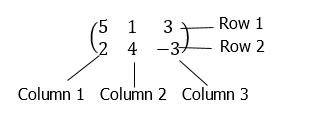
Has 2 rows and 3 columns, and it is said to have an order of (2 × 3) read as “2 by 3”. Also,
 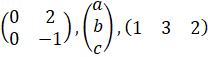 have orders (2
  2), (3
  1) and (1
  3) respectively.
In general, a matrix with m rows and n
 columns is said to have an order of m×n
 read as “m
 by n
by n ” matrix, hence in describing a matrix the number of rows is stated first before the number of columns.
A matrix is usually denoted by capital letter and the elements or entries are denoted by small letters. Each element has double suffixes which indicate the exact position of each element in the matrix e.g.

If 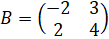 then
then  and
and 

Types of Matrix
- Row matrix: this is a matrix with only one row of elements e. g (1 4 6) which has an order 1 x 3.
- Column matrix: This is a matrix with only one column of elements e.g.
 which has an order 2
  1.
1. - Zero or null matrix: Any matrix whose elements are all zero is called a zero or null matrix e.g.
 .
. - A square matrix: This is a matrix with equal number of rows and columns e.g.
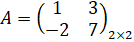 ,
, 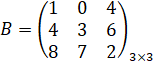 . The elements 1 and 7 in A and 1, 3 and 2 in B are said to be along the leading/main diagonal of the matrices. Square matrices have leading diagonals.
 - A diagonal matrix: This is a square matrix whose elements are all zeros except those along the leading diagonal e.g.
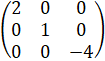
- Unit or identity matrix: This is a diagonal matrix whose elements in the leading diagonal are all unity (one) e.g.
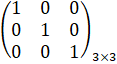 ,
, 
- Equal matrices: Two matrices are equal if they are of the same order and if they contain the same number of elements e.g. if
 and
and 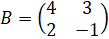
Then  implies that abcd=432-1 ∴ a=4, b=3, c=2
 and d=-1
Addition and Subtraction of Matrices
The sum or difference of two matrices a and b of the same order is a third matrix whose elements are obtained by adding or subtracting the corresponding elements.
Generally, if 
Then


Example 1: Let 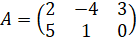 and
and 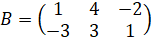 . Find
 ii.
ii.  iii.
iii. 
Solution:






Scalar Multiplication of Matrices
The product of a matric A and a scalar number say H
 is called the scalar product of the matrix A
 and the scalar H
 and is defined by the matrix HA
 i.e.
i.e.
If 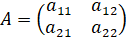 then
then 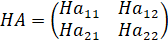 . Take for example the if given that
 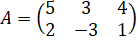 then
then 
Example 2: Let  and
and 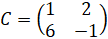 , find
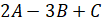 ii.
ii. 
Solution:





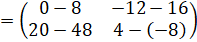
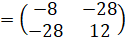
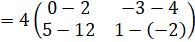
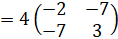
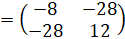
Note that ii. Can also be solved as follows