
Plane Shapes.
Mathematics for JS 1 3RD TERM.
Week1 and 2.
Theme: Mensuration and Geometry.
Plane Shapes.
Performance Objectives.
Student should be able to
- State the similarities and differences between
(a) Square and rectangle,
(b)Triangle and Trapezium,
(c) Parallelogram and circle.
- Find the area of plane shapes.
- Find the area of real-life objects.
Content.
Week 1.
Square and Rectangle.
Rectangle Square
Similarities.
- Both have 4 sides.
- They both have 4 angles.
- Each angle equals 90°.
- Sum of interior angles are the same.
Differences.
- All sides of a square are equal, in rectangle two opposites sides are equal.
- Rectangle has 2 lines of symmetry while a square has 4 lines of symmetry.
- In a square the diagonal bisects at right angle triangle, while in a rectangle the diagonals bisect at acute and obtuse angles.
Triangle and Trapezium.
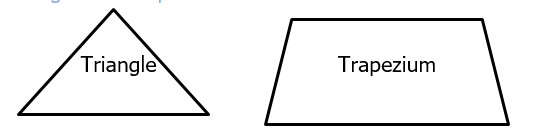
Similarities.
- Both have types called isosceles(opposite sides are equal).
- Both have base angles.
Differences.
- There are their types of triangle (equilateral triangles where all sides and angles are equal, Isosceles triangle where two base angles and opposite sides are equal, a scalene triangle where no side or angle is equal), while trapezium is of two types.
- Trapezium has parallel sides as bases and non-parallel leg.
- triangle has only one line of symmetry.
Parallelogram And Circle.
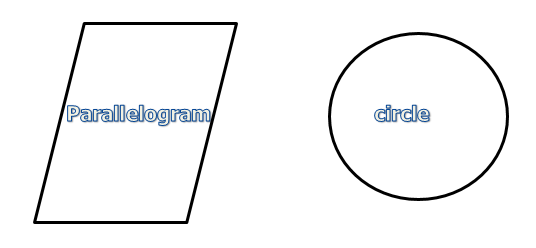
Similarities.
- The sum of interior angles are the same.
Differences.
- All sides of a parallelogram are parallel, while a circle has a round shape.
Area.
Area of plane shapes is a measure of the amount of surface surface it covers or occupies.
Area is measured in square units.
Example 1.Find the area of a rectangle of length 250cm and width 200cm.
Area of a rectangle =Lx B or(W)
(250 X200)cm2
=50,000cm2.
Example 2:Calculate the area of a parallelogram with the base 8cm and height 9cm
Area of parallelogram =base X height.
8cmX9cm
=72cm.
PERIOD 2.
Area of Triangles and trapezium.
Example1: Calculate the area of a triangle with base 5cm and height 4cm.
Area of a triangle =1/2 B x H.
=1/2X5X4
=2x5=10cm2.
Example 2: The parallel sides of trapezium of parallel sides 25cm and 35cm.If the area of the trapezium is 540cm2,find the distance between the parallel sides.
A=5(cm, h=?
Area of trapezium=1/2(a+b) xh
540=1/2(25+35)x h
540=1/2x60xh
540=30h
540/30=h
18cm=h.
Example 3: find the area of a circle with radius 12.5cm.
Area of a circle A=πr2
22÷7x12.5x12.5
=39.29cm2.