
Linear momentum I
Physics SSS2 Second Term
Sub Theme: Conservation Principle
WEEK 1
Linear momentum I
Performance Objectives
Students should be able to;
- Explain the concept of momentum and impulse.
- State and explain the meaning of each of Newton’s three laws of motion.
- Show graphically the relationship between produced by u given set of force acting on the same mass.
- State and explain the meaning of the law of conservation of linear momentum.
Newton’s First law of Motion, impulse and momentum
Content
The influence of unbalanced forces and the laws governing the motion are discussed in this topic.
Newton’s First Law of Motion
The first law states that every object continues in its state of rest or uniform motion in a straight line unless acted upon by an external force.
Inertia
It is the tendency of a body to remain in its state of rest or uniform linear motion. Newton’s law of motion is called law of inertia.
Applications of Newton’s First Law of Motion
1. When a moving vehicle is suddenly brought to rest by the application of the brakes, the passengers suddenly jerk forward as they tend to continue in their straight line motion. That is why it is advisable to use a safety belt.
2. A car driver in a stationary car hit by another car from behind is likely to suffer neck injuries because when the car is hit, his body is pushed forward, but his head stays still and is jerked backward in relation to his body. It is advisable to have a headrest to protect the driver and passengers from injury.
3. A moving body comes to rest due to opposing forces such as air resistance, friction or pull of gravity.
Momentum (p)
The momentum of a body is defined as the product of its mass and its velocity. The S.I unit is kgms-1 or Ns
P = mv
M = mass in kg, V = velocity in ms-1
Impulse
It is the product of the average force acting on a particle and the time during which it acts. It is numerically equal to change in momentum.
I = F × t, Ft = mv − mu.
mv is final momentum,
mu is initial momentum
The unit of impulse is Newton-second (Ns) or kgms – 1
Newton’s second law of motion:
The rate of change of momentum of a body is directly proportional to the applied force and takes place in the direction in which the force acts.
Force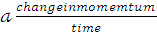
F 
F 
But  = ?
= ?
F ? m?,
f = km?,
if k = 1
f = ma
a is acceleration in ms-2
f is resultant force acting on the body and the unit is Newton.
Examples:
1. A net force of magnitude 0.6N acts on a body of mass 40g, initially at rest. Calculate the magnitude of the resulting acceleration.
Solution:
f = 0.6N, m = 40g = 0.04kg,
u = 0, a=?
f = ma
0.6 = 0.04 × ?
? = 0.6/0.04 =15ms−2
2. A ball of mass 5.0kg hits a smooth vertical wall normally with a speed of 2ms-1 and rebounds with the same speed. Determine the impulse experienced by the ball.
f=0.6N m=5.0kgu=2mls,
v=−2m/s (negative because of a change in direction)
Impulse = mv – mu
Impulse = 5(−2−2)
= 5 × (−4) = −20Ns
Newton’s Third Law of Motion
It states that Action and Reaction are equal and opposite. Or to every Action there is an equal and opposite Reaction.
Applications of Newton’s Third Law of Motion
1. Gun and bullet:
When a bullet is shot out of a gun the person firing it experiences the backwards recoil force of the gun. The recoil force of the gun (reaction) is equal to the propulsive force(action) acting on the bullet.
Force is proportional to change in momentum,
The momentum of bullet is equal and opposite to the momentum of gun.
mb – mass of bullet
vb – velocity of bullet
mg – mass of gun
vg – velocity of gun
mbvb = −mgvg
vg = 
2. Rocket and jet propulsion:
The momentum of the stream of hot gases issuing out of the nozzle behind the jet or rocket impacts an equal and opposite momentum to the rocket or aeroplane which undergoes a forward thrust.
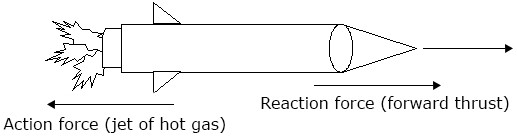
mr – mass of rocket
vr – velocity of rocket
mg – mass of hot gas
vg – velocity of hot gas
mrvr = −mgvg
vr= -
Newton’s Third Law of Motion
This states that when a body acts on another body with a force F, the second body acts on the first body with an equal amount of force but in the opposite direction.
That is, for every action, there is an equal but opposite reaction.
Applications of the Newton Third Law of Motion
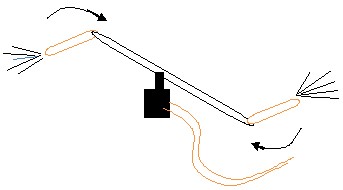
1. Garden sprinkler:
This has a Z-shaped tube mounted on a pivot and through which water flows into the tube. As water is forced out of the open end of the tube, the tube is pushed backward with a equal but opposite reaction. This way, the tube is able to spin round and round and water the field all around it.
2. Weightlessness or weight loss in a lift:
A person standing on a weighing machine in a lift descending with a certain acceleration will experience weight loss and if the downward acceleration of the lift is equal to the prevailing acceleration due to gravity at that location, the person becomes weightless and float around in the lift.
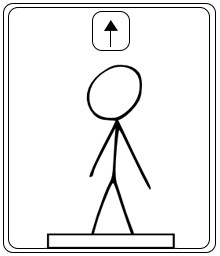
i. When the lift is ascending with acceleration a;
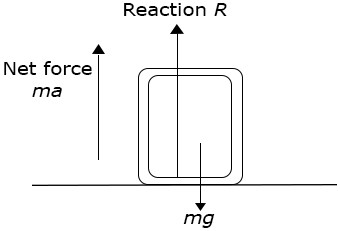
(Note: the value of R represents the reading on the weighing machine on which the person stands). In this case, the reading on the machine is greater than the usual weight W. The person will feel heavier as the lift ascends.
ii. When the lift is ascending but at constant velocity.
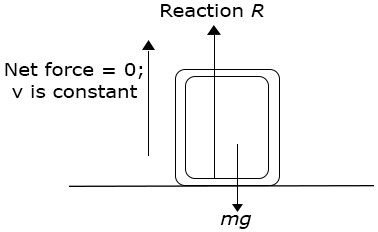
R – mg = Netforce
R – mg = 0
R = mg
(Note that in this case, the reading recorded on the weighing machine is the exact weight of the body at that location)
iii. When the lift is descending with acceleration a
Mg – R =m?
R = mg – m?
R = m(g − ?)
In this case, the person will feel lighter as the lift descend.
However, if the lift is descending with acceleration a = g
R = m(g − g)
R = m(0)
R = 0
In this case, the person will experience weightlessness (free fall). In fact, he will float around in the lift
Example 1
A tight rope walker of mass 60 kg stands in the middle of a rope and such that at his feet, the rope makes angle 50 to the horizontal. Calculate the tension in the rope.
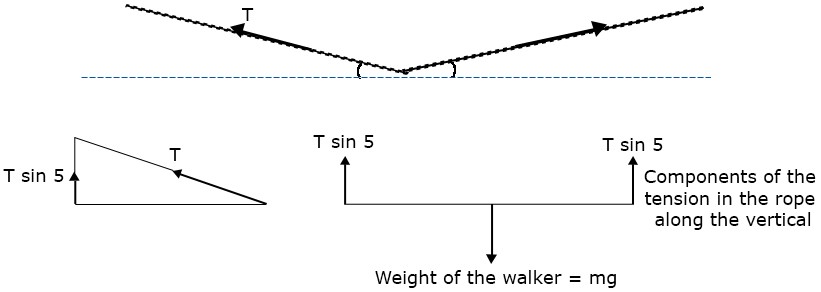
mg = Tsin5 + Tsin5
60 × 10 = T(2 × 0.087)
 = T
= T
T = 3448N
Example 2:
A brave but inadequate rugby player is being pushed backward by an opposing player who is exerting a force of 800 N on him. The mass of the losing player is 90.0 kg and he is accelerating at 1.2 m/s2. What is the force of friction between the losing player’s feet and the grass?
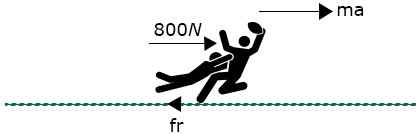
ma = 800 – fr
90 × 1.2 = 800 – fr
fr = 800 – 108
fr = 692N
Example 3:
A woman of mass 57 kg stands on a weighing machine inside a lift ascending at 0.2 m/s2. What is the reading on the machine?
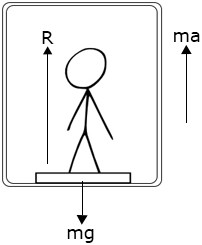
R – mg = ma
R = ma + mg
R = m(a + g)
R = 57(0.2 + 10)
R = 57 × 10.2
R = 581.4N