
Crop improvement
Agricultural Science S.S.S 3 First Term
WEEK 1
Crop improvement
Performance Objectives
Student should be able to:
1. Explain crop improvement.
2. State the aims of crop improvement.
Content
Meaning of crop improvement
Crop improvement can be described as the selection, breeding and development of new crop varieties which perform better than the existing varieties. The study of crop improvement is referred to as PLANT BREEDING. In-plant breeding, existing plants are scientifically modified which produce new strains, species and varieties that may meet the needs of man in his environment.
To achieve the above, the plant breeder first step in crop improvement is picking out high yielding individual plants which possess other desirable characters such as early maturing and pest or disease resistant. He also studies the nature of inheritance of crop plant and applies it to breed improved crop varieties. This is genetics which is the science of hereditary that enables plant breeders to transfer desirable traits from one plant to another thereby producing new crop varieties better than their parent crop plant. This improved crop varieties are further released for use by farmers.
Aims of crop improvement
The objectives of crop improvement can be summarized as follows:
1. To develop higher-yielding crops.
2. To produce crop with short gestation or early maturing crops.
3. To develop crops that are resistant to pests.
4. To develop crops resistant to diseases.
5. To produce crops that meet some specific growers/consumers requirements.
6. To produce crops that are adaptable to particular adverse conditions.
7. To improve the aesthetic value of produce.
8. To produce crops with some level of uniformity in growth habit.
9. To improve on the quality of crops.
Mendelian Laws (1958 - 1965)
Gregor Mendel was an Austrian monk who devoted a lot of his time to the scientific method of crop improvement. He carried out a lot of crosses using the garden peas. He is today known as the father of genetics because the present-day crosses is based on his findings.
There are two basic laws of Mendel namely; law of segregation and law of independent assortment.
I. Law of segregation: This states that from anyone parent, only one allele form of a gene is passed through a gamate to the offspring e.g a plant which has a gene for tallness (T) and also an allele for shortness (t) would transmit only one of these two alleles through a gamate to its offspring. That is, it will transmit either T or t. When this occurs, it means the two alleles are separating or segregating.
II. Law of independent assortment: This states that the segregating of one gene pair occurs independently of any other gene pair e.g the alleles for plant shape are located on one pair of chromosomes while the alleles for stem colour are located on another pair of chromosomes. It can also be looked at as the various characters belonging as a separate unit and are inherited different or the segregation of one gene pair occurs independently of any other gene pair.
The segregating of the plant shape (tall or short) alleles occur independently of the segregation of the stem colour (yellow and pink) alleles because each pair of similar chromosomes behave as independent unit during cell division.
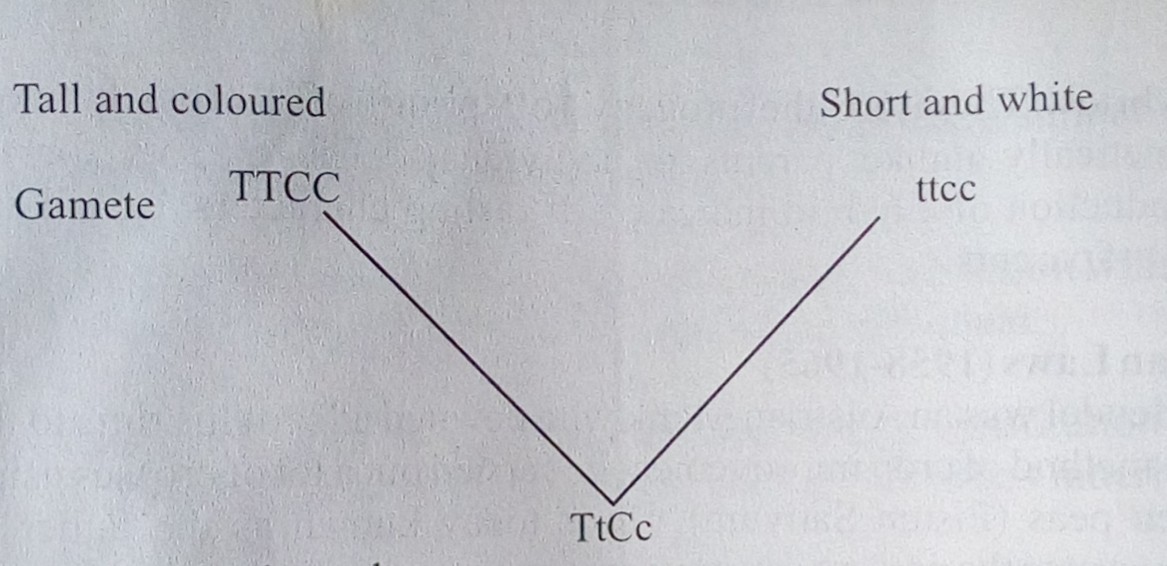
F1 = Tall and coloured
When the F1 was self-pollinated the ratio of 9:3:3:1 was obtained.
Thus, TtCc x TtCc
Gamate = TC Tc tC tc x TC Tc tC tc
Using Parson's square, we have the following possible phenotypes in a dihybrid law of inheritance.
Dihybrid cross
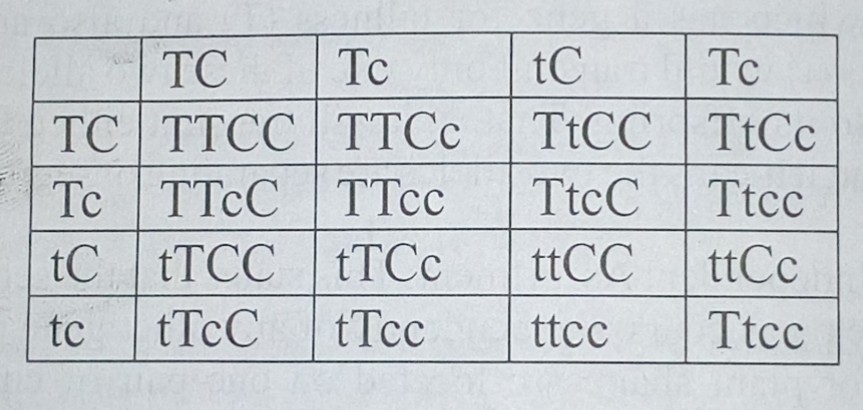
Tall and coloured plants = TTCC, TTcc, TtCC, TtCc = 9
Tall and white = TTcc, TtCc, tTcc = 3
Dwarf and coloured = ttCC, ttCc, ttcC = 3
Dwarf and white = ttcc = 1
The possible gamate in the F1 generation above are TC, TC, tC, tc.