
Carbon and its compounds
CHEMISTRY SSS1 Third Term
WEEK 2
Carbon and its compounds
Performance Objectives
The student should be able to:
- State the allotropes of carbon
- Explain the structures and properties of the allotropes of carbon
Content
Carbon
Carbon occurs naturally as diamond and graphite. It also occurs in an impure form as coal and in the combined state as carbon (iv) oxide, natural gas, petroleum, and wood. Other sources of carbon are mineral deposits of metallic trioxocarbonate (iv) such as calcium trioxocarbonate (iv) (limestone) and magnesium trioxocarbonate (iv) (dolomite). Carbon shows little tendency to acquire four electrons to form an anion or to lose four electrons to form a cation. Rather, it forms four covalent bonds.
The ability of carbon to form covalent bonds with other carbon atoms and atoms of other elements have made possible the vast number of stable carbon compounds exist. Carbon is also an essential constituent of all living things.
Allotropes of carbon
Allotropy is the property of some chemical elements to exist in two or more different forms.
Diamond, graphite and charcoal are three allotropes of pure carbon.
In all three allotropes, the carbon atoms are joined by strong covalent bonds, but in such different arrangements that the properties of the allotropes are very different.
Graphite
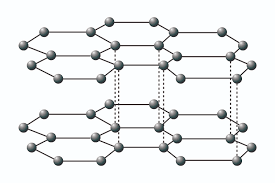
It is also a pure form of carbon. This allotrope of carbon is composed of flat two dimensional layers of carbon atoms which are arranged hexagonally. It is a soft, black, and slippery solid. This property of graphite persists because it cleaves easily between the layers.
In each layer, each C atom is linked to three C atoms via a C-C covalent bond. Each carbon here is sp2 hybridized. The fourth bond is formed as a pi bond. Since the π-electrons are delocalized, they are mobile and can conduct electricity.
Properties of Graphite:
- Since the layers are stacked over each other, this carbon allotrope can act as a lubricant.
- It also has metallic luster which helps in the conduction of electricity. It is a very good conductor of both heat and electricity
- One of the most important properties of graphite is that it is used as a dry lubricant for machines at high temperature where we cannot use oil.
- Graphite is used to make crucibles which have the property that they are inert to dilute acids as well as to alkalis.
Note: In comparison to diamond, Graphite is thermodynamically more stable.
. 
Structure of Carbon Allotrope (Graphite):
Graphite has a unique honeycomb layered structure. Each layer is composed of planar hexagonal rings of carbon atoms in which carbon-carbon bond length within the layer is 141.5 picometers.
Out of four carbon atoms three forms sigma bonds whereas the fourth carbon forms pi-bond. The layers in graphite are held together by Vander Waal forces.
Diamond
It is the purest crystalline allotrope of carbon. It has a number of carbons, linked together tetrahedrally. Each tetrahedral unit consists of carbon bonded to four carbon atoms which are in turn bonded to other carbons. This gives rise to an allotrope of carbon having a three-dimensional arrangement of C-atoms.
Each carbon is sp3 hybridized and forms covalent bonds with four other carbon atoms at the corners of the tetrahedral structure.
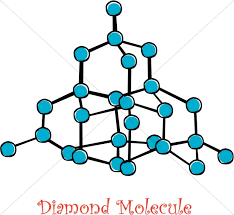
Structure of Diamond
Do you know why a Diamond is Hard?
It is hard because breaking a diamond crystal involves rupturing a large number of strong covalent bonds. Breaking covalent bonds is no easy task. This property makes this carbon allotrope the hardest element on earth.
Physical Properties of Diamond
- It is extremely hard
- It has a very high melting point
- It has a high relative density
- It is transparent to X-rays
- It has a high value of the refractive index
- It is a bad conductor of electricity
- It is a good conductor of heat
- It is insoluble in all solvents
With the exception of coal, which is mined from natural deposits, amorphous carbon are not considered as true allotropes of carbon, because the carbon atoms consist of minute crystals of graphite bound together by impurities. The other amorphous allotropic form of carbon include
Animal charcoal
This is produced by heating bones.in a limited supply of air.it contains a high percentage of calcium tetraoxophosphate (v) impurity. It has the property of absorbing color matter; hence, it is used in decolorizing crude sugar and petroleum jelly.
Wood charcoal
This is prepared by burning wood in a limited supply of air. It is fairly pure carbon because much of its impurities such as sulphur are driven out as gas or volatile liquids.it is a good absorbent hence, it is used in gas masks for absorbing poison. It is also used in the purification of noble gases and also as domestic fuels.
Sugar charcoal
This is formed when sugar is dehydrated either by burning the sugar in a limited supply of air or by the action of concentrated tetraoxsulphate (vi) acid
C6H12O6 ----à 6C + 6H2O
Sugar charcoal is the purest form of amorphous carbon.