
Systems of the body of farm animals.
Agricultural science SSS1 Second Term
Week 2
Systems of the body of farm animals.
Performance objectives
Students should be able to:
- Explain circulatory system of farm animals.
- Explain respiratory system of farm animals.
- Explain nervous system of farm animals.
Content
Circulatory System.
The circulatory system involves all the organs and tissues which are concerned with the movement of materials from one part of the body to another where they are either used or removed. These organs and tissues include the heart, the blood and blood vessels.
Composition of blood.
Blood is a fluid tissue. it is made up of two parts. the fluid plasma and the blood cells or corpuscles.
- Plasma:
This is the liquid portion of the blood . it is made up of water, blood protein like globulin, fibrinogen, prothrombin, dissolved mineral salts and other organic substances like hormones, enzymes, digested food and waste products within the body.
- The blood cells (corpuscles):
There are three blood cells or corpuscles. These are;
- Red blood cells(Erythrocytes)- these are biconcave and circular in shape, non-nucleated when matured. They are manufactured by the bone marrow and any excess is stored in the spleen. Erythrocytes contain an iron pigment called Haemoglobin which helps to transport oxygen.
- White blood cells (Leucocytes); they are irregular in shape, larger but fewer than red blood cells. They have a nucleus and are produced in the lymphatic tissues. The Phagocytic leukocytes attack and destroy foreign organisms in the body. In other words, white blood cells defend the body against foreign germs.
- The blood platelets (Thrombocytes):
They are irregular or star-shaped, tiny and non-nucleated. They are produced in the red bone marrow. The white blood cells are responsible for blood clotting.
Functions of the blood.
- It maintains body temperature by distributing heat during circulation.
- The red blood cells carry oxygen with the help of haemoglobin to different parts of the body.
- It transports hormones from ductless glands to their areas of activities.
- It transports waste products like carbon dioxide, mineral salts, urea, water to where they are removed.
- Leucocytes help to defend the body against germs.
- It helps in blood clotting with the aid of platelets.
- It also helps to transport digested food to the cells.
- It also helps to maintain the water level of the body.
The heart
The heart is the most powerful organ in the circulatory system. It helps to pump blood around the body. Each pumping action of the heart is known as a heartbeat.
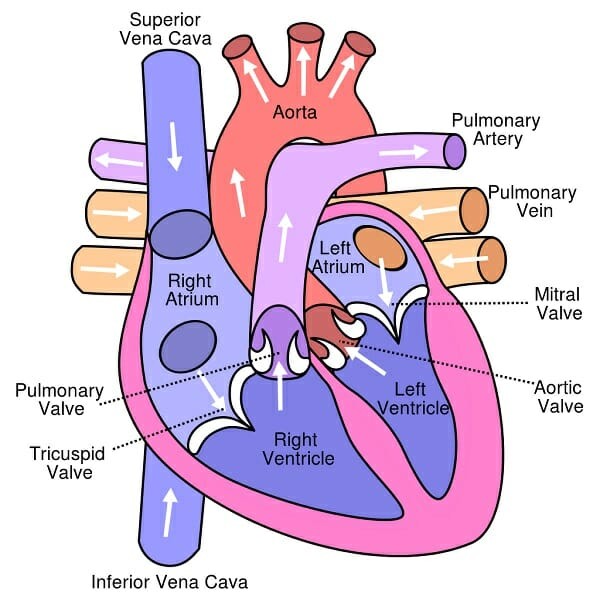
The heart is made of muscles called the cardiac muscles which contract and relax continuously, making the heart to beat ceaselessly. It is covered and protected by a thick membrane called pericardium which keeps the heart in a good position in the thoracic cavity.
The heart consist of four chambers:
- The upper auricles(right auricle and left auricle)
- The lower ventricles (right ventricle and left ventricle).
A central wall called the septum divides the heart into right and left halves.
Between the left auricle and left ventricle is an aperture guarded by biscupid or mitral valve and another valve. The triscupid valve is found between the right auricle and the right ventricle. These valves only permit one direct flow of blood.
Heart Beat occurs in two stages:
- Diastole
- Systole.
- Diastole; at this stage, the two auricles contract, creating high pressure in the blood which causes the biscupid and tricuspid valves to fold downward, thus allowing the blood to flow from the auricles into the ventricles. Deoxygenated blood enters the right ventricle from the right auricle while oxygenated blood enters the left ventricle from the left auricle.
- Systole; during this stage, the two ventricles contract, creating high pressure in the blood which causes two valves to close. Deoxygenated blood from the right ventricle passes into the pulmonary artery while oxygenated blood from the left ventricle passes into the aorta. While this is happening, blood from the body is filling up the auricles again. The first stage of the next heartbeat then follows after a short lapse of time and the cycle repeats itself.
The blood vessels:
The blood vessel is the network of spaces in the body through which materials are moved from one part of the body to the other with the aid of blood.
There are three types of blood vessels. These are:
- The artery carries blood away from the heart. It is further divided to form arterioles.
- The vein carries blood to the heart. It is further divided to form veinous.
- The capillaries are tiny blood vessels found around tissues and organs where the artery and vein meet. It is at this region that substance diffuse in and out of the blood.
Difference between artery and vein.
|
Artery |
Vein |
|
It carries blood to the heart. |
|
All vein except the pulmonary vein carries deoxygenated blood. |
|
It has a thin, less elastic and non-muscular wall. |
|
No valves.
|
|
It lies near the surface of the body. |
|
It has blood which flows under high pressure. |
The circulatory system in farm animals.
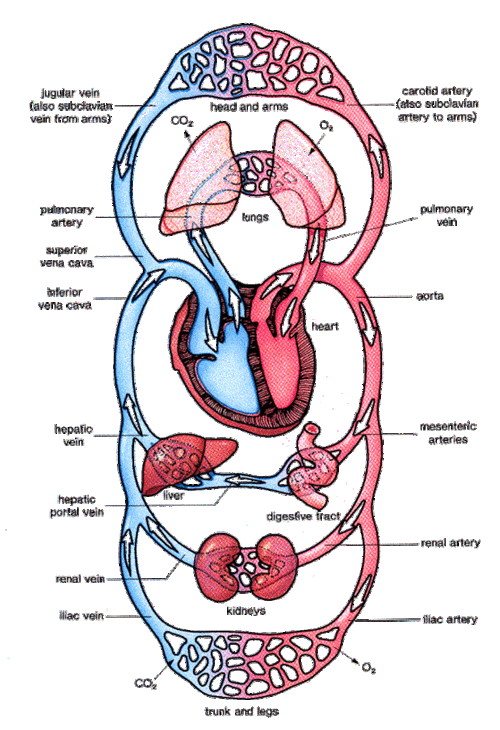
Farm animals possess a close circulatory system. This means that there is no mixing of oxygenated blood and deoxygenated blood in the heart. Farm animals also display a pattern of double circulation this implies that, for one complete circulation, blood has to pass through the heart twice, each time going through a separate pathway. The two pathways are referred to as the pulmonary circulation and the systemic circulation.
the pulmonary circulation is the movement of blood between the heart and the lungs while the systemic circulation is the movement of blood between the heart and all parts of the body besides the lungs.
Importance of the circulatory system.
- It circulates nutrients to the body tissues.
- It removes waste products from the body tissues.
Respiration can be represented by this equation
C6H12O6 + 6O2
+ 6O2 -> 6CO2 + 6H2O
 + Energy
(glucose) (oxygen) (carbon dioxide)(water) (ATP)
Types of respiration
- Aerobic respiration: this is the type of respiration which takes place in the presence of oxygen. This is the type possessed by all farm animals. Aerobic respiration can be represented by this equation.
C6H12O6 + 6O2
+ 6O2 -> 6CO2 + 6H2O
 + Energy
(glucose) (oxygen) (carbon dioxide)(water) (ATP)
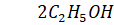
- Anaerobic respiration: this is the type of respiration which takes place in the absence of oxygen. In anaerobic respiration, the end products are energy, carbon dioxide and alcohol. It can be represented by this equation:
C6H12O6 -> 2C2H5OH
 + 2CO2
  + Energy
(glucose) (alcohol) (carbon dioxide)
This process is also referred to as fermentation.
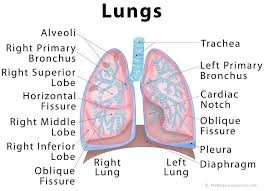
The most important organ of respiration in all animals is the lungs., while aquatic animals like fish use the gills to respire. Other organs associated with respiration are the nostril and diaphragm.
The lung is located in the thoracic cavity of farm animals. The atmospheric oxygen passes through the nostrils, the pharynx, larynx or voice box bronchi and to the lungs. The movement of oxygen through these organs finally terminates in the alveoli where the exchange of gases (oxygen and carbon dioxide) takes place.
Processes of breathing.
Breathing involves two processes:
1. Inspiration (inhalation); this involves the breathing in of air into the lungs. During the process, the following takes place within and around the lungs.
- The diaphragm contracts and flattens out.
- Intercostals muscles contract, ribs are thus raised.
- Sternum moves forward.
- The volume of thoracic cavity therefore increases and the pressure in the lungs is lowered.
- This, therefore, creates high pressure in the lungs and oxygen is taken into the lungs.
2. Expiration (exhalation): this involves the breathing out of the air from the lungs. During the process, the following takes place within and around the lungs.
- The diaphragm relaxes and returns to its dome shape.
- Intercostals muscles relax and the ribs are lowered.
- The sternum moves backwards.
- The volume of thoracic cavity therefore decreases; pressure in the lungs is increased and carbon dioxide is expelled from the lungs.
Differences between inhaled air and exhaled air.
|
Gas |
Inhaled Air |
Exhaled Air |
|
Oxygen |
21% |
16% |
|
Carbon dioxide |
0.03% |
4% |
|
Nitrogen |
79% |
79% |
|
Water vapour |
Variable |
Saturated |
The oxygen which diffuses into the blood through the lungs is now transported by the haemoglobin of the blood cells to various cells in the body. This oxygen is used to oxidize food substances in the mitochondria of the cells during tissue respiration to release energy used by farm animals for movement, growth, reproduction and other body metabolic activities.
Importance of the respiratory system.
- It supplies oxygen to the blood cells.
- It helps to reduce heat load in the body, especially in poultry.
- It removes carbon dioxide from the body.
- It promotes gaseous exchange.
Nervous system.
The nervous system includes all the organs and tissues which enable animals to respond to changes in their environment.
The nervous system of mammals is composed of two parts: the central nervous system and the peripheral nervous system.
Central nervous system.
This is made up of the brain and the spinal cord. Both are made up of thousands of nerve cells or neurons. The function of the central nervous system is the correlation of impulses from various sense organs and storage of impulses as information or impressions in the brain for reaction to future similar stimuli.
- The brain:
The bone is enclosed in a bony case called the cranium. It is divided into fore, mid and hindbrain.
The forebrain consists of olfactory lobes which receive sensory impulses for smell and the cerebrum which is the seat of consciousness, intelligence, memory and all voluntary actions. The midbrain consists mainly of optic lobes which control sight. The hindbrain consists of the cerebellum which is concerned with balance and body posture, receives impulses and coordinate action, respiration, heartbeat, digestive movements and blood supply.
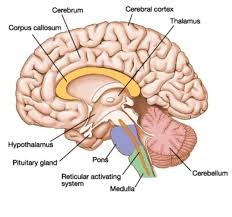
- The spinal cord:
The spinal cord stems from the medulla oblongata and runs through the neural canal of the vertebral column or backbone. It communicates between the brain and other parts of the body. It controls all the reflex(involuntary) actions of the body.
The peripheral nervous system.
It consists of the cranial and spinal nerves and the autonomic nervous system. The cranial and spinal nerves of the peripheral nervous system together with the central nervous system mediate relations between the animals and their external environment. On the other hand, the autonomic nervous system, consisting of the sympathetic and parasympathetic nervous system regulates events within the animals.
A neurone (nerve cell) is the structural and functional unit of the nervous system. It helps in receiving and relaying or transmission of impulses. A neurone has three main parts: the dendrite, cell body and the axon (nerve fibre or axis cylinder).
The cell body has dendrites extending from it, and a central nucleus. The axon is surrounded by myelin sheath which is interrupted at intervals, forming nodes of Ranvier. The axon terminates in dendrites.
Types of neurones.
- Sensory or Afferent neurones; these neurones carry impulses from receptors, such as the eyes, skin, ears, etc to the central nervous system.
- Motor or Efferent neurones; these neurones carry impulses from the central nervous system to effectors, such as muscles and glands in the body.
- Intermediate or relay neurones; these neurones receive, transmit and interpret messages in the spinal cord and brain.
Transmission of nerve impulses.
The dendrites usually receive messages and pass them to the cell body which then passes them(messages) out through the long axon to the dendrites of another nerve cell. However, there is no direct connection between the fibres of adjacent neurones. The junction between one end of a dendrite of one neurone and that of an axon of the next neurone is known as a synapse. The message passes from cell to cell across these synapses.
Reflex action.
These are actions carried out by animals in response to certain stimuli without first thinking or planning for them. They are not under the control of the brain. They are quick, automatic responses and entirely stereotype in nature.
Examples of simple reflex or involuntary actions include:
- The blinking of the eyes.
- The beating of the heart.
- Sneezing.
- The sudden removal of hands, legs or skin from the hot object.
- The jerking of the legs on tapping the knee cap.
Reflex arc.
This is the path traced out by the impulses concerned in a simple reflex action. It consists of three neurones; an afferent, intermediate and efferent neurones.
The message from the external stimuli is received by the sensory or receptor organs such as the skin in the case of the sudden removal of the leg from a hot object. The stimulus is sent to the brain or spinal cord through the sensory or efferent neurone. The intermediate or relay neurone in the brain and spinal cord receives, transmits and interprets the message. The interpreted message is then sent through the motor or efferent neurone to the organ or effector such as the muscle, which then causes the appropriate response, leading to the sudden withdrawal of the leg from the hot object.
The sense organs.
These are the organs which receive stimuli and with the help of the brain (voluntary action), the message is received and interpreted. Hence, such organ enables animals to respond to stimuli within the environment.
The sense organs include;
- Nose – a sense of smell
- Eyes- a sense of vision(sight)
- Ears – a sense of sound (hearing)
- Tongue- a sense of taste
- Skin- a sense of touch and heat.
Functions of the nervous system
- It coordinates body functions.
- It is responsible for bringing about locomotion or movement.
- It enables the body to respond to external stimuli.