
Deductive Proofs (I)
Mathematics SSS 1 Third Term
WEEK 1
Deductive Proofs (I)
Performance Objectives
Students should be able to;
- Participate in discussing the format for proving geometrical theorem.
- Take special note to the format
- Solve task given.
Types and Properties of Proofs
Content
A proof is a logical statement, using evidence to establish, a fact, a hypothesis or an argument put forward. On the other hand, a theorem is a general conclusion in science or mathematics which makes assumptions in order to explain some observations.
Geometry is a branch of mathematics that deals with the properties of plane shapes or solid shapes.
In theoretical geometry, the facts are proved for general cases by way of argument or reasoning rather than by measurement.
Therefore, theorems form the basis upon which geometry is built.
Angles
Angles are the distances or changes in direction between two lines or surfaces diverging from the same point measured in degrees (o).
Types of angles
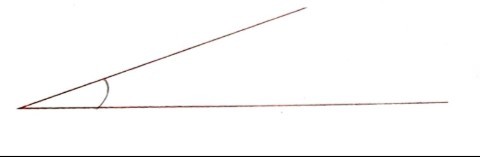
Acute angle: This is an angle that is less than 90°.
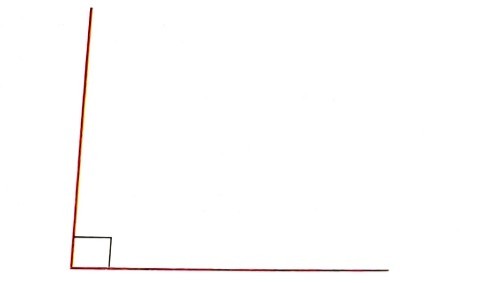
Right angle: This is an angle that is exactly 90 or a quarter of a revolution.
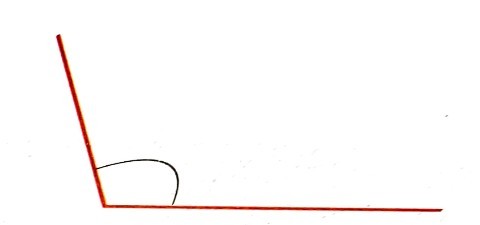
Obtuse angle: This is an angle that is greater than 90° but less than 180.
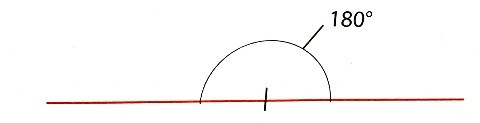
Angle on a straightline: This is an angle that is exactly 180" or two right angles.
Reflex angle: This is an angle that is greater than 180 but less than 360°.
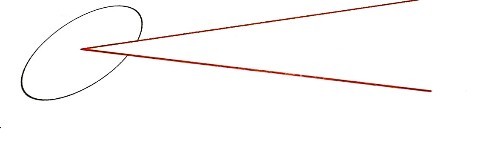
Angles at a point: This is exactly four right angles (360°).
a + b + c + d = 360
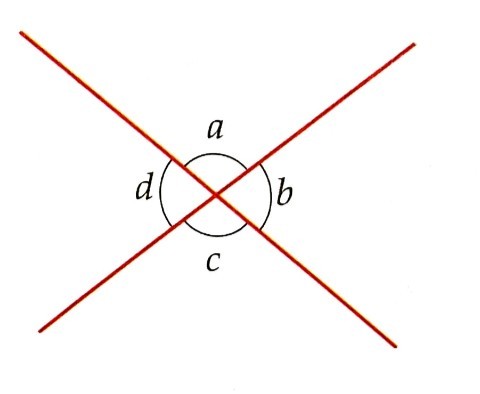
Elementary theorems
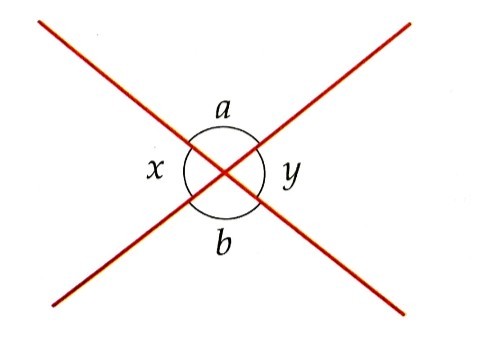
- Vertically opposite angles are equal
a = b
X = y
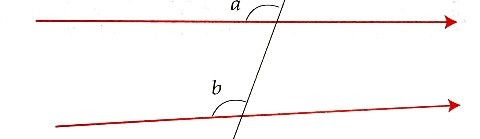
- Corresponding angles are equal
a = b
- Alternate angles are equal
y = X
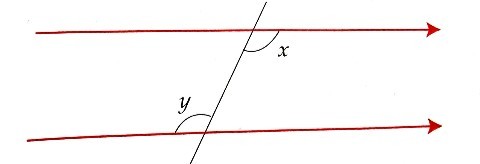
With these mathematical statements, we should be able to prove any given theorems which are mathematical facts.
To prove any theorem, the following procedures are required.
a) Give a general statement of the theorem in words.
b) Clear diagrams should be drawn with suitable lettering.
c) Give a statement of what is given, using the letters of the diagram.
d) State what is to be proved in terms of the letters of the diagram.
e) Construct more lines if necessary.
f) State the proof in the form of reasonable argument(s).
Theorem1
The sum of angles of a triangle is 180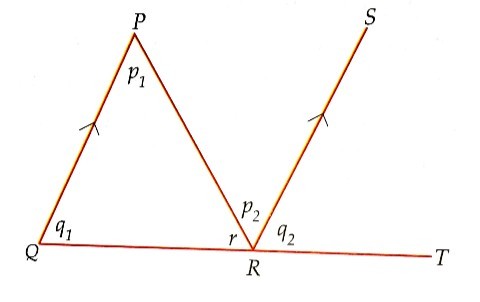
Given: PQR
To prove: P + Q + R = 180
Construction: Produce QR to point T and draw RS parallel to QP.
Proof: With lettering of the diagram above, QP||RS
q1 = q2(corresponding angles)
P1 = P2 (alternate angles)
r + P2 + q2 = 180° (QRT is an angle on a straight line)
Hence, r + P1 + q2 = 180°
Then PRQ + P + Q =180°
P + Q + R = 180°
Example 1
The angles of a triangle are 2x, 3x and 4x. Find the value of x in degrees.
Solution
2x + 3x + 4x = 180° (sum of angles in a triangle)
9x = 180°
X = 180/9
X = 20°
2x = 2 x 20° = 40
3x = 3 x 20° = 60°
4x = 4 x 20° = 80°
Hence, the angles in the triangle are 40, 60 and 80.
Example 2
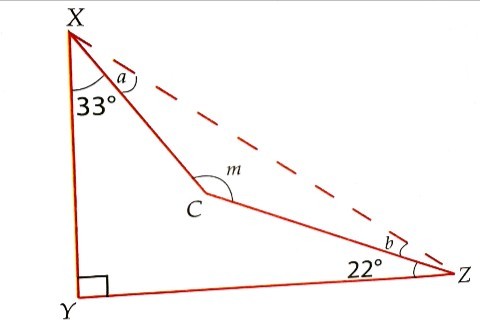
What is the value of the angle marked m?
Solution
Join point X to point Z and label the angles accordingly, as shown in the diagram above.
In AXYZ,
X + Y + Z = 180° (sum of angles of a triangle)
33 + a + 90° + 22° + b = 180°... i)
In XCZ,
a + b + m = 180 ... ii) (sum of angles of a triangle)
'. equate i) and ii)
33 + a + 90° + 22° + b = a + b + m
Collect like terms:
33 + a- a + 90° + 22°+ b-b = m
.: m = 33° + 90°+ 220
= 145°
Theorem 2
The exterior angle of a triangle is equal to the sum of the opposite interior angles
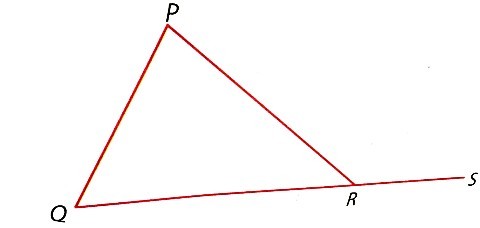
Given: PQR with QR extended to S.
To prove: PRS = P + Q
Proof. With lettering of the diagram,
PŘS + PŘQ = 180° (QRS is angle on a straight line.)
PŘS = 180°- PRQ
P + Q+ PŘQ = 180° (sum of angles of a triangle)
Hence, P + Q = 180°- PRQ
PŘS = P + Q
Example 3
Find the size of each marked angle in
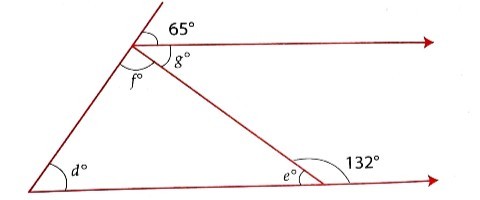
Solution
d = 65° (corresponding angles)
d + f = 132° (exterior angles of a triangle)
65 + f = 132°
f = 132° - 65°
= 67
f + g + 65 = 180° (angles on a straight line)
g = 180° - (65° + 67)
= 180° - 132 = 48°
g = e (alternate angles)
:. e = 48°
Example 4
In the diagram below, ABP = 110° and DČP = 163 Calculate BPC.
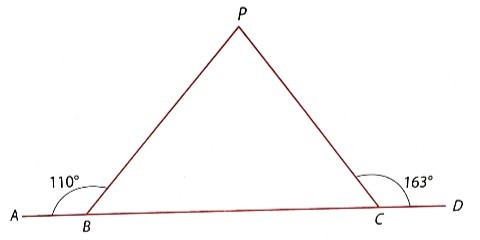
Solution
ABP + PBC = 180° (angles on a straight line)
PBC = 180°-110°
= 70°
PBC + BPC = PČD (exterior angles of a triangle)
70 + BPC = 163°
BPC = 163° - 70
= 93
Theorem 3
Pythagoras' theorem
In a right-angled triangle, the square of the hypotenuse is equal to the sum of the squares of the other two sides.
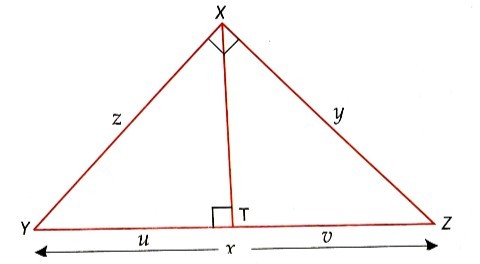
Given: XYZ with X = 90°. YZ, XZ and XY are of lengths x, y and z units, respectively.
To prove: x2 = y2 + z2
Construction: Draw a perpendicular line from X to meet YZ at T.
Proof. With the lettering of diagram above
In XYZ, cos Y = z/x
In XYT, cos Y = u/z
Therefore, z/x = u/z
:. z2 = ux ........i)
Similarly, y2 = vx .... ii)
By adding equations i) and ii),
we have: ux + vx = y2 + z2
x(u + v) =y2 + z2
Recall /x/ = u + v
X x X = y2 + z2
x = y2 + z2
Example 5
ABC is right-angled at A and /AB/ = 2/AC. Prove that /BC/2 = 5/AC/2
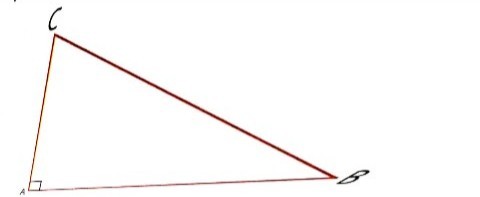
Solution
/AB/ = 2/AC/
By Pythagoras' theorem,
/BC/ is the hypotenuse
/BC/2 = /AC/2 + /AB/2
= /AC/2 + (2/AC/)2
= /AC/2 + 4/AC/2
/BC2/ = 5|AC|2