
Bearing 1
Mathematics SSS 2 Third Term
WEEK 2
Bearing 1
Performance Objectives
Students should be able to;
- Solve problems on trigonometry ratios
- Solve problems on angle of Elevation and Depression
- Define the 4 – 8 and 16 cardinal points
- State two bearing notations
Angle of Elevation and Depression
Content
Angle of Elevation
Suppose that you are looking at an object in the distance.
If the object is above you, then the angle of elevation is the angle your eyes look up.
If the object is below you, the angle of depression is the angle your eyes look down.
Angles of elevation and depression are measured from the horizontal.
It is common mistake not to measure the angle of depression from the horizontal.
The angle that an observer would raise his or her line of sight above a horizontal line in order to see an object. The angle of elevation is the angle between the horizontal and the
observer’s line of sight
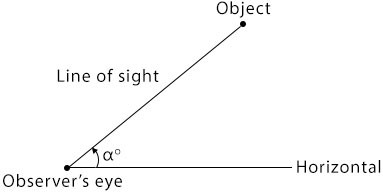
In the diagram above, the angle of elevation of the object from the observer is α0.
Angle of Depression
If the object is below the level of the observer, then the angle between the horizontal and the observer’s line of sight is called the angle of depression. If an observer were up above and
needed to look down, the angle of depression would be the angle that the person would need to lower his or her line of sight.
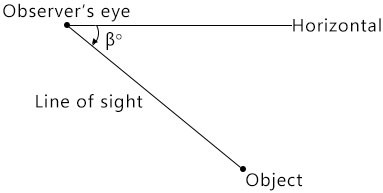
In the diagram above, the angle of depression of the object from the observer is β0.
NOTE: Using the angle of depression or elevation to an object, and knowing how far away the object is, enables us to find the height of the object using trigonometry.
The advantage of doing this is that it is very difficult to measure the height of a mountain or the depth of a canyon directly; it is much easier to measure how far away it is (horizontal distance) and to measure the angle of elevation or depression.
Measuring Angles of Elevation and Depression
Angles of elevation and depression can be measured with a simple instrument called Clinometers. Simple Clinometers is made from a chalk-board protractor in which a plumb-line hangs from the center of the protractor. The angle that the plumb-line makes with the 900 vertical axes when the Clinometers is placed in the observer’s direction is the angle of elevation or
depression.
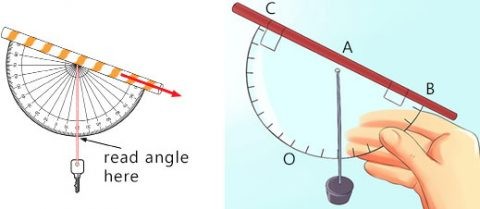
In the figure above, a plumb-line hangs from the center of the protractor at A. The observer sights an object along the line BAC. The angle of elevation e0 is the angle between AO and the plumb-line. The size of e0 can be read from the scale. Notice that e0 increases from 00 at O to 900 at B.
The Relationship between Angle of Elevation and Depression
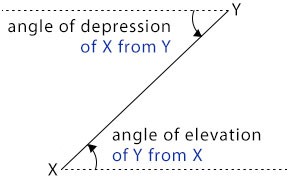
In other words, as shown in the diagrams below, the angle formed with the horizontal when an observer looks up is called angle of elevation whereas, the angle formed with the horizontal when an observer looks down is called angle of depression.
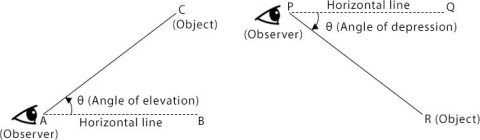
There is a connection between angle of elevation and angle of depression. For example, the angle of elevation of Y from X is the same as the angle of depression of X from Y. Therefore angles of elevation and depression are alternate angles and are therefore equal in a given situation.
The Compass Directions
Major Compass/Cardinal Directions
There are four major directions used to describe locations. These cardinal directions are:
North (N) South (S) East (E) West (W)
The four main directions, North, South, East and West, divide the angle at a point (360o), into four equal parts and each is 90o or a right angle.
Minor Cardinal Directions
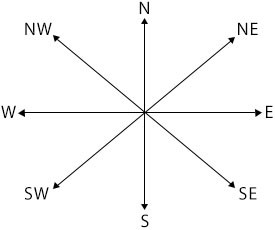
Other minor cardinal directions are those that lie in the midpoints as follows:
North and East called North-East (NE)
South and East called South-East (SE)
South and West called South-West (SW)
North and West called North-West (NW)
These minor cardinal directions subdivide each right angle into two equal parts such that the angle between each major cardinal and minor direction is 45o. The eight cardinal points are
illustrated below:
Bearing and its Types
Bearing is the direction of one point with respect to a given point.
If a line which points due North of a compass is fixed, the direction of any other line on the surface of the earth is given as the angle which it makes with the North-pointing line, this angle is called bearing. In particular, we must note that the bearing is measured from the line due North in a clockwise direction. Since bearings involve mainly finding directions, we use a compass to find them.
The Compass and Compass/Directional Bearing
The Compass is an instrument used in finding directions. It is also used in erecting a wind-vane in the correct position. A wind vane is an instrument used in detecting the direction of the
wind. It can, therefore be used in place of a compass to determine cardinal directions.
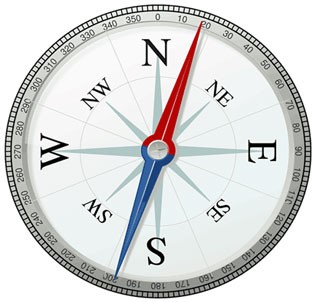
Compass bearing is the direction of one point with respect to a given point given in terms of the major or minor cardinal direction of the relative point.
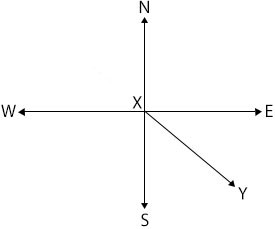
Consider the points X and Y in the diagram below:
The Acute Angle or Simple Bearing
This method involves using the acute angle which the line XY makes with the North or South (in the diagram above, the South Pole is appropriate) direction at X, Eastwards or Westwards. For example, in the diagram below, the bearing of Y from X is written as S 30o E or (or South 30o Eastwards) and is called the acute-angle bearing of Y from X.
In general, acute angle bearings are measured in relation to the North or South Pole and must therefore be greater than 0o but less than 90o as its name implies. If an angle related to the East or West pole is given, its complementary angle is used to give the acute-angle bearing.
The Three-figure or Surveyor’s Bearing
This method involves reading on the compass, the angle which the line XY makes with the North direction. This angle is the bearing of the object Y from the reference point X, and it is called the surveyor’s bearing of Y from X. The surveyor’s bearing is written with three digits known as three-figure bearings. When the angle is between 0o and 90o inclusive, say 7o, the bearing is written as 007o, that is, two zeros are added before the angle. Suppose the angle is 55o, we write it as 055o.
Directional versus Three-figure versus Acute Angle Bearing
Examples:
1.
|
Directional |
Three-figure Bearing |
Acute-Angle Bearing |
|
|
North |
000o/360o |
− |
|
|
North East |
045o |
N45oE |
|
|
East |
090o |
− |
|
|
South East |
135o |
S45oE |
|
|
South |
180o |
− |
|
|
South West |
225o |
S45oW |
|
|
West |
270o |
− |
|
|
North West |
315o |
N45oW |
|
2. Directional/Compass = NE
The three-figure bearing = 037o
Acute Angle bearing = N37oE
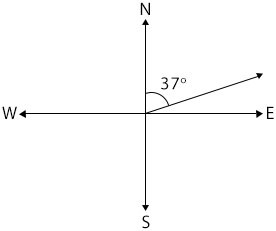
3. The compass/directional bearing = SE
The three-figure bearing = 117o
The Acute-angle bearing = S63oE
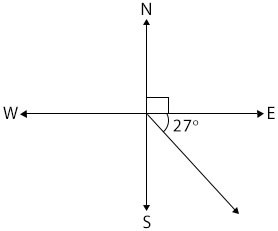
4. The compass/directional bearing = SW
The three-figure bearing = 246o
The Acute-angle bearing = S66oW
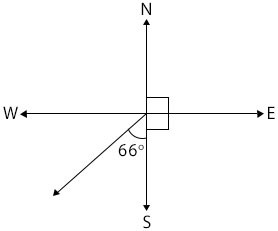
5. The compass/directional bearing = NW
The three-figure bearing = 344o
The Acute-angle bearing = N16oW
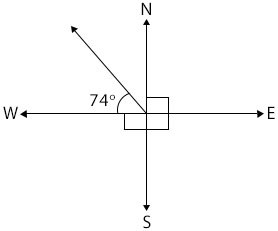
6. The table below shows the angles when the turning is clockwise from the South direction to the other cardinal directions.
|
Direction |
N |
E |
W |
NE |
NW |
SE |
SW |
|
|
Clockwise Turning from South |
180o |
270o |
90o |
225o |
135o |
315o |
45o |
|
Reciprocal/Back Bearing
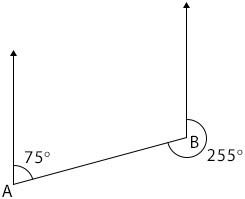
The bearing of B from A is 075o, while the bearing of A from B is 255o. 255o is called the back/ reciprocal bearing of 075o.
In general, if the bearing is less than 180o we add 180o to get the back bearing and if the bearing is greater than 180owe subtract 180o.
Example:
Find the bearing whose reciprocal/ back bearing is?
(i) 033o
Solution
33o is less than 180o
So we add 180o to 33o
180o + 33o = 218o
So the back bearing of 033o is 218o
(ii) 220o
Solution
220o is greater than 180o
So we subtract 180o from 220o
220o – 180o = 40o
So the back bearing of 220o is 40
Scale Drawing
Example:
Ibadan is 116km on a bearing 027 o from Lagos. How far north of Lagos is Ibadan? How far west of Ibadan is Lagos?
Solution:
Make a scale drawing of the data.
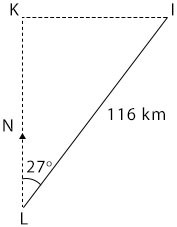
Scale: 1cm to 20km
K is the point which is due north of Lagos and due west of Ibadan. LK represents the distance that Ibadan is north of Lagos.
By measurement, LK ≈ 5.2cm
The true distance LK ≈ 5.2 × 20km
= 104km
IK represents the distance that Lagos is west of Ibadan.
By measurement, IK ≈ 2.6cm
The true distance IK ≈ 2.6 × 20km
= 52km
Thus Ibadan is approximately 104km north of Lagos and Lagos is approximately 104km north of Lagos and Lagos is approximately 52km west of Ibadan.
Example:
Use scale drawing to answer the questions that follow the diagram:
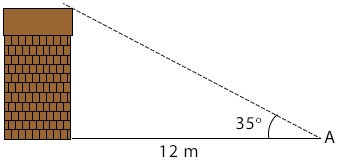
- What is the angle of depression (θ) of the top of the building from the observer at point A?
- Find the height of the building in the figure above.
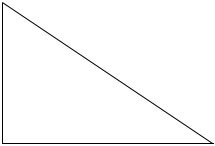
STEP 1: Draw a sketch of the figure in the form of a right-angled triangle.
STEP 2: Choose an appropriate scale, considering the measurements on the given lengths in the original diagram. From 12m, a scale of 1cm represent 2m can be used to draw 12m as 6cm.
STEP 3: Draw the appropriate diagram, measure and mark the given angle.
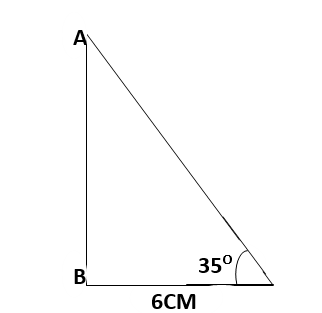
STEP 4: Measure length AB in cm then convert it back to m to get the height of the building