
Trigonometry
Mathematics SSS 2 Third Term
WEEK 1
Trigonometry
Performance Objectives
Students should be able to;
- Derive the sine rule
- Apply the sine rule
- Derive cosine rule
- Apply cosine rule
Derivation of Sine Rule
Content
The sine rule formula states that the ratio of a side to the sine function applied to the corresponding angle is same for all sides of the triangle.
In any ΔABC, the angles are usually denoted by the capital letters A, B,C and the sides opposite these angles a, b,c respectively.
For a triangle ABC, sine rule can be stated as given below:
asin A = bsin B
 = csin C
The sine rule formula can be used to find the measure of unknown angle or side of a triangle. It can be used to predict unknown values for two congruent triangles.
If for a given triangle, a, b, and c are the lengths of sides , and A, B, and C are the opposite angles then the sine rule formula is also stated as the reciprocal of this equation:
sin Aa = sin Bb
 = sin Cc
Derivation of the Sine Rule
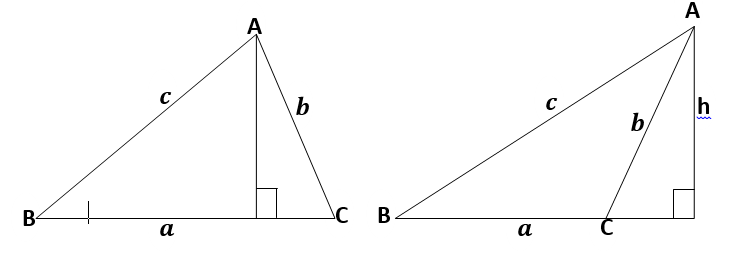
Given in any ΔABC (acute and obtuse angled Δs are given as;
asin A = bsin B
 = csin C
From the two diagrams above,
Sin B = hc …………………………………………………………………………..(1)
From the first diagram above,
Sin C = hc ………………………………………………………………………….(2)
From the second diagram above,
Sin (1800 – C) = hb
Therefore, Sin C = hc [Sin (1800 – Ɵ ) = sin Ɵ ]
From eqn (1) h = c Sin B
From eqn (2) h = b sin C
Therefore c sin B = b sin C
Therefore asin A = bsin B
Therefore asin A = bsin B
 = csin C
The sine rule can also be used for solving triangles which are not right angled and in which either two angles and any side are given or two sides and the angle opposite one of them are given.
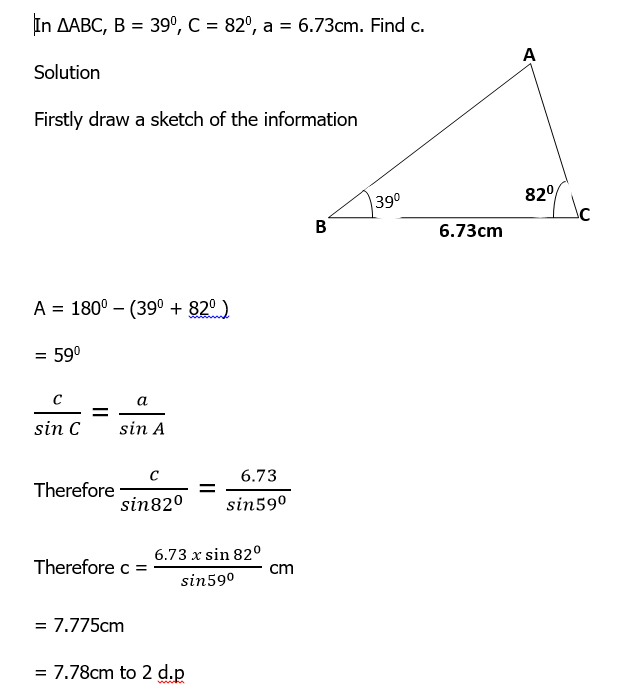
Example
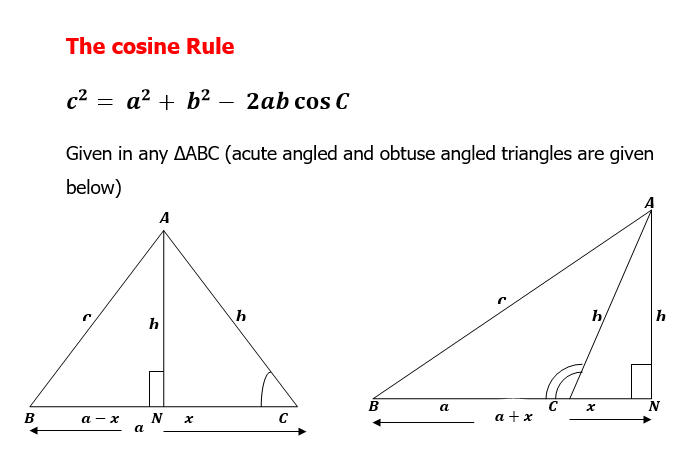
Derivation of cosine rule
that is: c2= a2+ b2- 2abcosC 
Using the diagram above form the first diagram C acute,
(pythagoras)
c2=(a- x)2+ h2
= a2- 2ax+ x2+ h2 
a2- 2ax+ b2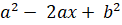
(in ΔACN, x2+ h2= b2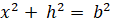 )
)
= x2+ b2-  2ab cos C
(in ΔACN, xb = cos C, x = b cos C)
Using the diagram above form the second diagram C obtuse,
(pythagoras)
c2=(a+ x)2+ h2
a2+ 2ax+ x2+ h2 
a2+ 2ax+ b2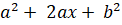
(in ΔACN, x2+h2= b2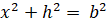 )
)
= a2+ b2+ 2a(-bcos C)
(in ΔACN, xb = cos C ACN)
= cos (1800 – C )
= -cos C, x = -bcos C
= a2+ b2- 2ab cos C
In either case, c2= a2+ b2- 2ab cos C
Similarly, b2= a2+ c2- 2ab cos B
And a2= b2+ c2- 2ab cos A
This formula the cosine rule is for solving triangles which are not right angled in which two sides and the included angle are given.
Example
Find /AB/
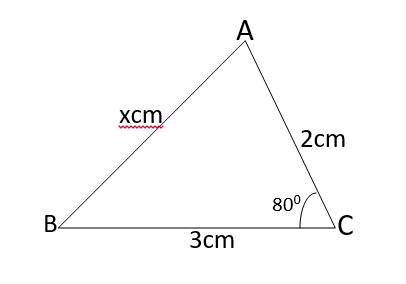
Solution
By the cosine rule
x2= 22+ 32- 2 x 2 x 3 cos 800
= 4 + 9 – 12 X 0.1736
= 13 – 2.0832
= 10.9168 = 10.92 to 4 s.f
X = 10.92
X = 3.305 = 3.3 to 2 s.f
Therefore, /AB/ = 3.3cm