
Production of propagation of waves
Physics SSS2 Third Term
Sub Theme: Waves Motion without Material Transfer
WEEK 1
Production of propagation of waves
Performance Objectives
Students should be able to;
- Generate Mechanical waves.
- State the important characteristics of waves.
- Produce circular and plane waves using a ripple tank
- Generate and demonstrate longitudinal and transverse waves using suitable materials.
Wave
Content
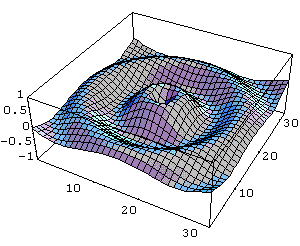
A wave is a disturbance which travels through a medium and transfers energy from one point to another without causing any permanent displacement of the medium itself. If you drop a stone into water in a basin or swimming pool, ripples or waves will be seen spreading outward from the source of the disturbance. As the waves generated spread out, they transfer energy from one point to the other without the water moving in the direction of the ripples.

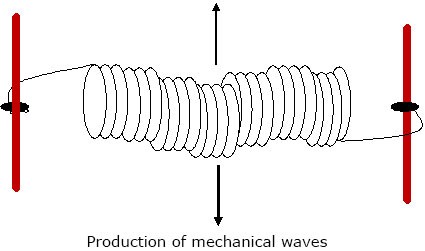
Waves can also be produced when one ties one end of a rope to a wall, hold the other end and make it to move up and down rapidly. Alternatively, get a long string and place both ends to two fixed points as shown below. Pluck the string i.e pull it either vertically downward or upward and release it. A wave will be generated.
Terms Used in Describing Waves
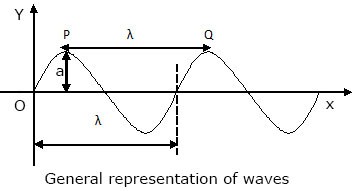
A wave can be represented as shown in the diagram below.
Terms as Applied to Wave Motion
1. Crest: This is a region of maximum upward displacement of the particles of the medium.
2. Trough: This is a region of maximum downward displacement of the particles of the medium
3. Phase: The particles of a wave are said to be in phase when they are at the same vertical distance from their mean position and are moving in the same direction.
4. Amplitude (a): It is the maximum displacement of the particles as measured from the mean position.
5. Period (T): This is the time taken by a particle to complete one circle or oscillation. Its unit is seconds. It can also be defined as the time taken for the wave to cover one wavelength. i.e from point P to Q or from Point O to R in the diagram above.
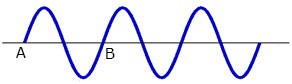
From a to B is a cycle. The time for the wave to move from A to B is called PERIOD
Period T = 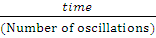
T = t/n
6. Frequency (f): This is defined as the number of circles the wave makes in one second. It is measured in Hertz (Hz)
f = n/t
7. Wavelength (λ): This is the distance between two successive crests or troughs in phase. It can also be defined as the distance covered by the wave after completing a circle. It is measured in metres. In the diagram, the wavelength λ is the distance (P Q) or (O R).
8. Wave velocity (v): This is the distance () the wave travels with time (t). its unit is m/s.
V = distance/time
During one cycle, the distance travelled = wavelength
Time to complete one cycle = period.
Therefore;
V = wavelength/period
V = λ/T
Since frequency is inverse of period, f = 1/T
V = λ/f
Example 1:
A wave travels a distance of 100m in 5 seconds. The distance between successive crests of the wave is 25cm. Calculate the frequency of the wave.
Solution:
Distance = 100m, time = 5 seconds λ = 25cm = (25/100) = 0.25m
Velocity = distance/time
= 100/5 = 20m/s
V = fλ
f = v/λ
f = 20/0.25 = 80Hz
Example 2:
A radio station broadcasts at a frequency of 200 kHz. If the speed of the wave is 3.0 x 10⁸ m/s, calculate the period and the wavelength of the wave.
Solution:
Frequency, f = 200kHz = 200000Hz, velocity, v = 3.0 × 10⁸ m/s
Period, T = 1/F = 1/200000
= 5 × 10⁻⁶seconds
V = fλ
Wavelength, λ =v/f
=  = 1.5 × 10³m
Example 3:
A vibrating source which has a frequency of 500Hz produces a sound whose velocity in air is 330m/s. Determine the distance which the sound travels when the source completes 100 vibrations.
Solution:
f = n/t
500 = 100/t
t = 0.2sec
This is the time for the wave to complete 100 cycles.
V = d/t
330 = d/0.2
d = 66.0m
Alternative Solution:
Frequency f = 500Hz or 500 circles per second.
If the source makes 500 circles in a second, then it will take the source (100/500) seconds to make 100 circles = 0.2s
Speed(v) = 
500 = 100/t
t = 0.2sec
Therefore s = vt = 330 × 0.2 = 66m