
Types of waves
Physics SSS2 Third Term
Sub Theme: Waves Motion without Material Transfer
WEEK 2
Types of waves
Performance Objectives
Students should be able to;
- Classify waves into longitudinal and transverse waves by using mode of vibrations
- Write down and explain the terms in the wave equation.
Types of Waves
Content
Waves can be classified under transverse waves and longitudinal waves. If the direction of propagation of the particles of the wave is perpendicular to the direction of vibration of the medium, the wave is transverse. Examples of transverse waves are, water waves and waves produced by plucking a string. If we consider material medium, waves can be classified under mechanical waves and electromagnetic waves. Mechanical waves require a material medium for propagation e.g water waves and waves in a string while electromagnetic waves do not require material medium for propagation. Examples of these waves are; radio waves, light waves, x-rays etc.
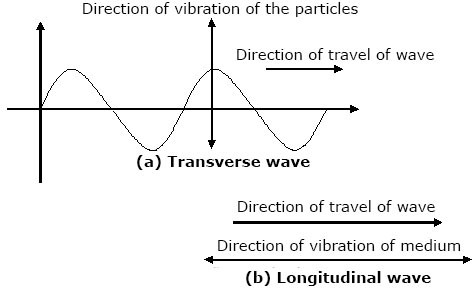
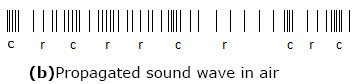
If the direction of travel of the wave is the same as the direction of vibration of the medium, the wave is longitudinal. Sound waves are example of longitudinal waves. In longitudinal waves, the vibrating particles behave like a spiral spring that has a series of compressed regions and spaced out regions travelling along it. Series of compressed regions are called compression (c) while series of spaced out regions are called rarefaction (r). See diagram (b) below.

Equation of a Travelling Wave
The equation of a travelling wave can be written mathematically as
Y = sinθ or y = cosθ
Angular velocity ω = θ/t radians per second
Θ = ωt
Y = sinωt or y = cosωt
Generally, A travelling wave with amplitude ‘A’ and constant angular velocity can be written as
Y = Asin(ωt ± Ø) ——- eqn 1
Ø is a constant for a wave that did not start from the origin
Ø is constant angular distance called phase constant which is related to linear distance x by
Ø = 2πx/λ ——- eqn 2
2π/λ = k, which we call wave number. Substituting eqn 2 into eqn 1, we have
Y = Asin(ωt ± 2πx/λ) = Asin(ωt ± kx)——- eqn 3
If we substitute ω = 2π/T and k=2π/λ into eqn 3, it becomes
Y = Asin(2πt/T ± 2πx/λ)
Or y = Asin2π(t/T ± x/λ) ——- eqn 4
Or y = Asin 2π/λ(λt/T ± x) ——- eqn 5
Recall that v =fλ
Λ = vt, therefore eqn 5 becomes
Y = Asin2π/λ(vt ± x) ——- eqn 6
+ for when the wave is propagating in the negative “x” direction
– for when the wave is propagating in the positive “x” direction
Example 1:
A travelling wave is given by the equation y = 0.03 Sin ( 2.2.5t ) where y and are in metres and t is in seconds. Find the amplitude, the wavelength, the frequency, the period and the speed of the wave.
Solution:
To solve this problem, we compare the equation with eqn 3
Y = Asin(ωt ± kx) (eqn 3)
Y = 0.03sin(2.2x − 3.5t)
Thus, amplitude A = 0.03m, angular frequency ω = 3.5 rad – s k = 2.2 m – 1
Λ = 2π/k = 2 ×  = 2.86m
Period T = 2π/ω = 2 × = 1.80s
The speed of the wave is given by
V = fλ = λ/T =  = 1.59m−s
Example 2:
The wavelength of a travelling wave is 5m at a frequency of 12 Hz.
- What is the wave velocity?
- If there is a crest at = 3m at time t, find three other positions of the crest at that instant
- What time later will there be another crest at = 3m ?
- If the amplitude of the wave is 1.5m, write the equation of the wave.
Solution:
1. v = fλ = 12 × 5 = 60m/s
2. The crests are at one wavelength apart, so there are crests at
X = 3m and
X = (3+5)m,
X = (3+5+5)m
X = (3 + 5 + 5 + 5)m
i.e. x = 3m, 13m, and 18m
3. A crest will arrive again at x = 3m after one period T = 1/f = 112 = 0.083s
4. The wave equation can be written as
Y = Asin2π/λ(vt − x)
A = 1.5m, v = 60m/s, λ = 5.0m
Hence, y = 1.5sin2π/5(60t − x) or
Y = 1.5sin2π(12t – x/5)