
Simple A. C Circuit
Physics SSS3 First Term
WEEK 1
Simple A. C Circuit
Performance Objectives
Students should be able to;
- Explain the peak and V.M.S of current and p.d
- Establish the phase relationship between current in a.c circuit.
- Explain reactance and impedance
Alternating Current
Content
A.C. circuits are circuits through which an alternating current flows. Such circuits are used extensively in power transmission, radio, telecommunication and medicine.
Alternating currents are produced by time dependent alternating voltages given by the relation E = E0 sin ωt. Much of what we learned about d.c. circuits also apply to a.c. circuits. The effects on such voltages on resistors, capacitors and inductors will be discussed.
Nomenclature in A.C Circuits
An Alternating Current (A.C.) is one that varies sinusoidally or periodically, in such a way as to reverse its direction periodically. The commonest form of such an a.c. can be represented by
I = I0 sin 2πft
I0 sin ωt
Where I is the instantaneous current at a time t, I0 is the maximum (or peak) value of current or its amplitude; f is the frequency and ω (= 2πft) is the angular velocity, (ωt) is the phase angle of the current. Alternating is also represented by
V = V0 sin 2πft
= V0 = ωt
Here, v, v0 are the instantaneous and peak (or maximum) values of the voltages or its amplitude
Example
If an a.c. voltage is represented by the relation V = 4 sin 900vπt, the peak voltage V0 = 4
V and 2πft = 900πt or f = 900/2 = 450 Hz. Then ω = 2πf = 900π.
Peak, and r.m.s Values of A.C.
An alternating current (or voltage) varies sinusoidally as shown below which is a sine waveform. The amplitude or peak value of the current I0, is the maximum numerical value of the current.

The root mean square (r.m.s.) value of the current is the effective value of the current.
Root-mean-square current is that steady current which will develop the same quantity of heat in the same time in the same resistance.
The r.m.s. value for the current is given by
Ir.m.s =I0/√2
= 0.070I0
The moving iron and the hot-wire meters measure the average value of the square of the current called the mean square current. They are however calibrated in such a way as to indicate the r.m.s. current directly. Thus most a.c. meters read the effective or r.m.s. values. The average value of an a.c. voltage or current is zero.
Resistance in A.C Circuit
At any instance the current through the resistor (R) is I and the voltage across it is V
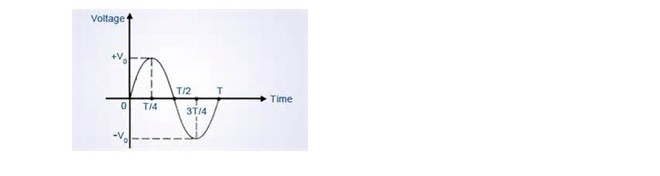

From Ohm’s law we have that V = IR
Thus the current is given by I = V/R
If we put V = V0 sin ωt, then the current is also given by
I =V/R = V0sin ωt/R
= I0 sin ωt
The voltmeter and ammeter connected in the circuit will read the r.m.s. value of voltage and current.
Hence we can also write that Ir.m.s. = Vr.m.s. /R
The voltage and the current are said to be in phase or in step with each other. This means that both of them attain their maximum, zero and minimum values at the same instant in time.
Example
Find the root mean square value of the sinusoidal voltage with peak value at 260V.
Solution
Using V0 = √2 x Vr.m.s.
Given that V0 = 260V, Vr.m.s. =?
V = √2Vr.m.s. ; 260 = √2Vr.m.s.
260 = 1.414Vr.m.s.
Vr.m.s = 260/1.414 = 183.867 = 184V
Capacitance in AC Circuits
When capacitors are connected across a direct current DC supply voltage they become charged to the value of the applied voltage, acting like temporary storage devices and maintain or hold this charge indefinitely as long as the supply voltage is present. During this charging process, a charging current, ( i ) will flow into the capacitor opposing any changes to the voltage at a rate that is equal to the rate of change of the electrical charge on the plates.
This charging current can be defined as: i = CdV/dt. Once the capacitor is “fully-charged” the capacitor blocks the flow of any more electrons onto its plates as they have become saturated. However, if we apply an alternating current or AC supply, the capacitor will alternately charge and discharge at a rate determined by the frequency of the supply. Then the Capacitance in AC circuits varies with frequency as the capacitor is being constantly charged and discharged.
We know that the flow of electrons through the capacitor is directly proportional to the rate of change of the voltage across the plates. Then, we can see that capacitors in AC circuits like to pass current when the voltage across its plates is constantly changing with respect to time such as in AC signals, but it does not like to pass current when the applied voltage is of a constant value such as in DC signals. Consider the circuit below.
AC Capacitor Circuit
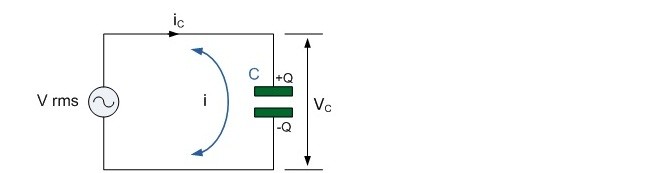
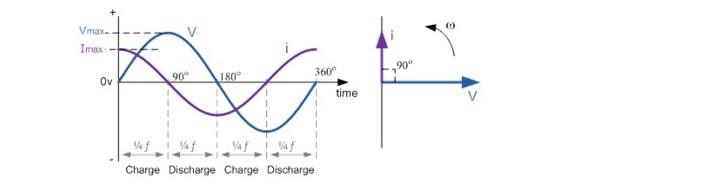
In the purely capacitive circuit above, the capacitor is connected directly across the AC supply voltage. As the supply voltage increases and decreases, the capacitor charges and discharges with respect to this change. We know that the charging current is directly proportional to the rate of change of the voltage across the plates with this rate of change at its greatest as the supply voltage crosses over from its positive half cycle to its negative half cycle or vice versa at points, 0o and 180o along the sine wave. Consequently, the least voltage change occurs when the AC sine wave crosses over at its maximum or minimum peak voltage level, (Vm). At these positions in the cycle the maximum or minimum currents are flowing through the capacitor circuit and this is shown below.
AC Capacitor Phasor Diagram
Capacitive Reactance
Capacitive Reactance in a purely capacitive circuit is the opposition to current flow in AC circuits only. Like resistance, reactance is also measured in Ohm’s but is given the symbol X to distinguish it from a purely resistive value. As reactance can also be applied to Inductors as well as Capacitors it is more commonly known as Capacitive Reactance for capacitors in AC circuits and is given the symbol Xc so we can actually say that Capacitive Reactance is Resistance that varies with frequency. Also, capacitive reactance depends on the value of the capacitor in Farads as well as the frequency of the AC waveform and the formula used to define capacitive reactance is given as:
Capacitive Reactance
Xc = 1/2πfc = 1/ωC
Where:
F is in Hertz and C is in Farads.
2πF can also be expressed collectively as the Greek letter Omega, ω to denote an angular frequency.
From the capacitive reactance formula above, it can be seen that if either of the Frequency or Capacitance where to be increased the overall capacitive reactance would decrease. As the frequency approaches infinity the capacitors reactance would reduce to zero acting like a perfect conductor. However, as the frequency approaches zero or DC, the capacitors reactance would increase up to infinity, acting like a very large resistance. This means then that capacitive reactance is “Inversely proportional” to frequency for any given value of Capacitance.