
Chemical combination 2
CHEMISTRY SSS1 Second Term
WEEK 2
Chemical combination 2
Performance Objectives
The student should be able to:
- Explain hydrogen bonds with examples
- Explain van der-Waal forces with examples
- Write the IUPAC name of common substances
Content
Hydrogen bond
A hydrogen bond is a weak type of force that forms a special type of dipole-dipole attraction which occurs when a hydrogen atom bonded to a strongly electronegative atom exists in the vicinity of another electronegative atom with a lone pair of electrons. These bonds are generally stronger than ordinary dipole-dipole and dispersion forces, but weaker than true covalent and ionic bonds.
A hydrogen atom attached to a relatively electronegative atom is a hydrogen bond donor. This electronegative atom is usually fluorine, oxygen, or nitrogen. The electronegative atom attracts the electron cloud from around the hydrogen nucleus and, by decentralizing the cloud, leaves the hydrogen atom with a positive partial charge. Because of the small size of hydrogen relative to other atoms and molecules, the resulting charge, though only partial, is stronger. In the molecule ethanol, there is one hydrogen atom bonded to an oxygen atom, which is very electronegative. This hydrogen atom is a hydrogen bond donor.
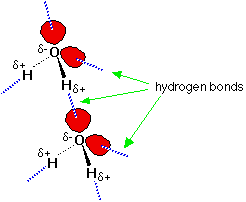
Hydrogen bonding in water molecules
Vander-Waals forces
Van der Waals forces are the weak forces that contribute to intermolecular bonding between molecules. Molecules inherently possess energy and their electrons are always in motion, so transient concentrations of electrons in one region or other lead electrically positive regions of a molecule to be attracted to the electrons of another molecule. Similarly, negatively charged regions of one molecule are repulsed by negatively charged regions of another molecule.
Van der Waals forces are the sum of the attractive and repulsive electrical forces between atoms and molecules. These forces differ from covalent and ionic chemical bonding because they result from fluctuations in the charge density of particles. Examples of van der Waals forces include hydrogen bonding, dispersion forces, and dipole-dipole interactions.
System of naming compounds
Chemical Nomenclature
The primary function of chemical nomenclature is to ensure that a spoken or written chemical name leaves no ambiguity concerning to what chemical compound the name refers to. Each chemical name should refer to a single substance. Today, scientists often refer to chemicals by their common names: for example, water is not often called dihydrogen oxide. However, it is important to be able to recognize and name all chemicals in a standardized way. The most widely accepted format for nomenclature has been established by IUPAC.
Molecular compounds are made when two or more elements share electrons in a covalent bond to connect the elements. Typically, non-metals tend to share electrons, make covalent bonds, and thus, form molecular compounds.
Rules for Naming Molecular Compounds:
- Remove the ending of the second element, and add “ide” just like in ionic compounds.
- When naming molecular compounds prefixes are used to dictate the number of a given element present in the compound. ” mono-” indicates one, “di-” indicates two, “tri-” is three, “tetra-” is four, “Penta-” is five, and “Hexa-” is six, “hepta-” is seven, “octo-” is eight, “nona-” is nine, and “deca” is ten.
- If there is only one of the first elements, you can drop the prefix. For example, CO is carbon monoxide, not mono-carbon monoxide.
- If there are two vowels in a row that sound the same once the prefix is added (they “conflict”), the extra vowel on the end of the prefix is removed. For example, one oxygen would be mono-oxide, but instead, it’s monoxide. The extra o is dropped.
Generally, the more electropositive atom is written first, followed by the more electronegative atom with an appropriate suffix. For example, H2O (water) can be called dihydrogen monoxide (though it’s not usually). Organic molecules (molecules made of C and H along with other elements) do not follow this rule.
Examples of Molecular Compound Names:
SO2 is called sulfur dioxide
SiI4 is called silicon tetraiodide
SF6 is called sulfur hexafluoride
CS2 is called carbon disulfide
Naming Acids and Bases
Acid names are based on the anion they form when dissolved in water; base names follow the rules for ionic, organic, or molecular compounds.
Acids are named by the anion they form when dissolved in water. Depending on what anion the hydrogen is attached to, acids will have different names.
the first syllable of the anion, then the suffix “-ic.” For example, HCl, which is hydrogen and chlorine, is called hydrochloric acid.
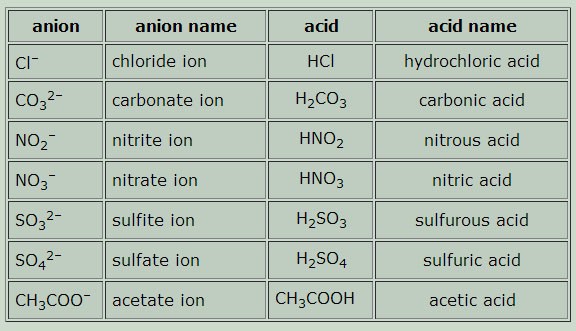
Nomenclature of common acids: This chart provides the nomenclature of some common anions and acids
More complex acids have oxygen in the compound. There is a simple set of rules for these acids.
- Any polyatomic ion with the suffix “-ate” uses the suffix “-ic” as an acid. So, HNO3 will be nitric acid.
- When you have a polyatomic ion with one more oxygen than the “-ate” ion, then your acid will have the prefix “per-” and the suffix “-ic.” For example, the chlorate ion is ClO3–. Therefore, HClO4 is called perchloric acid.
- With one less oxygen than the “-ate” ion, the acid will have the suffix “-ous.” For example, chlorous acid is HClO2.
- With two fewer oxygen than the “-ate” ion, the prefix will be “hypo-” and the suffix will be “-ous.” For example, instead of bromic acid, HBrO3, we have hypobromous acid, HBrO.
Naming Bases
Most strong bases contain hydroxide, a polyatomic ion. Therefore, strong bases are named following the rules for naming ionic compounds. For example, NaOH is sodium hydroxide, KOH is potassium hydroxide, and Ca(OH)2 is calcium hydroxide. Weak bases made of ionic compounds are also named using the ionic naming system. For example, NH4OH is ammonium hydroxide.
Weak bases are also sometimes molecular compounds or organic compounds because they have covalent bonds. Therefore, they are named following the rules for molecular or organic compounds. For example, methylamine (CH3NH2) is a weak base. Some weak bases have “common” names. For example, NH3 is called ammonia; its name isn’t derived from any naming system.