
Chemical Combination
CHEMISTRY SSS1 Second Term
WEEK 1
Chemical combination
Performance Objectives
The student should be able to:
- List the first twenty elements and their electronic configuration
- Explain electrovalent bond with examples
- Explain covalent bond with examples
- Explain metallic bonds with examples
- explain coordinate covalent bond with examples
Content
Electronic configuration
The electron configuration of an atom is the representation of the arrangement of electrons distributed among the orbital shells and subshells. Commonly, the electron configuration is used to describe the orbitals of an atom in its ground state, but it can also be used to represent an atom that has ionized into a cation or anion by compensating with the loss of or gain of electrons in their subsequent orbitals. Many of the physical and chemical properties of elements can be correlated to their unique electron configurations. The valence electrons, electrons in the outermost shell, are the determining factor for the unique chemistry of the element.
Before assigning the electrons of an atom into orbitals, one must become familiar with the basic concepts of electron configurations. Every element on the Periodic Table consists of atoms, which are composed of protons, neutrons, and electrons. Electrons exhibit a negative charge and are found around the nucleus of the atom in electron orbitals, defined as the volume of space in which the electron can be found within 95% probability. The four different types of orbitals (s, p, d, and f) have different shapes, and one orbital can hold a maximum of two electrons (S Orbital). The p orbital can hold a maximum of 6 electrons, d orbital can hold a maximum of 10 electrons, and f orbitals can hold a maximum of 14 electrons.
Electron Configuration for Atoms of the First 20 Elements
when the electrons are arranged in their lowest energy state, the atom is in the ground state. The following table summarizes the ground-state electron configuration of the first 20 elements on the periodic table.
NB: the superscripts add up to the atomic number of the atom.
|
Name |
Atomic Number |
Electron Configuration |
|
Period 1 |
||
|
Hydrogen |
1 |
1s1 |
|
Helium |
2 |
1s2 |
|
Period 2 |
||
|
Lithium |
3 |
1s2 2s1 |
|
Beryllium |
4 |
1s2 2s2 |
|
Boron |
5 |
1s2 2s22p1 |
|
Carbon |
6 |
1s2 2s22p2 |
|
Nitrogen |
7 |
1s2 2s22p3 |
|
Oxygen |
8 |
1s2 2s22p4 |
|
Fluorine |
9 |
1s2 2s22p5 |
|
Neon |
10 |
1s2 2s22p6 |
|
Period 3 |
||
|
Sodium |
11 |
1s2 2s22p63s1 |
|
Magnesium |
12 |
1s2 2s22p63s2 |
|
Aluminum |
13 |
1s2 2s22p63s23p1 |
|
Silicon |
14 |
1s2 2s22p63s23p2 |
|
Phosphorus |
15 |
1s2 2s22p63s23p3 |
|
Sulfur |
16 |
1s2 2s22p63s23p4 |
|
Chlorine |
17 |
1s2 2s22p63s23p5 |
|
Argon |
18 |
1s2 2s22p63s23p6 |
|
Period 4 |
||
|
Potassium |
19 |
1s2 2s22p63s23p64s1 |
|
Calcium |
20 |
1s2 2s22p63s23p64s2 |
Chemical bonding
Chemical bonding is one of the most basic fundamentals of chemistry that explains other concepts such as molecules and reactions. Without it, scientists wouldn't be able to explain why atoms are attracted to each other or how products are formed after a chemical reaction has taken place. To understand the concept of bonding, one must first know the basics behind atomic structure.
Chemical bonds are the connections between atoms in a molecule. These bonds include both strong intramolecular interactions, such as covalent and ionic bonds. They are related to weaker intermolecular forces, such as dipole-dipole interactions, the London dispersion forces, and hydrogen bonding.
Types of chemical bonding
Electrovalent (Ionic) bonding
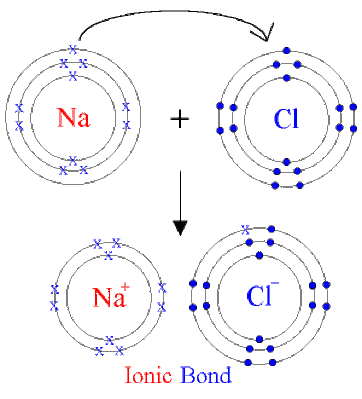
Finally, for atoms with the largest electronegativity differences (such as metals bonding with nonmetals), the bonding interaction is called ionic, and the valence electrons are typically represented as being transferred from the metal atom (potassium) to the nonmetal(fluorine). Once the electrons have been transferred to the non-metal, both the metal and the non-metal are considered to be ions. The two oppositely charged ions attract each other to form an ionic compound.
For example the bonding between sodium and chlorine to form sodium chloride, bonding between magnesium and oxygen to form magnesium oxide
Covalent bonding
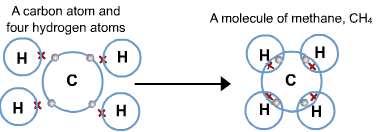
Chemical bonds are the forces of attraction that tie atoms together. Bonds are formed when valence electrons, the electrons in the outermost electronic “shell” of an atom, interact. The nature of the interaction between the atoms depends on their relative electronegativity. Atoms with equal or similar electronegativity form covalent bonds, in which the valence electron density is shared between the two atoms. The electron density resides between the atoms and is attracted to both nuclei. This type of bond forms most frequently between two non- metals.
When there is a greater electronegativity difference than between covalently bonded atoms, the pair of atoms usually forms a polar covalent bond. The electrons are still shared between the atoms, but the electrons are not equally attracted to both elements. As a result, the electrons tend to be found near one particular atom most of the time. Again, polar covalent bonds tend to occur between non-metals. Examples of covalent bonding include two chlorine atoms coming together to form chlorine molecules. One carbon atom mutually sharing electrons with four hydrogen atoms to form methane
Metallic bonding
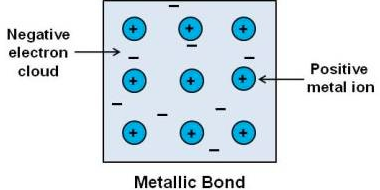
A metallic bond is a type of chemical bond formed between positively charged atoms in which the free electrons are shared among a lattice of cations. In contrast, covalent and ionic bonds form between two discrete atoms. Metallic bonding is the main type of chemical bond that forms between metal atoms.
Metallic bonding is often described as an array of positive ions in a sea of electrons.
The metal is held together by the strong forces of attraction between the delocalized electrons and the positive ions.
Metals tend to have high melting points and boiling points suggesting strong bonds between the atoms.
Coordinate covalent (dative) bond
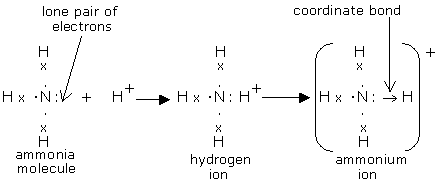
A coordinate bond (also called a dative covalent bond) is a covalent bond (a shared pair of electrons) in which both electrons come from the same atom. A covalent bond is formed by two atoms sharing a pair of electrons. The atoms are held together because the electron pair is attracted by both of the nuclei. In the formation of a simple covalent bond, each atom supplies one electron to the bond - but that does not have to be the case.
The Reaction between Ammonia and Hydrogen Chloride
If these colorless gases are allowed to mix, a thick white smoke of solid ammonium chloride is formed.
The reaction is
NH3 (g) + HCl (g) → NH4Cl(s)
Ammonium ions, NH4+, are formed by the transfer of a hydrogen ion (a proton) from the hydrogen chloride molecule to the lone pair of electrons on the ammonia molecule.
When the ammonium ion, NH4+, is formed, the fourth hydrogen is attached by a dative covalent bond, because only the hydrogen's nucleus is transferred from the chlorine to the nitrogen. The hydrogen's electron is left behind on the chlorine to form a negative chloride ion. Once the ammonium ion has been formed it is impossible to tell any difference between the dative covalent and the ordinary covalent bonds. Although the electrons are shown differently in the diagram, there is no difference between them in reality.
Another example is dissolving water in hydrochloric acid
H2O + HCl → H3O+ + Cl−
The H3O+ ion is variously called the hydroxonium ion, the hydronium ion or the oxonium ion. In an introductory chemistry course, whenever you have talked about hydrogen ions (for example in acids), you have actually been talking about the hydroxonium ion. A raw hydrogen ion is simply a proton and is far too reactive to exist on its own in a test tube.
If you write the hydrogen ion as H+(aq), the "(aq)" represents the water molecule that the hydrogen ion is attached to. When it reacts with something (an alkali, for example), the hydrogen ion simply becomes detached from the water molecule again. Note that once the coordinate bond has been set up, all the hydrogens attached to the oxygen are exactly equivalent. When a hydrogen ion breaks away again, it could be any of the three.