
Periodic table 2
CHEMISTRY S.S.S.2 First term
WEEK 2
Periodic table 2
Performance objectives
Students should be able to:
- Explain the diagonal relationship between at least two elements in the periodic table.
- Define ionization energy and state its trend across the period and down the group
- Define electron affinity and state its trend across the period and down the group
Content
Periodicity of fundamental properties
Periodicity is the variation of properties of elements across the period and down the group. The key to the periodicity of elements lies in the electronic configuration of atoms. It is to be expected, therefore, that any physical properties connected with electron arrangement will also experience this periodicity. Such physical properties include ionization energy, melting and boiling point, electron affinity, atomic radii, ionic radii, electronegativity, electrical and thermal conductivities, etc.
- Melting and boiling points: elements in group 1,2,3 have strong metallic bonds which increase in strength from group1 to group3 across any particular period. Their melting and boiling points also increase correspondingly since a lot of energy is needed to break these bonds. In group4, the elements show very high melting points. These elements have covalent bond that links the atoms together, forming giant three dimensional crystalline lattices. E.g diamond. Very high temperatures are needed to overcome these bonding. Group 5,6,7 and 0 show low melting and boiling points. This is because an element in this group exists as simple covalent molecules that are held together by weak inter molecular forces. Thus, less energy is required to break these weak bonds.
Generally, within a period melting and boiling points of metallic elements increase from left to right, while those of non-metallic elements decrease. Within a group, however, the melting and boiling points of metallic elements decrease down the group while those of non-metallic elements increase.
- Ionization energy: this is the energy needed for complete removal of valence electron in its ground state from an isolated atom in its gaseous state at a specific temperature to form an ion. The ionization potential is the voltage which when applied, causes this energy change and hence removes the electron concerned. Ionization energy decreases down the group because the outer electrons becomes progressively separated from the nucleus and so are less tightly held. In passing from left to right across the period, ionization energy increases i.e. formation of cations becomes more difficult owing to the increase in nuclear charge.
- Electrical and thermal conductivities: These properties decrease across the period and increase down the group. Thus, metals are good electrical and thermal conductors; non-metals are poor electrical and thermal conductors.
- Electron Affinity: Electron affinity (E.A.) is the energy change that occurs when an electron is added to a gaseous atom. Electron affinity can further be defined as the enthalpy change that results from the addition of an electron to a gaseous atom. It can be either a positive or negative value. The greater the negative value, the more stable the anion is.
Exothermic the electro affinity is positive
X(g) + e- ------à X- + energy
Endothermic reaction the elctroaffinity is negative.
X(g) + e- + Energy --------à X-
It is more difficult to come up with trends that describe the electron affinity. Generally, the elements on the right side of the periodic table will have large negative electron affinity. The electron affinities will become less negative as you go from the top to the bottom of the periodic table. However, Nitrogen, Oxygen, and Fluorine do not follow this trend. The noble gas electron configuration will be close to zero because they will not easily gain electrons.
- Electronegativity: Electronegativity is the measurement of an atom to compete for electrons in a bond. The higher the electronegativity, the greater its ability to gain electrons in a bond. Electronegativity will be important when we later determine polar and non-polar molecules. Electronegativity is related to ionization energy and electron affinity. Electrons with low ionization energies have low electronegativities because their nuclei do not exert a strong attractive force on electrons. Elements with high ionization energies have high electronegativities due to the strong pull exerted by the positive nucleus on the negative electrons. Therefore the electronegativity decrease from top to bottom and from left to right it increases.
- Metallic character: The metallic character is used to define the chemical properties that metallic elements present. Generally, metals tend to lose electrons to form cations. Nonmetals tend to gain electrons to form anions. They also have a high oxidation potential therefore they are easily oxidized and are strong reducing agents. Metals also form basic oxides; the more basic the oxide, the higher the metallic character.
As you move across the table from left to right, the metallic character decreases, because the elements easily accept electrons to fill their valance shells. Therefore, these elements take on the nonmetallic character of forming anions. As you move up the table, the metallic character decreases, due to the greater pull that the nucleus has on the outer electrons. This greater pull makes it harder for the atoms to lose electrons and form cations.
Diagonal Relationship
In the periodic table, particularly for the elements lithium and magnesium, beryllium and aluminum, boron, and silicon, there is a diagonal resemblance. This is to be expected, since, in moving from left to right across the periodic table, the metallic properties gradually decrease, whilst on descending a group, they increase. Hence, elements diagonally below one another have similar properties.
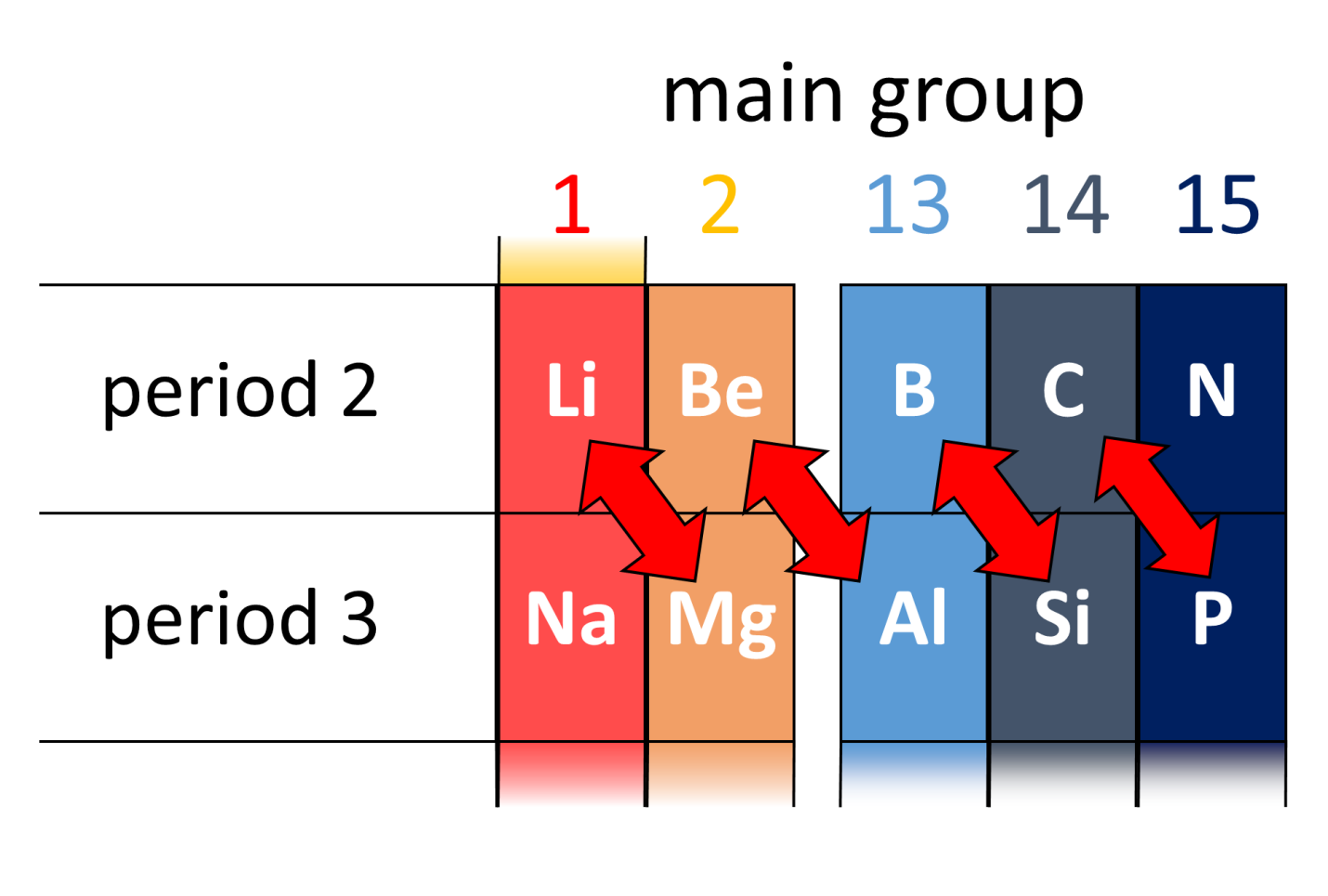
Diagonal relationship of elements in the periodic table.
The ions of lithium and magnesium have the following characteristic:
- Both metals combine with nitrogen at high temperatures.
- They are extensively hydrated due to small size.
- Their tetraoxosulphate(vi) and trioxocarbonate(iv) are insoluble in water.
In all these reactions, lithium differs from the rest of the elements in group1
Beryllium and aluminum have similar properties e.g.
- They both form salts which are extensively hydrolyzed in solution
- Their hydroxides are amphoteric.
- Their oxides have high melting points.
- Both beryllium and aluminum chlorides have low melting points, deliquescent solids and they dissolve in water to give an acidic solution.
Similar relationships are found with boron and silicon and their compounds.