
Periodic Table I
CHEMISTRY SSS2 First Term
WEEK 1
Periodic Table I
Performance objectives
Students should be able to:
- State the periodic law.
- Arrange common elements into groups and periods.
- Identify at least two characteristic features of each of the families of these elements.
Content
Historical development of the periodic table
In chemistry, classification of elements began with Lavoisier, whose classification was essentially into metals and non-metals. Between 1869-1871, a Russian scientist called Dmitri Mendeleev devised the periodic law. He developed the periodic law, which states that the properties of an element varied periodically with their relative atomic masses. He arranged elements in increasing order of relative atomic mass. This, elements having similar properties kept on reoccurring t regular intervals or periods, forming families of relative elements.
Mendeleev's periodic table had many gaps. He predicted the properties of some of these missing elements. Later, some elements such as germanium, scandium, and gallium e.t.c where discovered which did not only fit into Mendeleev’s periodic table, but they also had the predicted properties.
With the discovery of electronic configuration of the atoms, it became clear that elements do vary regularly, not just with their relative atomic mass but also with their relative atomic number. Hence, in the modern periodic table classification is based on atomic number, rather than relative atomic mass. The modern periodic law states that the physical and chemical properties of the elements are the periodic functions of its atomic numbers.
Features of the Periodic Table
The modern periodic table is divided into eight verticals columns known as groups and seven horizontal columns known as periods.
Groups: The groups are numbered from 0 to 7 and constitute elements of similar chemical properties. Elements in the same group have the same number of electrons in the outermost shell of their atoms. In between group 2 and group, 3 are the Transition metals.
Periods: The period consists of those elements arranged in the horizontal row in the periodic table and are numbered 1 to 7. Elements in the same periods have the same number of electron shells, which correspond to the periods i.e. elements of period 2 have two electron shells, those of period 3 have three electron shells, and so on.
The first period consists of only two elements hydrogen and helium. With the exception of the first period, each complete period begins with an alkali metal (group1) and ends with a noble gas (group8).
In period 6 and 7 are the elements of the Lantinides and Actinides series respectively. They are collectively known as the Inner transition elements.
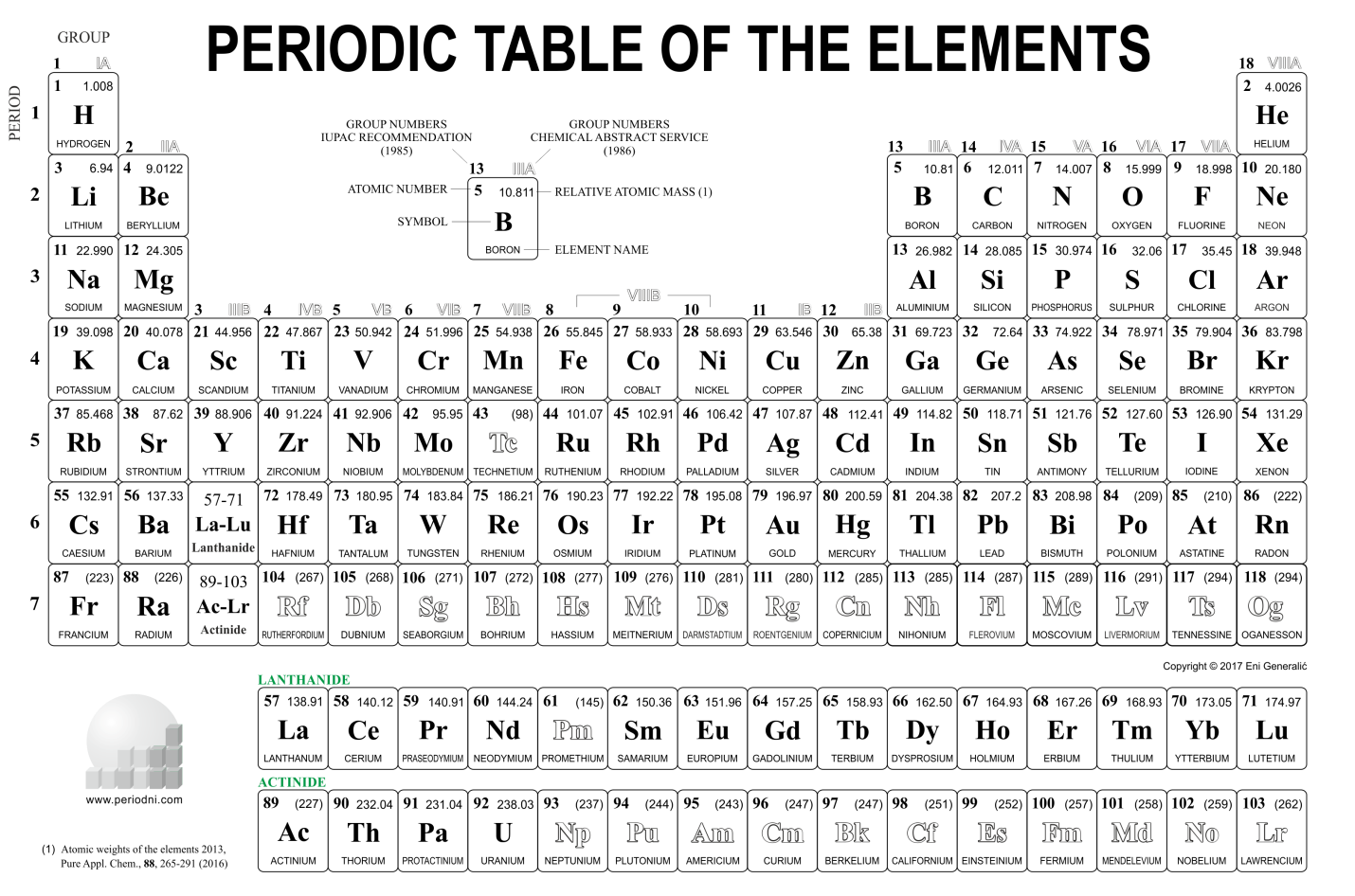
Families of Elements
Elements of the same group may be said to belong to one family. They show similar properties because their atoms have the same number of valence electrons. Certain properties of the elements in the same group show a gradual change with increasing atomic number e.g physical properties.
In the case of chemical properties, the reactivity may increase or decrease with increasing atomic number. For example, the oxidizing power of halogens decreases with increasing atomic number.
Group I: Group1 elements include sodium, lithium, potassium, caesium, rubidium and francium. They are univalent elements because they have one valence electron. They ionize readily by donating one electron. They form positive ions. Hence, they are good reducing agents. Their reducing properties increase down the group and decreases across the period.
Na ----à Na+ + e-
They form electrovalent compounds. They are good conductors of electricity and are very electropositive.
They react vigorously with cold water to alkalis and liberate hydrogen gas and they are also known as Alkali Metals.
2Na + 2H2O ----à NaOH(aq)
The oxides of group1 elements dissolve in water to form strong alkalis.
Na2O + H2O ----à 2NaOH(aq)
The trioxocarbonate (iv) and tetraoxosuphate (VI) salts of group1 elements are also soluble in water. On heating they decompose to give oxygen and dinitrogen (iv) salts.
2NaNO3(s) ----à 2NaNO2(S) + O2(g)
Group II: Group II is also known as alkaline earth metals and they include beryllium, magnesium, calcium, strontium, barium, radium. They are divalent elements because they have two valence electrons and they ionize by donating two valence electrons.
Mg ----à Mg2+ + 2e-
They are reducing agents and they form electrovalent compounds. Beryllium does not react with cold water or steam, magnesium reacts with only steam while calcium reacts with cold water, liberating hydrogen gas forming magnesium oxide, and calcium oxide respectively.
Mg(s) + H2O(g) ----à MgO(s) + H2(g)
Ca(s) + H2O(g) ----à Ca(OH)2 + H2(g)
Calcium oxide dissolves in water to form calcium hydroxide solution, which is a very weak alkali.
CaO(s) + H2O(l) ----à Ca(OH)2(aq)
Magnesium oxide is insoluble in water. Trioxonitrate(v) salt of group II decompose easily on heating to form oxides, oxygen, and brown fumes of Nitrogen(IV)oxide gas.
2Mg(NO3)2(s) ----à 2MgO(s) + O2(g) + 4NO2(g)
2Ca(NO3)2(s) ----à 2CaO(s) + O2(g) + 4NO2(g)
Group III: Boron, aluminum, gallium, indium, and thallium belong to groupIII. They are trivalent because each atom three valence electron. They are donors of three valence electrons. Hence, they are reducing in nature and form electrovalent compounds.
Al ----à Al3+ + 3e-
Both their oxides and hydroxides are amphoteric in nature (i.e they have both acidic and basic properties).
Al2O3(s) + 2NaOH(aq) + 3H2O ------à 2NaAl(OH)4(aq)
Al2O3(s) + 3H2SO4(aq) ------à Al2(SO)4(aq) + 3H2O(l)
2Al(OH)3 + 3H2SO4(aq) ------à Al2(SO4)3(aq) + 6H2O(l)
Al(OH)3 + NaOH(aq) ------à NaAl(OH)4(aq)
Group IV: group4 elements four valence electrons. The nonmetals in this family react by gaining four extra electrons through the formation of covalent bonds (sharing bonds). Group4 elements are also called the carbon family. Members of this group include carbon, silicon, germanium, tin, and lead. They are tetravalent and they form covalent compounds. Group IV elements show trends in changing from nonmetals to metals on moving down the group. Caron does not react with water in any form, but tin and silicon reacts with steam to form +4 oxides and hydrogen.
Si(s) + 2H2O(g) ------à SiO2(g) + 2H2(g)
Sn(s) + 2H2O(g) ------à SnO2(g) + 2H2(g)
Group V: Nitrogen, phosphorus, arsenic, antimony, and bismuth belong to this group. They are nonmetals and they show two valencies of 3 and 5. They are electron acceptors and they form several oxides of different properties e.g Nitrogen(i)oxide,N2O, Nitrogen(ii)oxideNO, Nitrogen(iii)oxide, N2O3, phosphorus (iii)oxide P4O6, phosphorus (v)oxide P4O10, Nitrogen(v)oxide, N2O5, Nitrogen(iv)oxide, NO2. Nitrogen and phosphorus have similar chemical properties and they form similar hydrides, NH3 and PH3, and chlorides NCl3 and PCl3.
NH3 and PH3 form salts with hydrogen chloride.
NH3 + HCl ------à NH4Cl
PH3 + HCl ------à PH4Cl
Both chlorides NCl3 and PCl3 are covalent liquids, and are rapidly hydrolyzed by water
PCl3(l) + 3H2O(l) ------à H3PO3(aq) + 3H+ + 3Cl-
NCl3(l) + 3H2O(l)------àNH3(g) + 3HOCl(aq)
Group VI: Elements in group VI include oxygen, sulphur, polonium, tellurium and selenium. They are nonmetals, electron acceptors and oxidizing in nature e.g
2Mg(s) + O2(g) ------à 2Mg2+O2-(s)
Fe(s) + S(s) ------à Fe2+S2-(s)
They do not attack water in any form. Both oxygen and sulphur combine directly with hydrogen to yield water and hydrogen sulphide respectively.
H2(g) + S(s) ------à H2S(g)
2H2(g) + O2(g) ------à 2H2O(l)
Group VII: They are known as the halogens. They include fluorine, chlorine, bromine, iodine, and astatine. They are the most reactive nonmetals and exist mainly as salts rather than free elements in nature. Halogens show great similarities in property because each of their atoms has the same number of electrons in their valence shell. Some of the similarities are as follows:
- They are colored
- They exist as diatomic molecules eg F2, Cl2, Br2, I2
- They ionize to form a univalent negative ion.
CL2 + 2e- ------à 2Cl-
- All the elements exhibit a valence of one in covalent combination with hydrogen and in electrovalent combination with metals.
- As electron acceptors, all halogens are oxidizing agents eg
2Fe(s) + Cl2(g) ------à 2Fe3+(aq) + 2Cl-(aq)
S2-(aq) + Br2(l) ------à 2Br-(aq) + S(s)
Group O: The elements of group O are known as the rare gases and noble gases. They have no bonding electron in their outermost shell because the number of electrons in their outer most shell is complete. They include helium, neon, argon, krypton, xenon, radon (which is radioactive), because of their non reactivity they exist freely as monatomic molecules in the atmosphere. They exhibit gradation in their physical properties which is related to the progressive increase in their atomic numbers. E.g. their melting and boiling point increase while their ionization energy decrease down the group.