
Ionic Theory 1
CHEMISTRY SSS2 Third term
WEEK 1
Ionic Theory 1
Performance objectives
Students should be able to:
- State the difference between electrovalent and covalent compounds.
- Distinguish between strong electrolytes and weak electrolytes.
- Investigate the movement of ions in solution.
Content
Introduction to Ionic theory
The theory proposed that when an electrolyte is melted or dissolved in water, some if not all of the molecules of the substance dissociate into freely-moving charge ions i.e. positive ions (called cations) and negative ions (anions).
Difference between Electrovalent and Covalent compounds
. Electrovalent compounds are formed by the complete transfer of electrons, while covalent compounds are formed by the sharing of electrons between 2 atoms.
. Electrovalent compounds have high melting and boiling point, while the covalent compounds have low melting and boiling point.
. Electrovalent compounds have high melting and boiling point, while the covalent compounds have low melting and boiling point.
. Electrovalent compounds are made up of ions while covalent compounds are made up of molecules
. Electrovalent compounds are god conductors of electricity while covalent bonds are bad conductors of electricity.
Movement of ions in solution
In Binary Ionic Compounds and Their Properties, when an ionic compound dissolves in water, the positive and negative ions originally present in the crystal lattice persist in solution. Their ability to move nearly independently through the solution permits them to carry positive or negative electrical charges from one place to another. Hence the solution conducts an electrical current.
Electrolytes
Substances whose solutions conduct electricity are called electrolytes. All soluble ionic compounds are strong electrolytes. They conduct very well because they provide a plentiful supply of ions in solution. Some polar covalent compounds are also strong electrolytes. Common examples are HCl, HBr, HI, and H2SO4, all of which react with H2O to form large concentrations of ions. A solution of HCl, for example, conducts even better than one of NaCl having the same concentration.
MOVEMENT OF IONS
All ions, such as electrons are electrically charged particles sensitive to the influence of the positive and negative terminals of a battery.
- Cations are positive and therefore move towards a negative terminal (Cathode)
- The anions are negative and therefore move towards a positive terminal (Anode)
When an electric current flows across an aqueous solution, cations and anions move in opposite directions
.
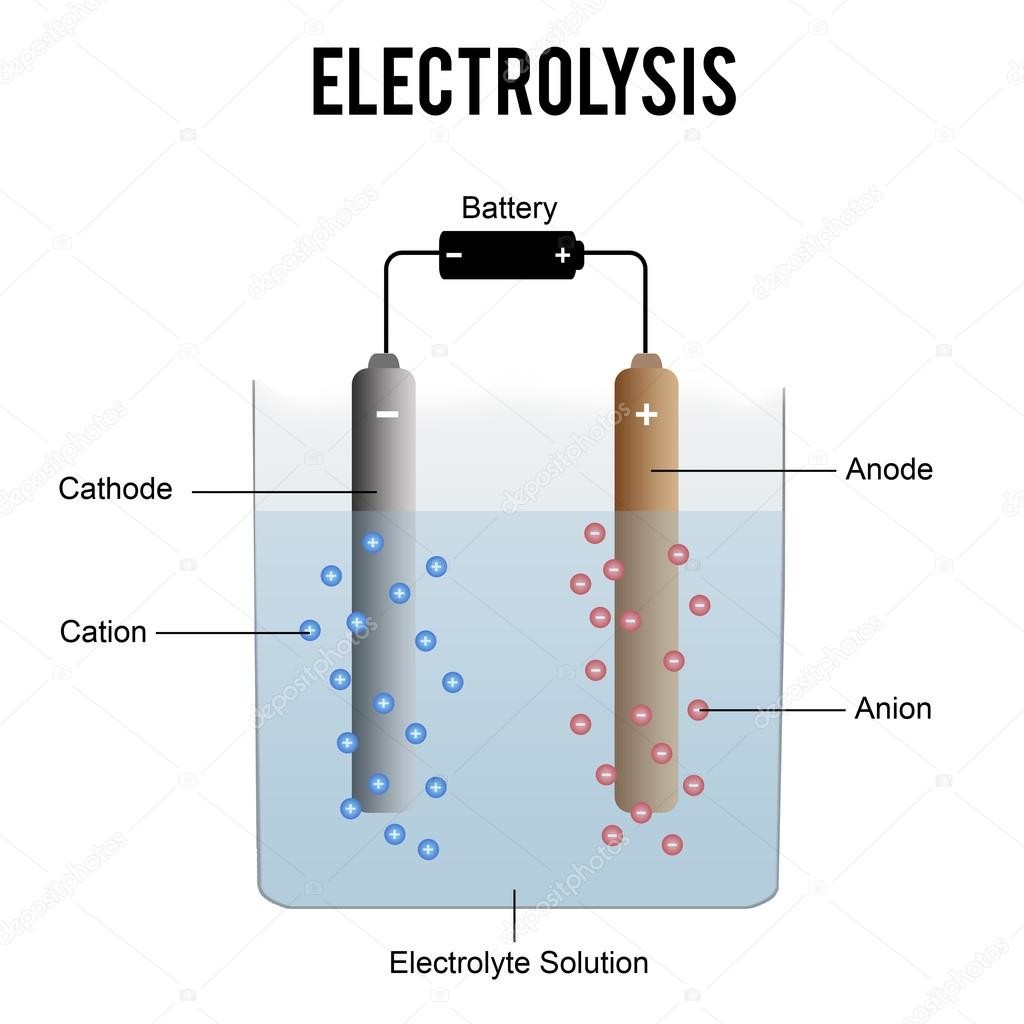
Movement of ions in solution
Difference between strong and week electrolyte
- Strong Electrolytes – Electrolytes are chemical species that conduct electricity when dissolved in solution.
- Weak electrolytes – An electrolyte that ionizes to a small extent in solution is called a weak electrolyte.
The difference between strong and weak electrolytes as follows.
- The extension of ionization is more in strong electrolytes while the extension of ionization is less in weak electrolytes.
- Strong electrolytes have high electrical conductivity while weak electrolytes have low electrical conductivity
- Ostwald’s dilution law is not applicable in strong electrolytes but it is applicable in weak electrolytes
- Strong electrolytes are electrolytes that are completely ionized while weak electrolytes are partially ionized