
Ionic Theory 2
CHEMISTRY SSS2 Third Term
WEEK 2
Ionic Theory 2
Performance objectives
Students should be able to:
- Rank and explain the position of ions in the electrochemical series.
- Explain the factors responsible preferential discharge of ions.
Content
Position of ions in the electrochemical series
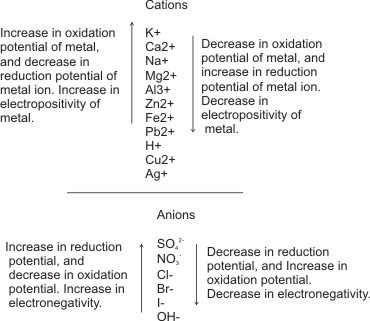
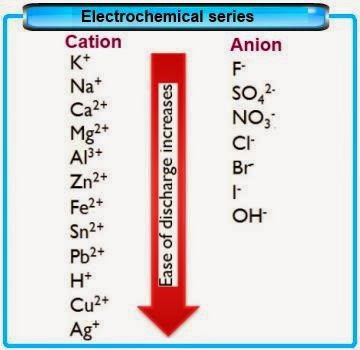
The electrochemical series (see below) is an orderly arrangement of metals and their ions based on how well the ions accept electrons and become reduced.
The lower the position of metals and their ions in the series, the more likely their ions are reduced at the cathode, hence the more the preference for them been discharged.
Notice that during electrolysis, reduction occurs at the cathode.
The Electrochemical Series
Example, in the presence of H+ and Na+ in a solution, and if all other factors are constant, H+ will accept electrons more readily and subsequently be discharged at the cathode in preference to Na+.
The electrochemical series also shows the arrangement of negatively charged particles which migrate to the anode. In the same way as above, the lower the position of a negatively charged particle in the series, the more likely it gives off electrons and become oxidized at the anode.
For example, considering all other factors constant, a solution containing OH- and SO42- ions will have the OH-, which is lower in the electrochemical series discharged at the anode in preference to SO42-.
The Electrochemical Series
Factors affecting preferential discharge of ions
There are three factors affecting preferential discharge
- Position of ions in the Electrochemical Series (E.C.S.)
The position of an ion in the electrochemical series often determines its order of preference in discharge. The following diagram shows the order of preferential discharge of Cations and Anions. Take the example of electrolysis of an aqueous solution of NaCl. Cations: Na+ and H+ compete with each other for discharge. The electrochemical series predicts the discharge of H+. Anions: Cl- and OH- compete for discharge. The electrochemical series predicts the discharge of OH-.
- Concentration of ions in solution.
When the concentration of one ion is much higher than the other, the more concentrated ion is discharged even though it is against the prediction of electrochemical series e.g. When a concentrated 3M NaCl solution is electrolyzed, Cl- ions are discharged even though OH- ions are predicted to be discharged according to the electrochemical series. Here, the concentration factor is more important than the electrochemical series. factor. However, H+ ions are discharged even though a high concentration of Na+ as the difference in electrochemical series between H+ and Na+ is so great that the concentration factor becomes not more important than the electrochemical series factor.
(3) Nature of electrodes
When inert electrodes (graphite, platinum, gold) are used in electrolysis, the electrolytic reactions will be independent of the nature of the inert electrodes. However, when copper electrodes are used in the electrolysis of aqueous copper (II) sulphate solution, the copper electrode (anode) itself will take part in one of the electrolytic reactions.